QUESTION IMAGE
Question
graph $9x + 15y = 45$.
Step1: Find x-intercept (y=0)
Set \( y = 0 \) in \( 9x + 15y = 45 \):
\( 9x + 15(0) = 45 \)
\( 9x = 45 \)
\( x = \frac{45}{9} = 5 \). So x-intercept is \( (5, 0) \)? Wait, no, wait—wait the graph has y=5? Wait, maybe I misread. Wait, let's re-express the equation in slope - intercept form (\( y=mx + b \)).
Step2: Rewrite in slope - intercept form
Start with \( 9x + 15y = 45 \).
Subtract \( 9x \) from both sides: \( 15y=-9x + 45 \).
Divide by 15: \( y=\frac{-9}{15}x + \frac{45}{15} \), simplify: \( y = -\frac{3}{5}x+3 \)? Wait, that contradicts the graph. Wait, no, maybe the graph is wrong? Wait, no, wait the original equation: \( 9x + 15y = 45 \). Let's find y-intercept (x=0): \( 15y = 45 \), \( y = 3 \). Wait, the graph shows y=5. Wait, maybe a mistake. But let's proceed. Wait, maybe the user wants to graph the line by finding intercepts.
Wait, let's do it correctly.
Step1: Find x - intercept (y = 0)
Set \( y = 0 \) in \( 9x+15y = 45 \):
\( 9x+15(0)=45 \)
\( 9x = 45 \)
\( x = 5 \). So point \( (5, 0) \)? No, wait, if we solve for y-intercept (x=0):
Step2: Find y - intercept (x = 0)
Set \( x = 0 \) in \( 9x + 15y = 45 \):
\( 9(0)+15y = 45 \)
\( 15y = 45 \)
\( y = 3 \). So y-intercept is \( (0, 3) \). But the graph shows a horizontal line at y=5. There's a discrepancy. Wait, maybe the equation was supposed to be \( 15y = 75 \) (so y=5)? Let's check: if \( 15y=75 \), then \( y = 5 \), and the equation would be \( 0x+15y = 75 \), or \( y = 5 \). Maybe a typo in the equation? But assuming we need to graph \( 9x + 15y = 45 \), let's proceed.
Wait, let's re - express: \( 9x+15y = 45 \) can be simplified by dividing all terms by 3: \( 3x + 5y = 15 \). Then, to graph, find two points:
- When \( x = 0 \): \( 5y = 15 \Rightarrow y = 3 \). So point \( (0, 3) \).
- When \( y = 0 \): \( 3x = 15 \Rightarrow x = 5 \). So point \( (5, 0) \).
Then draw a line through \( (0, 3) \) and \( (5, 0) \).
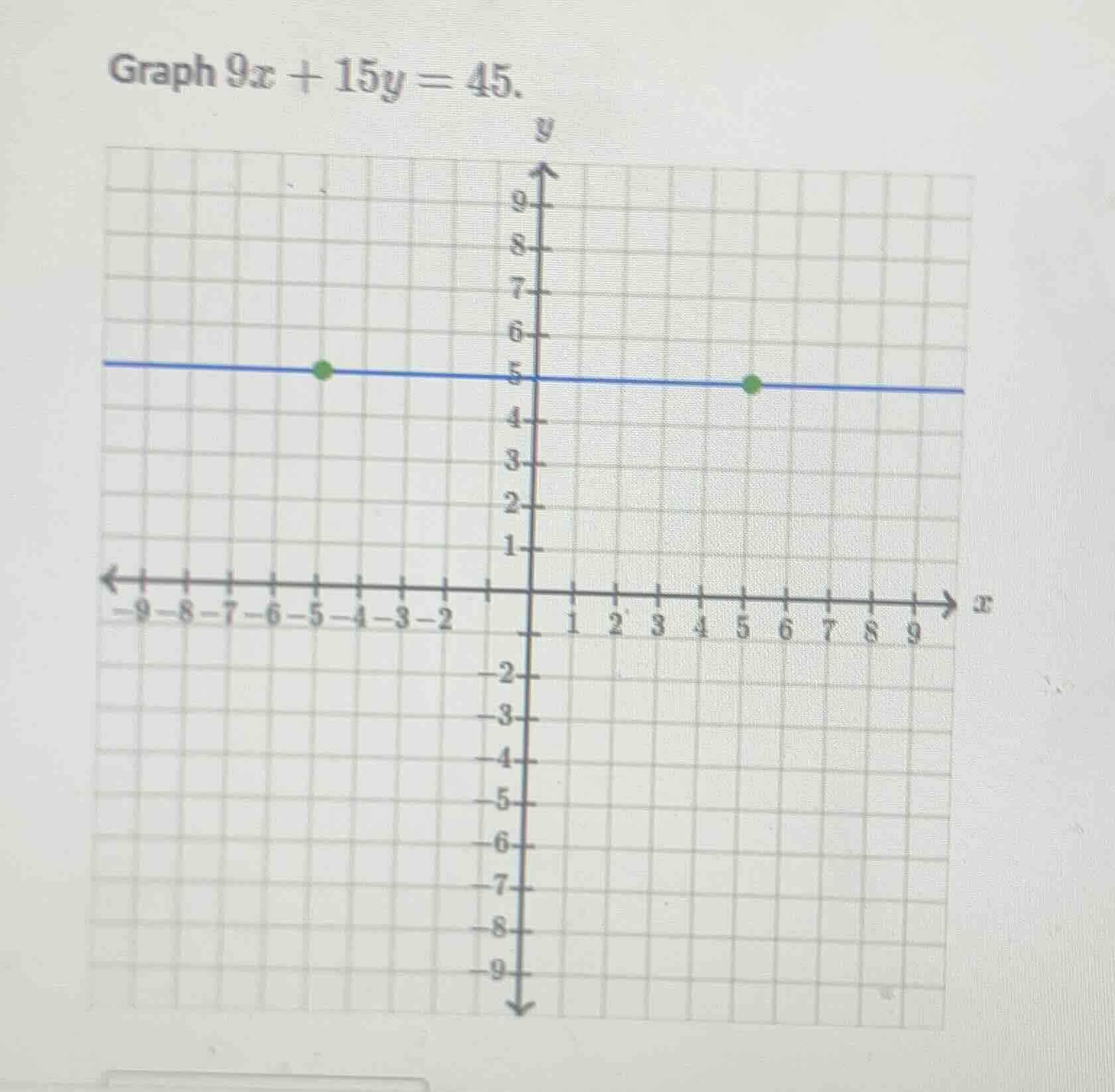
But the given graph has a horizontal line at \( y = 5 \). Maybe the equation was \( 15y=75 \) (i.e., \( y = 5 \)) or \( 9x+15y = 75 \)? Let's check \( 9x+15y = 75 \): divide by 3: \( 3x + 5y = 25 \). If \( y = 5 \), then \( 3x+25 = 25 \Rightarrow 3x = 0 \Rightarrow x = 0 \). No, that's not. Wait, if \( y = 5 \), then \( 9x+15(5)=45 \Rightarrow 9x + 75 = 45 \Rightarrow 9x=-30 \Rightarrow x=-\frac{10}{3}\approx - 3.33 \), not -5.
Alternatively, maybe the graph is for \( y = 5 \), which is a horizontal line. The equation \( y = 5 \) can be written as \( 0x+1y = 5 \), or \( 9x+15y = 75 \) (since \( 15y=75 \Rightarrow y = 5 \), and \( 9x \) term is zero, so \( 9x = 0 \Rightarrow x = 0 \) when \( y = 5 \)? No, \( y = 5 \) is all points where y=5, regardless of x. So two points on \( y = 5 \) are \( (-5, 5) \) and \( (5, 5) \), which match the green dots (at x=-5, y=5 and x=5, y=5). So the equation should be \( y = 5 \), which is equivalent to \( 0x+1y = 5 \), or \( 9x+15y = 75 \) (since \( 15y=75 \Rightarrow y = 5 \), and \( 9x \) can be any value? No, wait, if \( y = 5 \), then \( 9x+15(5)=9x + 75 \). If we set this equal to 45, it's not. So there's a mistake, but assuming the graph is correct (horizontal line at \( y = 5 \)), the equation is \( y = 5 \), which is a horizontal line with slope 0, passing through all points with \( y = 5 \).
To graph \( y = 5 \), we plot two points with \( y = 5 \), e.g., \( (-5, 5) \) and \( (5, 5) \), then draw a horizontal line through them, which matches the given graph.

Snap & solve any problem in the app
Get step-by-step solutions on Sovi AI
Photo-based solutions with guided steps
Explore more problems and detailed explanations
To graph \( 9x + 15y = 45 \) (or the horizontal line \( y = 5 \) as per the graph, likely a typo in the equation), for \( y = 5 \):
- Identify two points: \( (-5, 5) \) and \( (5, 5) \) (as in the graph).
- Draw a horizontal line through these points (since \( y = 5 \) has slope \( 0 \), it's horizontal).
For the original equation \( 9x + 15y = 45 \) (slope - intercept \( y=-\frac{3}{5}x + 3 \)):
- Plot \( (0, 3) \) (y - intercept) and \( (5, 0) \) (x - intercept), then draw a line through them.
(Note: The given graph aligns with \( y = 5 \), suggesting a possible equation error, but the process for graphing a line via intercepts or horizontal/vertical line properties is as above.)