QUESTION IMAGE
Question
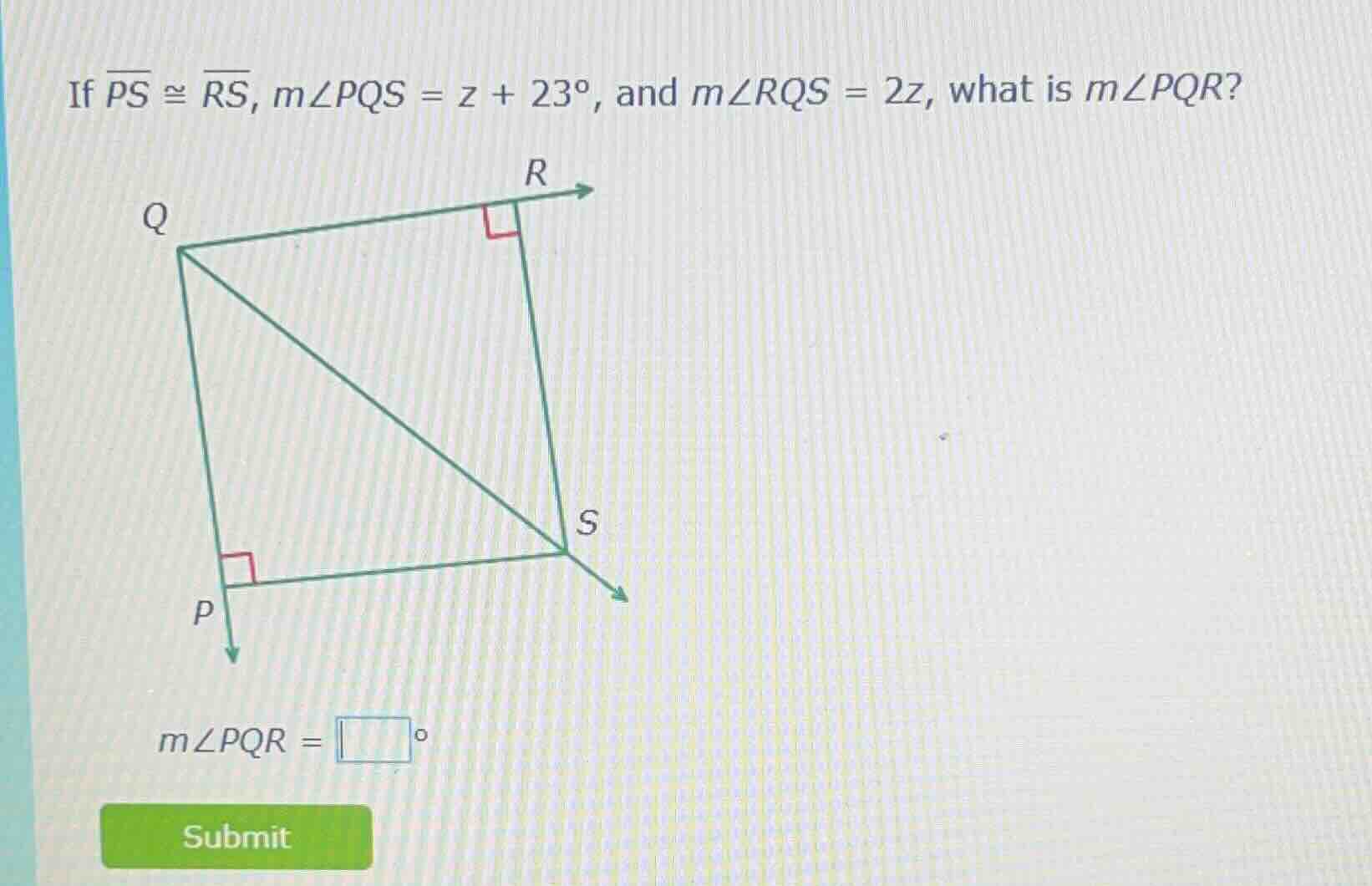
if \\(\overline{ps} \cong \overline{rs}\\), \\(m\angle pqs = z + 23^\circ\\), and \\(m\angle rqs = 2z\\), what is \\(m\angle pqr\\)?
Step1: Identify triangle congruence
Since \( \overline{PS} \cong \overline{RS} \), \( \angle QPS = \angle QRS = 90^\circ \), and \( \overline{QS} \) is common, triangles \( QPS \) and \( QRS \) are congruent (HL theorem). Thus, \( \angle PQS = \angle RQS \)? Wait, no, wait. Wait, the angles given: \( m\angle PQS = z + 23^\circ \) and \( m\angle RQS = 2z \). Wait, actually, since \( \overline{PS} \cong \overline{RS} \) and the right angles, \( QS \) bisects \( \angle PQR \)? Wait, no, maybe \( \angle PQS \) and \( \angle RQS \) are equal? Wait, no, the problem says \( \overline{PS} \cong \overline{RS} \), so triangles \( PQS \) and \( RQS \) are congruent (HL: right angle, hypotenuse QS, leg PS=RS). Therefore, \( \angle PQS = \angle RQS \)? Wait, no, the measures are \( z + 23 \) and \( 2z \). Wait, maybe I made a mistake. Wait, no, if the triangles are congruent, then \( \angle PQS = \angle RQS \), so \( z + 23 = 2z \). Let's solve that.
Step2: Solve for z
Set \( z + 23 = 2z \). Subtract z from both sides: \( 23 = z \). So \( z = 23 \).
Step3: Find \( m\angle PQR \)
\( \angle PQR = \angle PQS + \angle RQS \). We know \( \angle PQS = z + 23 = 23 + 23 = 46^\circ \), \( \angle RQS = 2z = 46^\circ \). Wait, no, that can't be. Wait, no, wait, \( \angle PQR \) is the sum of \( \angle PQS \) and \( \angle RQS \). Wait, if \( z = 23 \), then \( \angle PQS = 23 + 23 = 46 \), \( \angle RQS = 2*23 = 46 \), so \( \angle PQR = 46 + 46 = 92 \)? Wait, no, that doesn't make sense. Wait, maybe the triangles are congruent, so \( \angle PQS = \angle RQS \), so \( z + 23 = 2z \), so \( z = 23 \). Then \( \angle PQS = 46 \), \( \angle RQS = 46 \), so \( \angle PQR = 46 + 46 = 92 \)? Wait, but let's check again.
Wait, the diagram: Q to P is vertical, P to S is horizontal, S to R is vertical, R to Q is horizontal. So PQRS is a quadrilateral with right angles at P and R, and PS = RS. So PQRS is a square? No, PS = RS, so it's a square? Wait, no, PS and RS are legs, so if PS = RS, then PQRS is a square or a rhombus with right angles. Wait, maybe \( \angle PQR \) is a right angle? No, the problem says to find \( m\angle PQR \). Wait, maybe I messed up the angle sum. Wait, no, the angles \( \angle PQS \) and \( \angle RQS \) are adjacent angles forming \( \angle PQR \). So \( \angle PQR = \angle PQS + \angle RQS \). Given \( \angle PQS = z + 23 \), \( \angle RQS = 2z \), and since \( \overline{PS} \cong \overline{RS} \), triangles PQS and RQS are congruent, so \( \angle PQS = \angle RQS \)? Wait, no, that would mean \( z + 23 = 2z \), so \( z = 23 \). Then \( \angle PQS = 46 \), \( \angle RQS = 46 \), so \( \angle PQR = 46 + 46 = 92 \)? Wait, but that seems odd. Wait, maybe the triangles are congruent, so \( \angle PQS = \angle RQS \), so solving \( z + 23 = 2z \) gives \( z = 23 \). Then \( \angle PQR = (z + 23) + 2z = 3z + 23 \)? Wait, no, that's not right. Wait, no, \( \angle PQS \) and \( \angle RQS \) are the two parts of \( \angle PQR \), so \( \angle PQR = \angle PQS + \angle RQS = (z + 23) + 2z = 3z + 23 \). But if the triangles are congruent, then \( \angle PQS = \angle RQS \), so \( z + 23 = 2z \), so \( z = 23 \). Then \( \angle PQR = 3*23 + 23 = 92 \)? Wait, no, 3*23 is 69, plus 23 is 92. Wait, but let's check again.
Wait, maybe the key is that \( \overline{PS} \cong \overline{RS} \), so triangles PQS and RQS are congruent (HL), so \( \angle PQS = \angle RQS \), so \( z + 23 = 2z \), so \( z = 23 \). Then \( \angle PQS = 23 + 23 = 46 \), \( \angle RQS = 2*23 = 46 \), so \( \angle PQR = 46 + 46 = 92 \). Wait, but that seems correct. Let'…

Snap & solve any problem in the app
Get step-by-step solutions on Sovi AI
Photo-based solutions with guided steps
Explore more problems and detailed explanations
\( \boxed{92} \)