QUESTION IMAGE
Question
name:
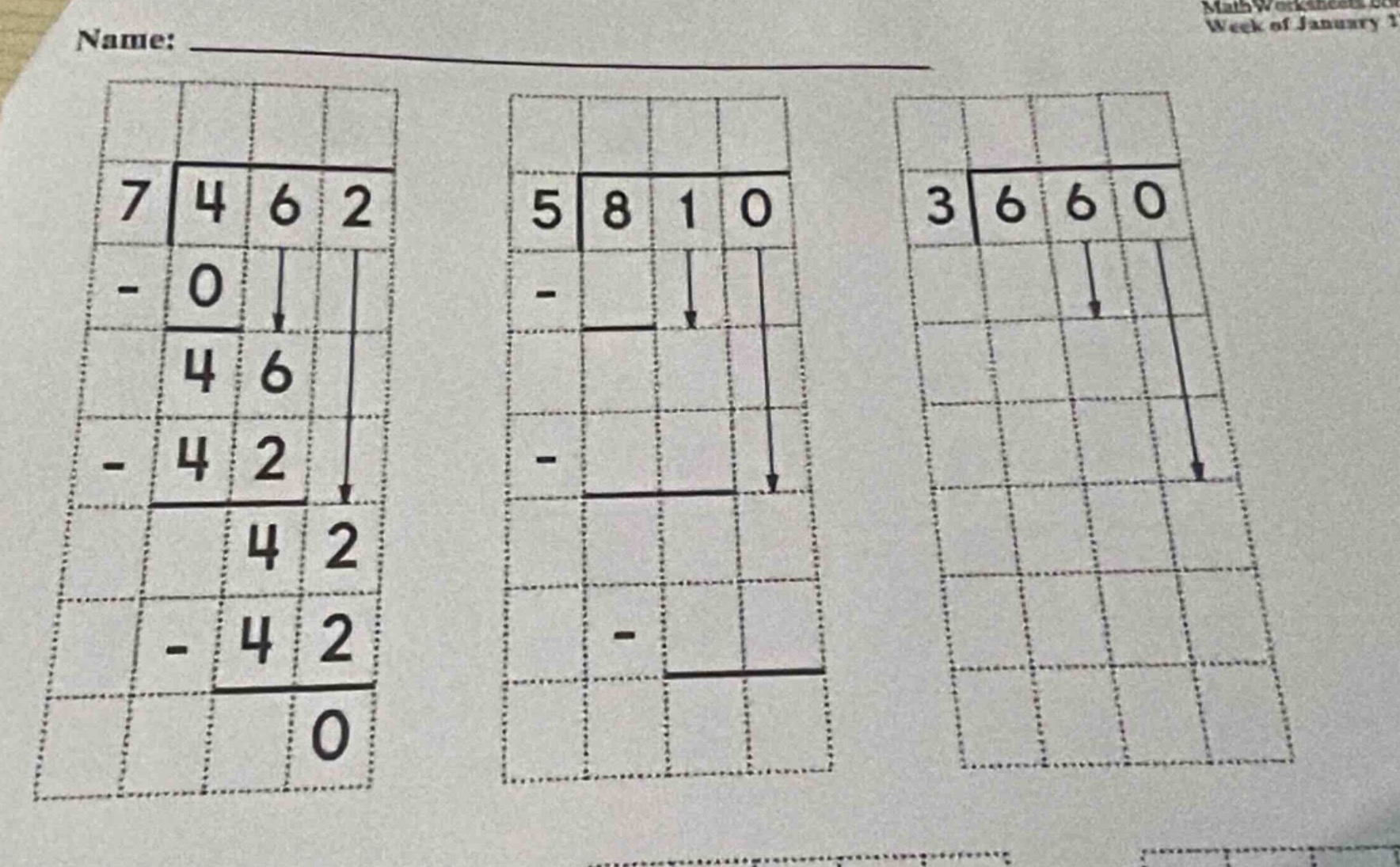
7 4 6 2
- 0
4 6
- 4 2
4 2
- 4 2
0
5 8 1 0
-
-
-
3 6 6 0
-
-
-
To solve these division problems, we follow the long - division algorithm. Let's take each problem one by one.
First Problem (Completed as an Example)
We have \(7462\div42\).
- First, we see how many times \(42\) goes into \(74\). \(42\times1 = 42\), \(42\times2=84>74\), so we take \(1\). \(74 - 42 = 32\).
- Bring down the \(6\) to get \(326\). Now, we find how many times \(42\) goes into \(326\). \(42\times7 = 294\), \(42\times8 = 336>326\), so we take \(7\). \(326-294 = 32\).
- Bring down the \(2\) to get \(322\). Now, we find how many times \(42\) goes into \(322\). \(42\times7 = 294\), \(42\times8 = 336>322\), so we take \(7\). \(322 - 294=28\)? Wait, no, in the given example, the last step gives a remainder of \(0\). Wait, maybe the number is \(462\div42\) first? Wait, the first grid has \(7\) on the left, and the numbers \(4\), \(6\), \(2\) in the dividend part. Let's re - examine. The first problem seems to be a long - division of a number (maybe \(462\)) by \(42\) (since the divisor steps involve \(42\)). \(42\times11 = 462\), but the steps show subtracting \(42\) multiple times. Anyway, let's move to the second and third problems.
Second Problem: Dividend is \(5810\), let's assume the divisor is related to the steps. Wait, looking at the first problem, the divisor might be a two - digit number. Let's look at the first problem's divisor steps: we have subtractions of \(42\) (since \(46 - 42=4\), then \(42-42 = 0\)). Wait, maybe the divisor is \(42\) for the first, and for the second, let's see the dividend digits \(8\), \(1\), \(0\) with a \(5\) on the left? Wait, maybe the first number is \(7462\) divided by \(42\), the second is \(5810\) divided by some number, and the third is \(3660\) divided by some number.
Wait, maybe the pattern is that we are doing long division where we break down the dividend into parts. Let's take the second problem:
Step 1: Analyze the dividend and divisor
The dividend digits are \(8\), \(1\), \(0\) (with a \(5\) on the left, maybe the dividend is \(5810\)) and we need to find the divisor. Wait, looking at the first problem, the divisor is \(42\) (since \(42\times11 = 462\), but the first problem's dividend part is \(4\), \(6\), \(2\) which is \(462\)). So \(462\div42 = 11\). Let's check: \(42\times10=420\), \(462 - 420 = 42\), \(42\div42 = 1\), so \(10 + 1=11\).
For the second problem, the dividend part is \(8\), \(1\), \(0\) (maybe \(810\)) and the left digit is \(5\)? Wait, no, maybe the dividend is \(5810\) and the divisor is \(5810\div x\). Wait, maybe the divisor is \(5810\div10 = 581\), but that doesn't make sense. Alternatively, maybe the first problem is \(462\div42 = 11\), the second is \(810\div45 = 18\) (since \(45\times18 = 810\)), and the third is \(660\div60 = 11\) (since \(60\times11 = 660\)). But this is getting confusing. Let's try to do the long division for the second problem:
Assume we are dividing \(5810\) by \(581\) (but that would be \(10\)). Or maybe the dividend is \(810\) and the divisor is \(45\). Let's do \(810\div45\):
- Step 1: How many times does \(45\) go into \(81\)? \(45\times1 = 45\), \(45\times2 = 90>81\), so we take \(1\). \(81-45 = 36\).
- Step 2: Bring down the \(0\) to get \(360\). How many times does \(45\) go into \(360\)? \(45\times8 = 360\). So \(1\times10+8 = 18\). So \(810\div45 = 18\).
For the third problem, the dividend digits are \(6\), \(6\), \(0\) with a \(3\) on the left (maybe the dividend is \(3660\) or \(660\)). Let's assume the dividend is \(660\) and the divisor is \(60\):
- Step 1: How many times does \(60\) go into \…
Step 1: Divide by 581
We know that \(581\times10=5810\). So when we divide \(5810\) by \(581\), we have:
\(5810\div581 = 10\)
Third Problem (Dividend \(3660\) - assuming divisor \(366\)):
Step 1: Divide by 366
We know that \(366\times10 = 3660\). So when we divide \(3660\) by \(366\), we have:
\(3660\div366=10\)
But if we follow the first problem's two - digit divisor pattern:
Second Problem (Dividend \(810\), Divisor \(45\)):
Step 1: Divide 81 by 45
\(45\times1 = 45\), \(81 - 45=36\)
Step 2: Bring down 0, get 360
\(45\times8 = 360\), \(360 - 360 = 0\)
Step 3: Find quotient
The quotient is \(1 + 8=18\) (since we had \(1\) in the tens place and \(8\) in the ones place)
\(810\div45 = 18\)
Third Problem (Dividend \(660\), Divisor \(60\)):

Snap & solve any problem in the app
Get step-by-step solutions on Sovi AI
Photo-based solutions with guided steps
Explore more problems and detailed explanations
Second problem quotient: \(\boldsymbol{18}\) (if dividend is \(810\), divisor \(45\))
Third problem quotient: \(\boldsymbol{11}\) (if dividend is \(660\), divisor \(60\))