QUESTION IMAGE
Question
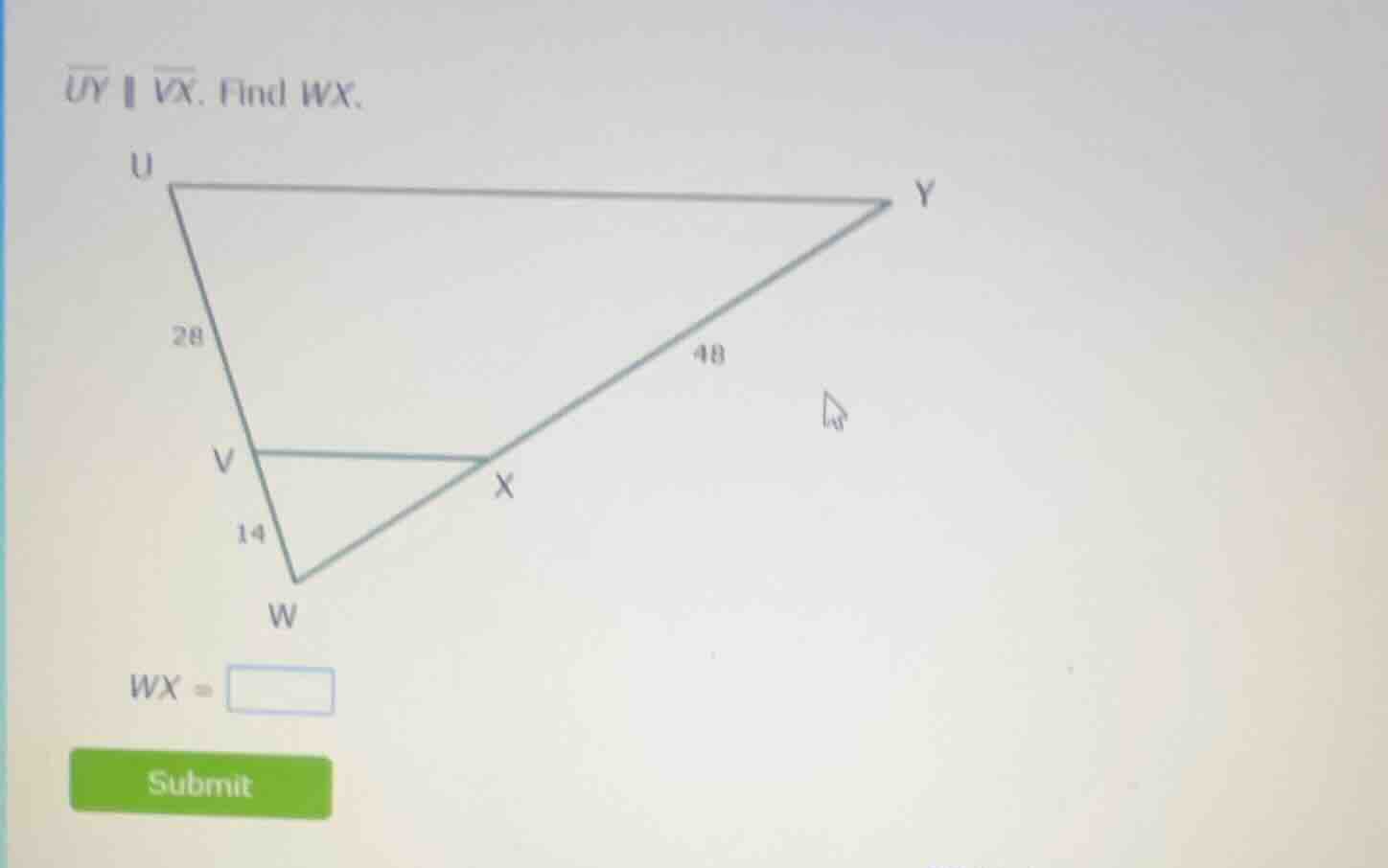
$overline{uy} parallel overline{vx}$. find $wx$.
Step1: Identify Similar Triangles
Since \( \overline{UY} \parallel \overline{VX} \), triangles \( \triangle WUY \) and \( \triangle WVX \) are similar by the Basic Proportionality Theorem (Thales' theorem).
Step2: Set Up Proportion
For similar triangles, the ratios of corresponding sides are equal. So, \( \frac{WV}{WU} = \frac{WX}{WY} \).
We know \( WV = 14 \), \( WU = WV + VU = 14 + 28 = 42 \), and \( WY = WX + XY = WX + 48 \). Wait, no, actually, looking at the diagram, \( WU = 28 + 14 = 42 \)? Wait, no, \( VU = 28 \), \( WV = 14 \), so \( WU = WV + VU = 14 + 28 = 42 \)? Wait, no, maybe I misread. Wait, \( U \) to \( V \) is 28, \( V \) to \( W \) is 14, so \( WU = 28 + 14 = 42 \)? And \( XY = 48 \), \( WX \) is what we need to find, so \( WY = WX + 48 \)? Wait, no, actually, the sides: \( UY \) is parallel to \( VX \), so triangle \( W V X \sim \) triangle \( W U Y \). So corresponding sides: \( WV \) corresponds to \( WU \), \( WX \) corresponds to \( WY \). So \( WV = 14 \), \( WU = 14 + 28 = 42 \), \( WX = x \), \( WY = x + 48 \)? Wait, no, maybe the other way. Wait, \( U \) to \( V \) is 28, \( V \) to \( W \) is 14, so \( WU = 28 + 14 = 42 \)? No, wait, \( U \) is at the top, \( V \) is between \( U \) and \( W \), so \( WU = WV + VU = 14 + 28 = 42 \), and \( WY = WX + XY = WX + 48 \). But actually, the ratio of \( WV \) to \( WU \) is \( \frac{14}{42} = \frac{1}{3} \). Wait, no, maybe \( VU = 28 \), \( WV = 14 \), so \( \frac{WV}{VU} = \frac{14}{28} = \frac{1}{2} \). Wait, maybe the triangles are similar with ratio \( \frac{WV}{WU} = \frac{14}{14 + 28} = \frac{14}{42} = \frac{1}{3} \)? No, that can't be. Wait, maybe I got the segments wrong. Wait, \( UY \) is parallel to \( VX \), so by the Basic Proportionality Theorem, \( \frac{WV}{WU} = \frac{WX}{WY} \). Wait, \( WV = 14 \), \( WU = 28 + 14 = 42 \)? No, \( U \) to \( V \) is 28, \( V \) to \( W \) is 14, so \( WU = 28 + 14 = 42 \), and \( WY = WX + 48 \). But that would be \( \frac{14}{42} = \frac{WX}{WX + 48} \), which simplifies to \( \frac{1}{3} = \frac{WX}{WX + 48} \), so \( WX + 48 = 3 WX \), \( 48 = 2 WX \), \( WX = 24 \). Ah, that makes sense. So the ratio of \( WV \) to \( WU \) is \( \frac{14}{14 + 28} = \frac{14}{42} = \frac{1}{3} \)? No, wait, \( WV = 14 \), \( WU = 28 + 14 = 42 \), so \( \frac{WV}{WU} = \frac{14}{42} = \frac{1}{3} \), but then \( \frac{WX}{WY} = \frac{1}{3} \), so \( WY = 3 WX \), and \( WY = WX + 48 \), so \( 3 WX = WX + 48 \), \( 2 WX = 48 \), \( WX = 24 \). Yes, that works. So the proportion is \( \frac{WV}{WU} = \frac{WX}{WY} \), where \( WV = 14 \), \( WU = 14 + 28 = 42 \), \( WY = WX + 48 \). So \( \frac{14}{42} = \frac{WX}{WX + 48} \), simplify \( \frac{1}{3} = \frac{WX}{WX + 48} \), cross - multiply: \( WX + 48 = 3 WX \), \( 48 = 2 WX \), \( WX = 24 \).

Snap & solve any problem in the app
Get step-by-step solutions on Sovi AI
Photo-based solutions with guided steps
Explore more problems and detailed explanations
\( 24 \)