QUESTION IMAGE
Question
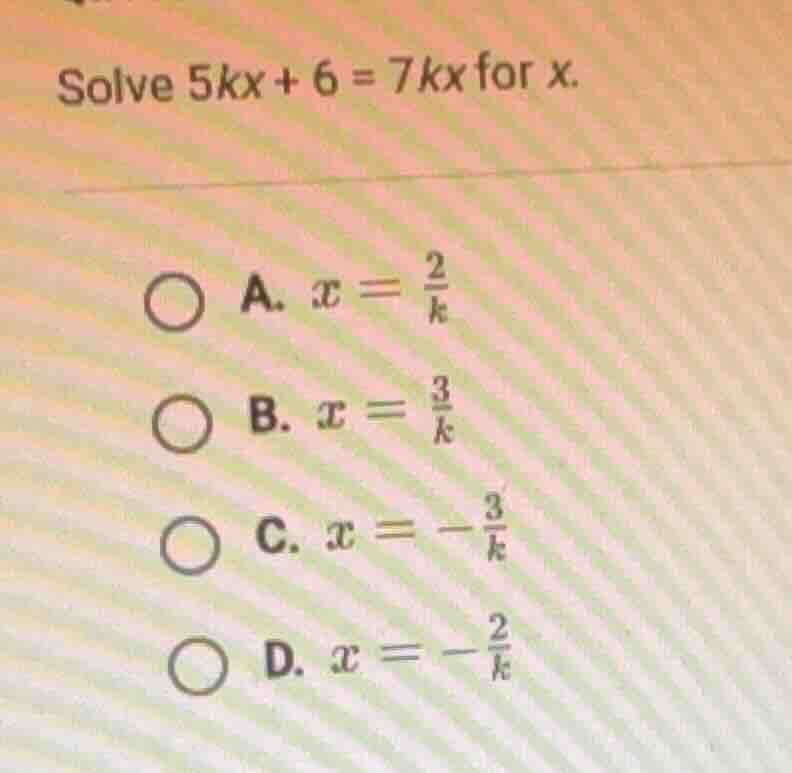
solve $5kx + 6 = 7kx$ for $x$.
a. $x = \frac{2}{k}$
b. $x = \frac{3}{k}$
c. $x = -\frac{3}{k}$
d. $x = -\frac{2}{k}$
Step1: Subtract \(5kx\) from both sides
To isolate the terms with \(x\), we subtract \(5kx\) from both sides of the equation \(5kx + 6 = 7kx\). This gives us \(6=7kx - 5kx\).
Step2: Simplify the right - hand side
Simplify \(7kx-5kx\) using the rule of combining like terms. Since \(7kx - 5kx=(7 - 5)kx = 2kx\), the equation becomes \(6 = 2kx\).
Step3: Solve for \(x\)
Divide both sides of the equation \(6 = 2kx\) by \(2k\) (assuming \(k
eq0\)). We have \(x=\frac{6}{2k}=\frac{3}{k}\)? Wait, no, wait. Wait, let's re - do step 1. Wait, maybe I made a mistake. Let's start over.
Wait, original equation: \(5kx+6 = 7kx\)
Subtract \(5kx\) from both sides: \(5kx+6-5kx=7kx - 5kx\)
Which simplifies to \(6 = 2kx\)
Now, divide both sides by \(2k\): \(x=\frac{6}{2k}=\frac{3}{k}\)? But wait, that's not matching. Wait, no, wait, maybe I messed up the sign. Wait, no, let's check again.
Wait, maybe the correct step is:
Start with \(5kx + 6=7kx\)
Subtract \(7kx\) from both sides: \(5kx+6 - 7kx=7kx-7kx\)
Which is \(- 2kx+6 = 0\)
Then subtract 6 from both sides: \(-2kx=-6\)
Then divide both sides by \(- 2k\): \(x=\frac{-6}{-2k}=\frac{3}{k}\)? No, that's not right. Wait, no, wait, let's do it properly.
Wait, \(5kx+6 = 7kx\)
Subtract \(5kx\) from both sides: \(6=7kx - 5kx\)
\(7kx-5kx = 2kx\), so \(6 = 2kx\)
Then \(x=\frac{6}{2k}=\frac{3}{k}\). But the options have \(x = \frac{3}{k}\) as option B? Wait, but let's check the options again.
Wait, the options are:
A. \(x=\frac{2}{k}\)
B. \(x=\frac{3}{k}\)
C. \(x =-\frac{3}{k}\)
D. \(x=-\frac{2}{k}\)
Wait, maybe I made a mistake in the sign. Let's try subtracting \(7kx\) from both sides:
\(5kx + 6-7kx=7kx - 7kx\)
\(-2kx+6 = 0\)
\(-2kx=-6\)
\(x=\frac{-6}{-2k}=\frac{3}{k}\). So the answer should be B. \(x = \frac{3}{k}\)
Wait, but let's check with an example. Let \(k = 3\). Then the original equation is \(5\times3x+6=7\times3x\)
\(15x + 6=21x\)
Subtract \(15x\) from both sides: \(6 = 6x\)
\(x = 1\)
Now, if \(k = 3\), then \(\frac{3}{k}=\frac{3}{3}=1\), which matches. So the correct answer is B.

Snap & solve any problem in the app
Get step-by-step solutions on Sovi AI
Photo-based solutions with guided steps
Explore more problems and detailed explanations
B. \(x=\frac{3}{k}\)