QUESTION IMAGE
Question
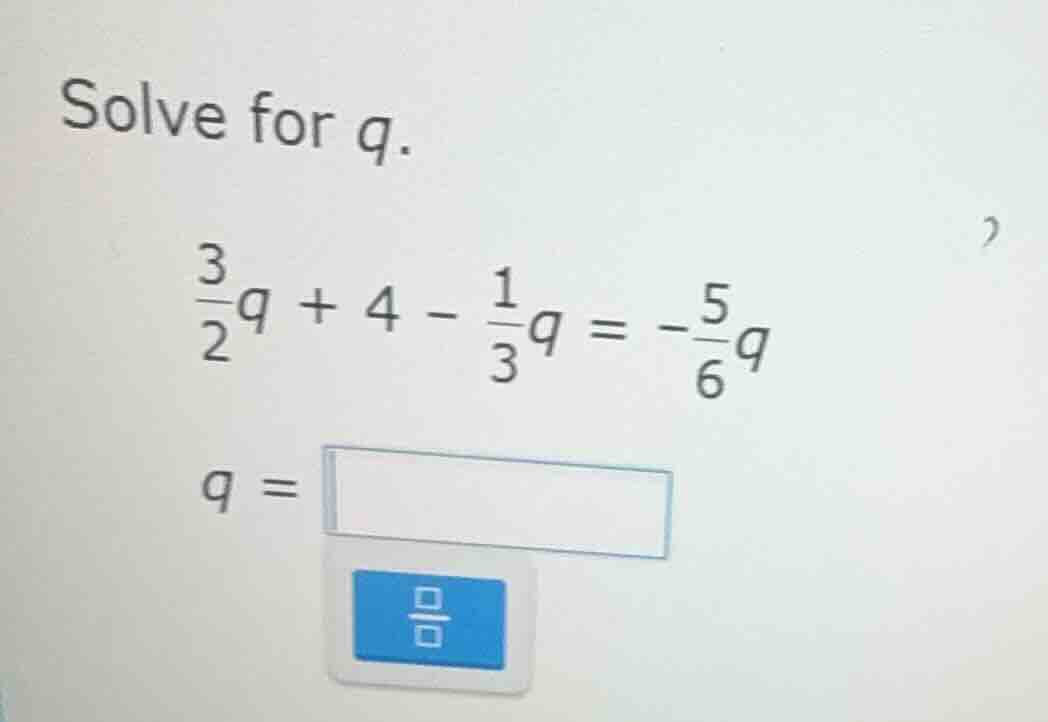
solve for q.\\(\frac{3}{2}q + 4 - \frac{1}{3}q = -\frac{5}{6}q\\)\\(q =\\)
Step1: Combine like terms on the left
First, we combine the \(q\)-terms on the left side. The coefficients of \(q\) are \(\frac{3}{2}\) and \(-\frac{1}{3}\). To combine them, we find a common denominator, which is 6. So \(\frac{3}{2}q-\frac{1}{3}q=\frac{9}{6}q - \frac{2}{6}q=\frac{7}{6}q\). The equation becomes \(\frac{7}{6}q + 4=-\frac{5}{6}q\).
Step2: Add \(\frac{5}{6}q\) to both sides
Adding \(\frac{5}{6}q\) to both sides to get all \(q\)-terms on the left. \(\frac{7}{6}q+\frac{5}{6}q + 4=-\frac{5}{6}q+\frac{5}{6}q\). Combining the \(q\)-terms: \(\frac{12}{6}q+4 = 0\), which simplifies to \(2q+4 = 0\).
Step3: Subtract 4 from both sides
Subtract 4 from both sides: \(2q+4 - 4=0 - 4\), so \(2q=-4\).
Step4: Divide by 2
Divide both sides by 2: \(\frac{2q}{2}=\frac{-4}{2}\), so \(q = - 2\).

Snap & solve any problem in the app
Get step-by-step solutions on Sovi AI
Photo-based solutions with guided steps
Explore more problems and detailed explanations
\(-2\)