QUESTION IMAGE
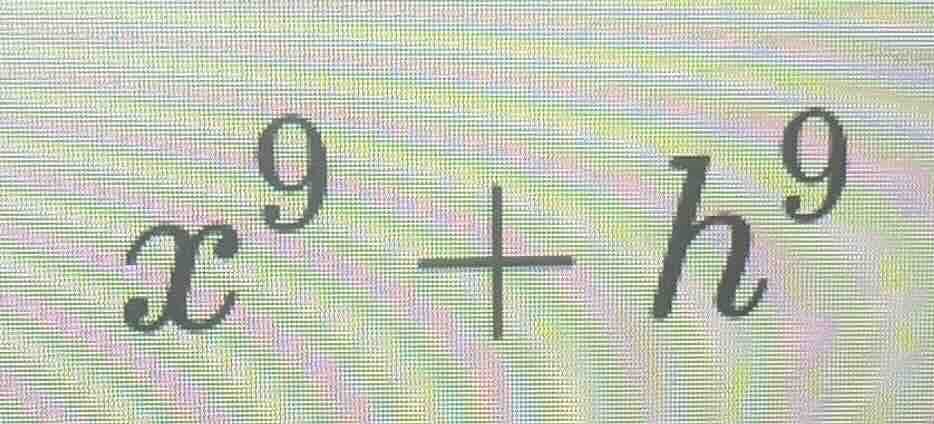
Question
$x^9 + h^9$
To factor \( x^9 + h^9 \), we can use the sum of cubes formula and the sum of ninth - powers formula.
Step 1: Recall the sum of cubes formula
The sum of cubes formula is \( a^{3}+b^{3}=(a + b)(a^{2}-ab + b^{2}) \). Also, we know that \( a^{9}+b^{9}=(a^{3})^{3}+(b^{3})^{3} \)
Step 2: Apply the sum of cubes formula to \( (a^{3})^{3}+(b^{3})^{3} \)
Let \( a=x \) and \( b = h \), then \( x^{9}+h^{9}=(x^{3})^{3}+(h^{3})^{3} \)
Using the sum of cubes formula \( a^{3}+b^{3}=(a + b)(a^{2}-ab + b^{2}) \) with \( a=x^{3} \) and \( b = h^{3} \), we get:
\( (x^{3})^{3}+(h^{3})^{3}=(x^{3}+h^{3})(x^{6}-x^{3}h^{3}+h^{6}) \)
Step 3: Factor \( x^{3}+h^{3} \) further
We use the sum of cubes formula again for \( x^{3}+h^{3} \), where \( a = x \) and \( b=h \)
\( x^{3}+h^{3}=(x + h)(x^{2}-xh+h^{2}) \)
Step 4: Combine the factors
Substitute \( x^{3}+h^{3}=(x + h)(x^{2}-xh + h^{2}) \) back into the expression \( (x^{3}+h^{3})(x^{6}-x^{3}h^{3}+h^{6}) \)
We get \( x^{9}+h^{9}=(x + h)(x^{2}-xh + h^{2})(x^{6}-x^{3}h^{3}+h^{6}) \)
If we want to factor \( x^{6}-x^{3}h^{3}+h^{6} \) further (in the complex number system), we can note that \( x^{6}-x^{3}h^{3}+h^{6}=(x^{2})^{3}+(-h^{2})^{3}+(xh)^{3}-3(x^{2})(-h^{2})(xh) \) (using the identity \( a^{3}+b^{3}+c^{3}-3abc=(a + b + c)(a^{2}+b^{2}+c^{2}-ab - bc - ca) \) with \( a=x^{2},b=-h^{2},c = xh \))
But in the real number system, the complete factorization is \( x^{9}+h^{9}=(x + h)(x^{2}-xh + h^{2})(x^{6}-x^{3}h^{3}+h^{6}) \)
If we are working in the complex number system, we can factor \( x^{6}-x^{3}h^{3}+h^{6} \) as a product of quadratic factors. Let \( y=\frac{x^{3}}{h^{3}} \), then \( x^{6}-x^{3}h^{3}+h^{6}=h^{6}(y^{2}-y + 1) \), and the roots of \( y^{2}-y + 1=0 \) are \( y=\frac{1\pm\sqrt{1 - 4}}{2}=\frac{1\pm\sqrt{- 3}}{2}=\omega,\omega^{2} \) (where \( \omega=e^{\frac{2\pi i}{3}}=-\frac{1}{2}+i\frac{\sqrt{3}}{2} \) and \( \omega^{2}=e^{\frac{4\pi i}{3}}=-\frac{1}{2}-i\frac{\sqrt{3}}{2} \))
So \( x^{6}-x^{3}h^{3}+h^{6}=(x^{2}-\omega xh+\omega^{2}h^{2})(x^{2}-\omega^{2}xh+\omega h^{2}) \)
But for the real - valued factorization (over the reals), the answer is \( (x + h)(x^{2}-xh + h^{2})(x^{6}-x^{3}h^{3}+h^{6}) \)
If we consider the problem of factoring \( x^{9}+h^{9} \) (assuming factoring is the task here), the factored form (over the real numbers) is \( \boldsymbol{(x + h)(x^{2}-xh + h^{2})(x^{6}-x^{3}h^{3}+h^{6})} \)

Snap & solve any problem in the app
Get step-by-step solutions on Sovi AI
Photo-based solutions with guided steps
Explore more problems and detailed explanations
To factor \( x^9 + h^9 \), we can use the sum of cubes formula and the sum of ninth - powers formula.
Step 1: Recall the sum of cubes formula
The sum of cubes formula is \( a^{3}+b^{3}=(a + b)(a^{2}-ab + b^{2}) \). Also, we know that \( a^{9}+b^{9}=(a^{3})^{3}+(b^{3})^{3} \)
Step 2: Apply the sum of cubes formula to \( (a^{3})^{3}+(b^{3})^{3} \)
Let \( a=x \) and \( b = h \), then \( x^{9}+h^{9}=(x^{3})^{3}+(h^{3})^{3} \)
Using the sum of cubes formula \( a^{3}+b^{3}=(a + b)(a^{2}-ab + b^{2}) \) with \( a=x^{3} \) and \( b = h^{3} \), we get:
\( (x^{3})^{3}+(h^{3})^{3}=(x^{3}+h^{3})(x^{6}-x^{3}h^{3}+h^{6}) \)
Step 3: Factor \( x^{3}+h^{3} \) further
We use the sum of cubes formula again for \( x^{3}+h^{3} \), where \( a = x \) and \( b=h \)
\( x^{3}+h^{3}=(x + h)(x^{2}-xh+h^{2}) \)
Step 4: Combine the factors
Substitute \( x^{3}+h^{3}=(x + h)(x^{2}-xh + h^{2}) \) back into the expression \( (x^{3}+h^{3})(x^{6}-x^{3}h^{3}+h^{6}) \)
We get \( x^{9}+h^{9}=(x + h)(x^{2}-xh + h^{2})(x^{6}-x^{3}h^{3}+h^{6}) \)
If we want to factor \( x^{6}-x^{3}h^{3}+h^{6} \) further (in the complex number system), we can note that \( x^{6}-x^{3}h^{3}+h^{6}=(x^{2})^{3}+(-h^{2})^{3}+(xh)^{3}-3(x^{2})(-h^{2})(xh) \) (using the identity \( a^{3}+b^{3}+c^{3}-3abc=(a + b + c)(a^{2}+b^{2}+c^{2}-ab - bc - ca) \) with \( a=x^{2},b=-h^{2},c = xh \))
But in the real number system, the complete factorization is \( x^{9}+h^{9}=(x + h)(x^{2}-xh + h^{2})(x^{6}-x^{3}h^{3}+h^{6}) \)
If we are working in the complex number system, we can factor \( x^{6}-x^{3}h^{3}+h^{6} \) as a product of quadratic factors. Let \( y=\frac{x^{3}}{h^{3}} \), then \( x^{6}-x^{3}h^{3}+h^{6}=h^{6}(y^{2}-y + 1) \), and the roots of \( y^{2}-y + 1=0 \) are \( y=\frac{1\pm\sqrt{1 - 4}}{2}=\frac{1\pm\sqrt{- 3}}{2}=\omega,\omega^{2} \) (where \( \omega=e^{\frac{2\pi i}{3}}=-\frac{1}{2}+i\frac{\sqrt{3}}{2} \) and \( \omega^{2}=e^{\frac{4\pi i}{3}}=-\frac{1}{2}-i\frac{\sqrt{3}}{2} \))
So \( x^{6}-x^{3}h^{3}+h^{6}=(x^{2}-\omega xh+\omega^{2}h^{2})(x^{2}-\omega^{2}xh+\omega h^{2}) \)
But for the real - valued factorization (over the reals), the answer is \( (x + h)(x^{2}-xh + h^{2})(x^{6}-x^{3}h^{3}+h^{6}) \)
If we consider the problem of factoring \( x^{9}+h^{9} \) (assuming factoring is the task here), the factored form (over the real numbers) is \( \boldsymbol{(x + h)(x^{2}-xh + h^{2})(x^{6}-x^{3}h^{3}+h^{6})} \)