QUESTION IMAGE
Question
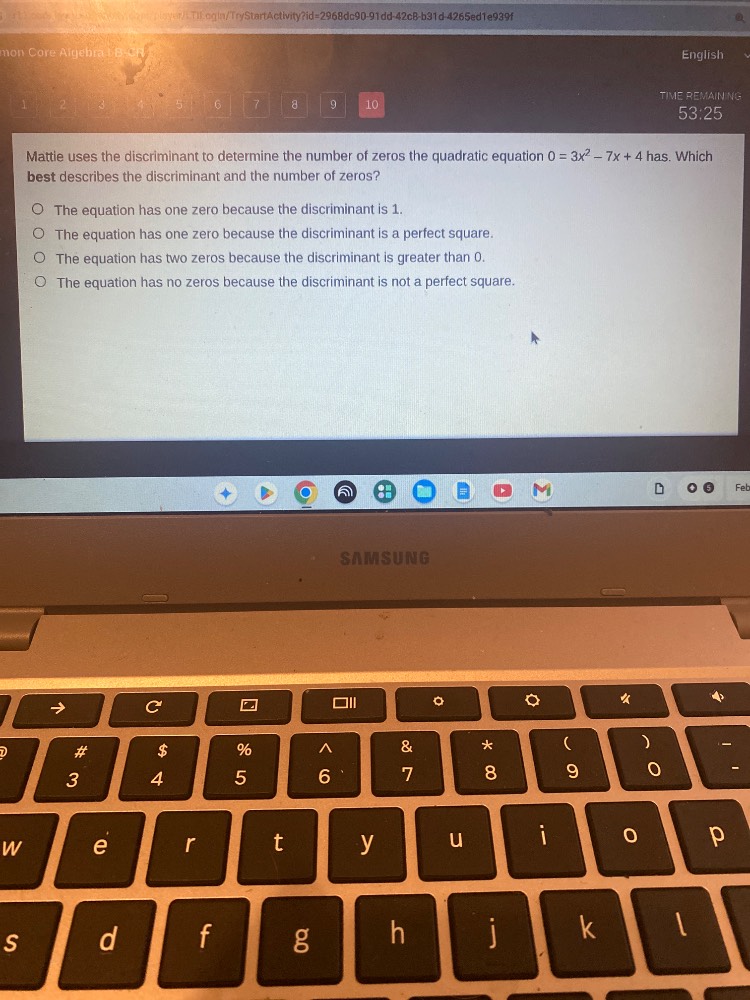
mattie uses the discriminant to determine the number of zeros the quadratic equation $0 = 3x^2 - 7x + 4$ has. which best describes the discriminant and the number of zeros?
- the equation has one zero because the discriminant is 1.
- the equation has one zero because the discriminant is a perfect square.
- the equation has two zeros because the discriminant is greater than 0.
- the equation has no zeros because the discriminant is not a perfect square.
Step1: Recall discriminant formula
For a quadratic equation \(ax^{2}+bx + c = 0\), the discriminant \(D=b^{2}-4ac\). Here, \(a = 3\), \(b=-7\), \(c = 4\).
Step2: Calculate discriminant
Substitute values into the formula: \(D=(-7)^{2}-4\times3\times4=49 - 48 = 1\).
Step3: Analyze discriminant and zeros
Since \(D = 1>0\), a quadratic equation with a positive discriminant has two distinct real zeros. Also, \(D = 1\) is a perfect square, but the key here is the sign of the discriminant for the number of zeros. However, let's check the options:
- First option: Says one zero, but \(D = 1>0\) means two zeros, so wrong.
- Second option: Says one zero, but \(D>0\) means two zeros, wrong.
- Third option: \(D = 1>0\), so two zeros, correct.
- Fourth option: \(D = 1\) is a perfect square and \(D>0\) means two zeros, so wrong.

Snap & solve any problem in the app
Get step-by-step solutions on Sovi AI
Photo-based solutions with guided steps
Explore more problems and detailed explanations
The equation has two zeros because the discriminant is greater than 0. (The corresponding option among the given choices, likely the third option as per the analysis)