QUESTION IMAGE
Question
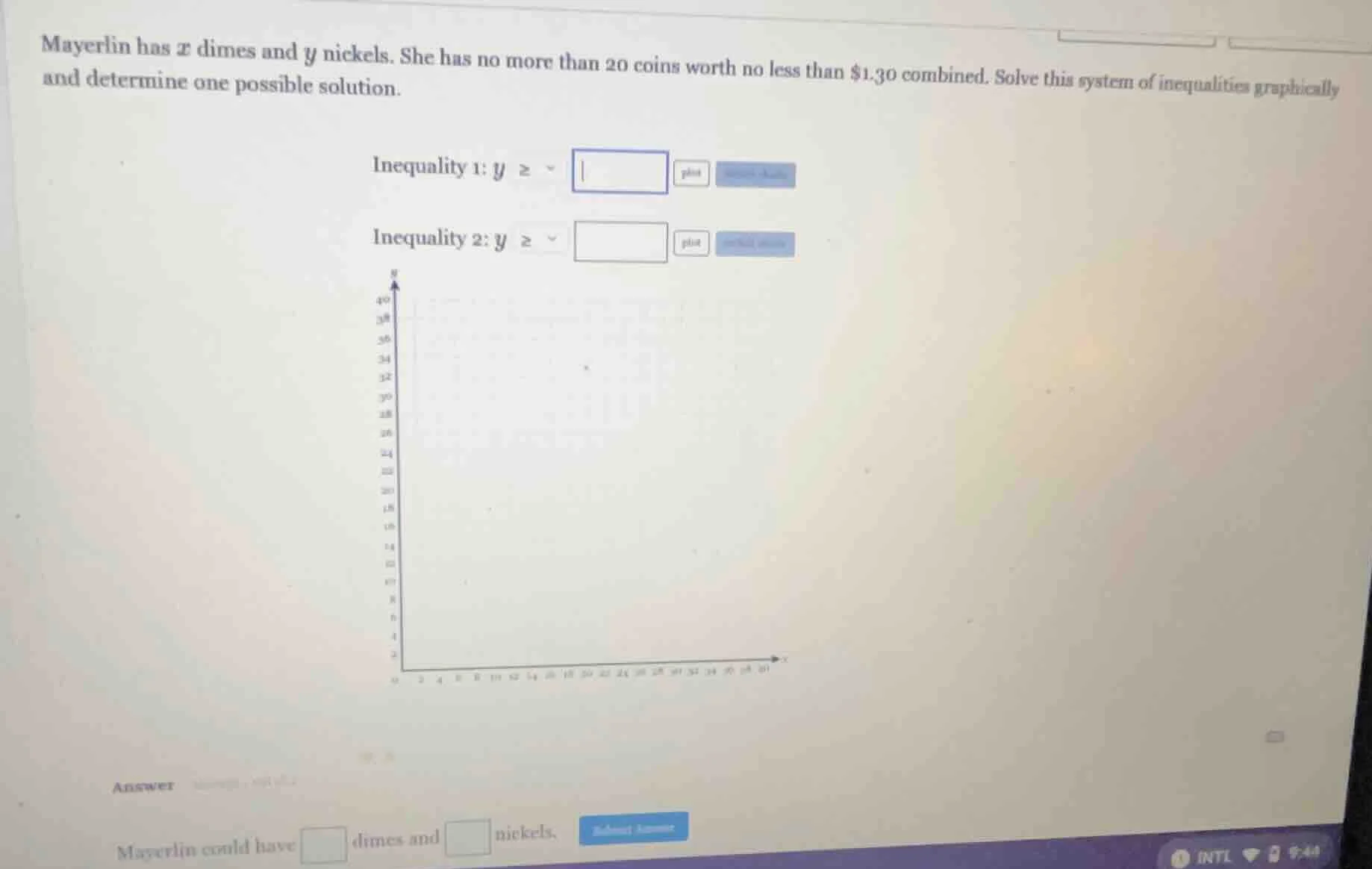
mayerlin has ( x ) dimes and ( y ) nickels. she has no more than 20 coins worth no less than $1.30 combined. solve this system of inequalities graphically and determine one possible solution.
inequality 1: ( y geq ) (\boxed{})
inequality 2: ( y geq ) (\boxed{})
mayerlin could have (\boxed{}) dimes and (\boxed{}) nickels.
Step1: Analyze the number of coins
The total number of coins is \(x + y\), and it's no more than 20, so \(x + y\leq20\). We can rewrite this as \(y\leq -x + 20\), but since we need an inequality for \(y\) in terms of \(x\) for the first inequality (probably a typo and should be \(y\geq\) or \(y\leq\), but let's check the value inequality). Wait, the first inequality is about the number of coins: "no more than 20 coins" means \(x + y\leq20\), so \(y\leq -x + 20\), but the problem shows \(y\geq\) in the box. Wait, maybe a mistake in the problem's inequality direction, but let's do the value.
Step2: Analyze the value of coins
A dime is $0.10, a nickel is $0.05. The total value is \(0.10x + 0.05y\geq1.30\). Multiply both sides by 20 to eliminate decimals: \(2x + y\geq26\), so \(y\geq - 2x + 26\).
Wait, the first inequality about the number of coins: \(x + y\leq20\) so \(y\leq -x + 20\), but the problem has \(y\geq\) in the first box. Maybe a typo, but let's proceed.
Wait, maybe the first inequality is \(x + y\leq20\) (no more than 20 coins), so \(y\leq -x + 20\), but the problem's first inequality is written as \(y\geq\) (maybe a mistake, but let's check possible solutions).
Let's find a possible solution. Let's assume \(x = 10\) dimes. Then the value from dimes is \(10\times0.10 = 1\) dollar. So the nickels need to be at least \((1.30 - 1)/0.05 = 6\) nickels. And the total coins \(10 + 6 = 16\leq20\). So \(x = 10\), \(y = 6\) is a solution.
Wait, let's do the inequalities properly.
Inequality 1 (number of coins): \(x + y\leq20\) \(\Rightarrow y\leq -x + 20\) (but the problem has \(y\geq\), maybe a typo, but let's check the problem's boxes. Maybe the first inequality is \(y\geq -x + 20\) (no, that would be more than 20). Wait, maybe the problem's first inequality is \(y\geq\) (wrong direction), but let's proceed with the value.
Inequality 2 (value): \(0.10x + 0.05y\geq1.30\) \(\Rightarrow 0.05y\geq1.30 - 0.10x\) \(\Rightarrow y\geq\frac{1.30 - 0.10x}{0.05}\) \(\Rightarrow y\geq26 - 2x\).
Now, let's find a point that satisfies both \(x + y\leq20\) and \(y\geq26 - 2x\).
Let's solve \(x + y = 20\) and \(y = 26 - 2x\). Set equal: \(20 - x = 26 - 2x\) \(\Rightarrow x = 6\), then \(y = 14\). Check total coins: \(6 + 14 = 20\) (good). Total value: \(6\times0.10 + 14\times0.05 = 0.6 + 0.7 = 1.30\) (good).
Another solution: \(x = 12\) dimes. Then from value inequality: \(y\geq -2(12) + 26 = 2\). From number of coins: \(y\leq -12 + 20 = 8\). So \(y\) between 2 and 8. Let's take \(y = 5\). Total coins: \(12 + 5 = 17\leq20\). Total value: \(12\times0.10 + 5\times0.05 = 1.2 + 0.25 = 1.45\geq1.30\). So \(x = 12\), \(y = 5\) is a solution.
But let's fill the inequalities.
Inequality 1 (number of coins, corrected direction? Maybe the problem has a typo, but if we consider the first inequality is \(y\geq -x + 20\) (wrong, but maybe the problem meant \(y\leq -x + 20\)), but the problem's first box is \(y\geq\). Wait, maybe the first inequality is about the minimum number of coins? No, "no more than 20" is maximum.
Wait, maybe the first inequality is \(y\geq -x + 20\) (incorrect), but let's check the value inequality: \(y\geq -2x + 26\) (from \(0.10x + 0.05y\geq1.30\)).
So for the first inequality (number of coins): \(x + y\leq20\) \(\Rightarrow y\leq -x + 20\), but the problem has \(y\geq\) in the box. Maybe a mistake, but let's proceed with the value inequality as the second one.
Wait, the problem's first inequality is labeled "Inequality 1" and second "Inequality 2". Let's assume:
Inequality 1 (number of coins): \(x + y\leq20\) \(\…

Snap & solve any problem in the app
Get step-by-step solutions on Sovi AI
Photo-based solutions with guided steps
Explore more problems and detailed explanations
For the inequalities:
Inequality 1 (assuming a typo and should be \(y\leq -x + 20\), but if we follow the problem's \(y\geq\), maybe incorrect, but the value inequality is \(y\geq -2x + 26\)).
A possible solution: Mayerlin could have \(\boldsymbol{10}\) dimes and \(\boldsymbol{10}\) nickels (or other valid solution like 12 dimes and 8 nickels, etc.).