QUESTION IMAGE
Question
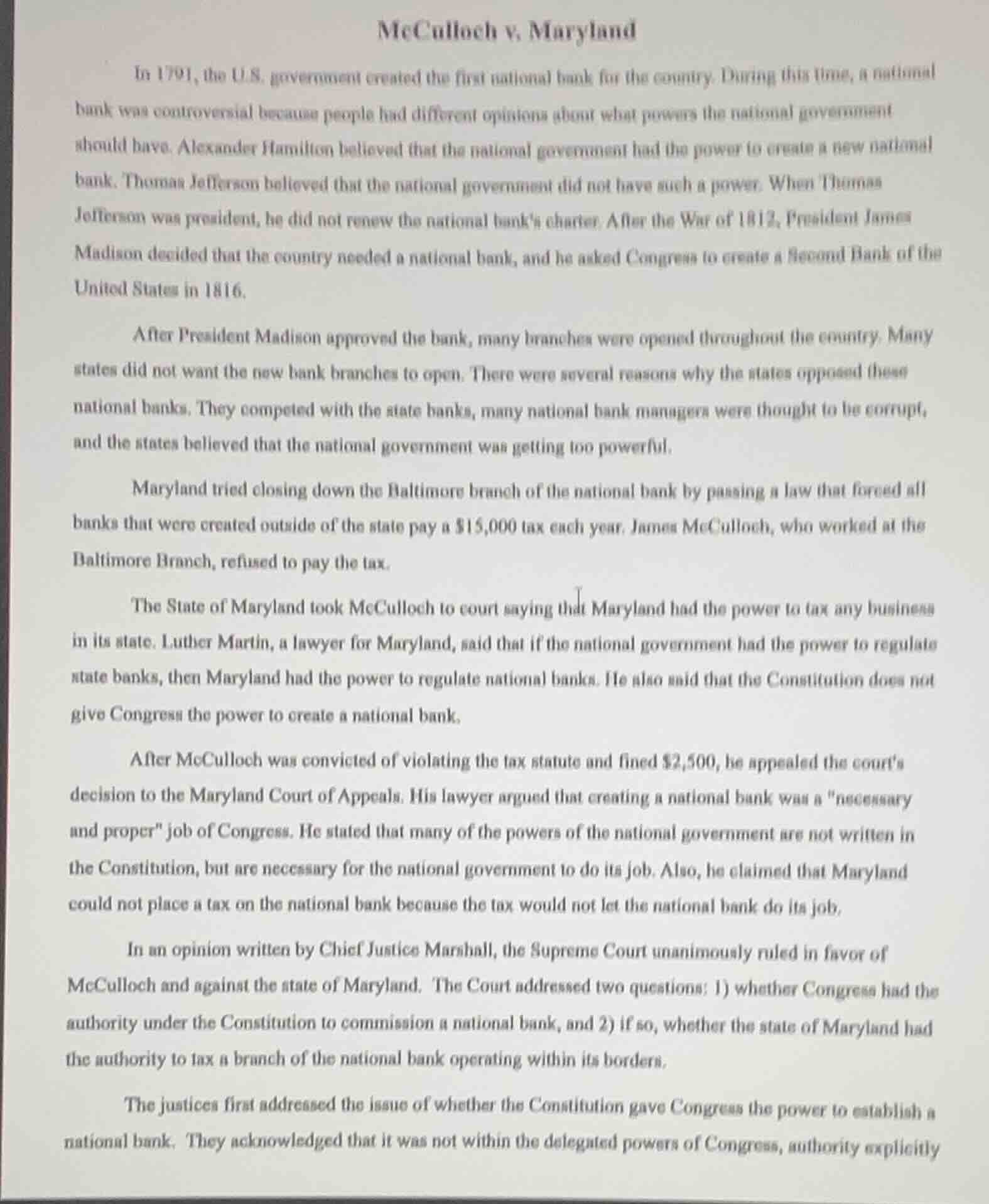
mcculloch v. maryland
in 1791, the u.s. government created the first national bank for the country. during this time, a national bank was controversial because people had different opinions about what powers the national government should have. alexander hamilton believed that the national government had the power to create a new national bank. thomas jefferson believed that the national government did not have such a power. when thomas jefferson was president, he did not renew the national banks charter. after the war of 1812, president james madison decided that the country needed a national bank, and he asked congress to create a second bank of the united states in 1816.
after president madison approved the bank, many branches were opened throughout the country. many states did not want the new bank branches to open. there were several reasons why the states opposed these national banks. they competed with the state banks, many national bank managers were thought to be corrupt, and the states believed that the national government was getting too powerful.
maryland tried closing down the baltimore branch of the national bank by passing a law that forced all banks that were created outside of the state pay a $15,000 tax each year. james mcculloch, who worked at the baltimore branch, refused to pay the tax.
the state of maryland took mcculloch to court saying that maryland had the power to tax any business in its state. luther martin, a lawyer for maryland, said that if the national government had the power to regulate state banks, then maryland had the power to regulate national banks. he also said that the constitution does not give congress the power to create a national bank.
after mcculloch was convicted of violating the tax statute and fined $2,500, he appealed the courts decision to the maryland court of appeals. his lawyer argued that creating a national bank was a
ecessary and proper\ job of congress. he stated that many of the powers of the national government are not written in the constitution, but are necessary for the national government to do its job. also, he claimed that maryland could not place a tax on the national bank because the tax would not let the national bank do its job.
in an opinion written by chief justice marshall, the supreme court unanimously ruled in favor of mcculloch and against the state of maryland. the court addressed two questions: 1) whether congress had the authority under the constitution to commission a national bank, and 2) if so, whether the state of maryland had the authority to tax a branch of the national bank operating within its borders.
the justices first addressed the issue of whether the constitution gave congress the power to establish a national bank. they acknowledged that it was not within the delegated powers of congress, authority explicitly
Since no specific question is provided about the text (e.g., a question about the legal principles, historical context, etc.), it's not possible to generate a solution. If you have a question related to this text, such as analyzing the legal concepts, understanding the historical significance, or answering a multiple - choice question about it, please provide that question so that I can assist you.

Snap & solve any problem in the app
Get step-by-step solutions on Sovi AI
Photo-based solutions with guided steps
Explore more problems and detailed explanations
Since no specific question is provided about the text (e.g., a question about the legal principles, historical context, etc.), it's not possible to generate a solution. If you have a question related to this text, such as analyzing the legal concepts, understanding the historical significance, or answering a multiple - choice question about it, please provide that question so that I can assist you.