QUESTION IMAGE
Question
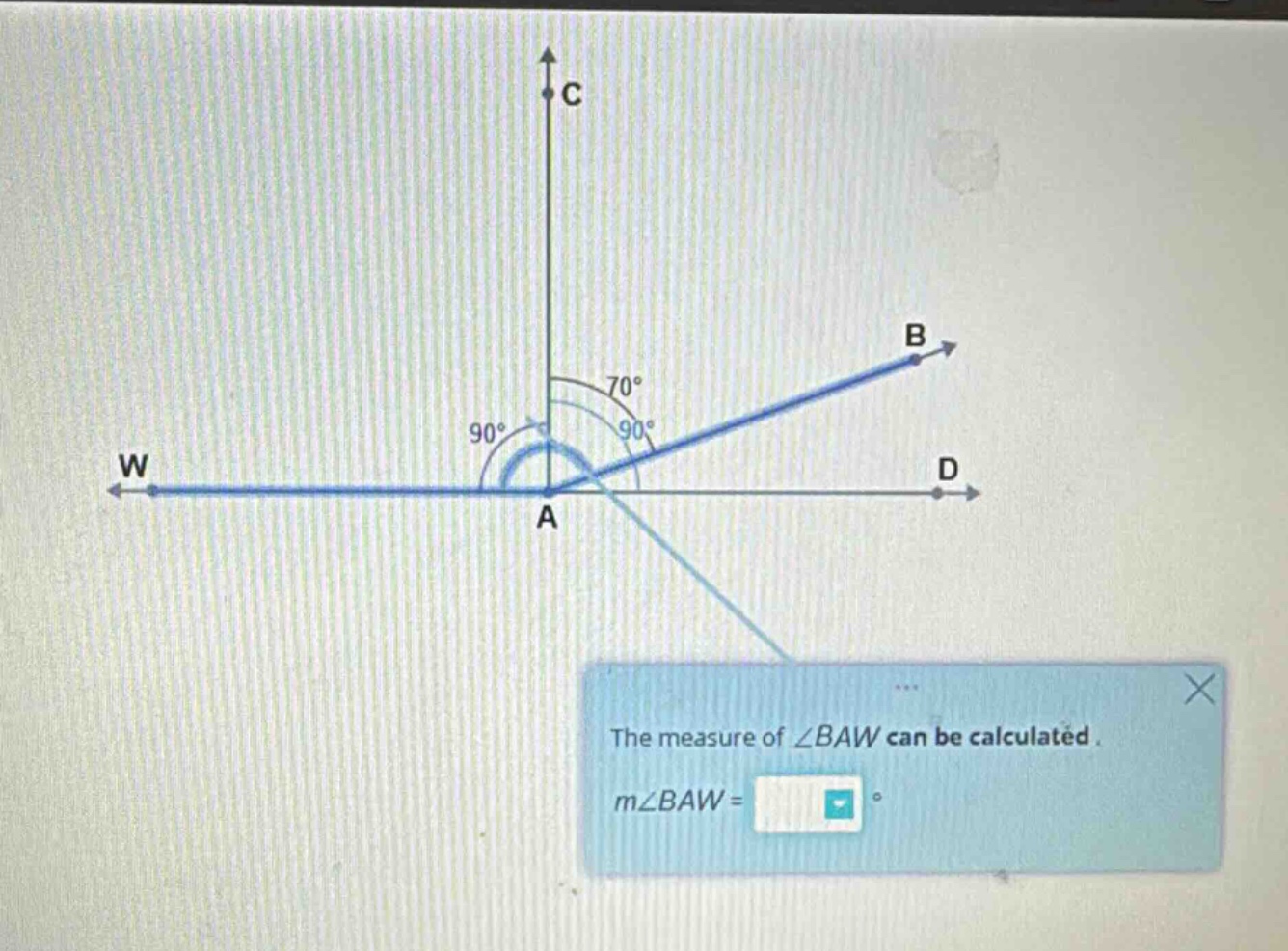
the measure of $\angle baw$ can be calculated. $m\angle baw = \square ^\circ$
Step1: Analyze the angles around point A
We know that the sum of angles on a straight line is \(180^\circ\), but here we have a combination of right angles and the given \(70^\circ\) angle. First, note that \(\angle CAD = 90^\circ\) (right angle), \(\angle CAB = 70^\circ\), and \(\angle WAC = 90^\circ\) (right angle). To find \(\angle BAW\), we can use the fact that the total around the straight line or the sum of angles. Let's see, the angle from \(W\) to \(A\) to \(D\) is a straight line (\(180^\circ\)), but we have angles from \(W\) to \(A\) to \(C\) (\(90^\circ\)), \(C\) to \(A\) to \(B\) (\(70^\circ\)), and \(B\) to \(A\) to \(D\) (\(90^\circ - 70^\circ= 20^\circ\))? Wait, no, better to calculate the total angle for \(\angle BAW\).
Wait, actually, the angle \(\angle BAW\) is composed of \(\angle WAC + \angle CAB + \angle BAD\)? No, wait, let's look at the diagram. \(W\)---\(A\)---\(D\) is a straight line (180 degrees). \(A\)---\(C\) is vertical (90 degrees from \(W\)---\(A\)---\(C\) and 90 degrees from \(C\)---\(A\)---\(D\)). So, \(\angle WAC = 90^\circ\), \(\angle CAD = 90^\circ\). Then, \(\angle CAB = 70^\circ\), so \(\angle BAD = 90^\circ - 70^\circ = 20^\circ\)? Wait, no, maybe another approach. The total angle \(\angle BAW\) is \(\angle WAC + \angle CAB + \angle BAD\)? No, wait, \(W\) to \(A\) to \(C\) is 90 degrees, \(C\) to \(A\) to \(B\) is 70 degrees, and \(B\) to \(A\) to \(D\) is 20 degrees (since \(C\) to \(A\) to \(D\) is 90 degrees, so 90 - 70 = 20). But \(W\) to \(A\) to \(D\) is 180 degrees. So \(\angle BAW = \angle WAC + \angle CAB + \angle BAD\)? Wait, no, \(\angle WAC\) is 90 degrees, \(\angle CAB\) is 70 degrees, and \(\angle BAD\) is 20 degrees? Wait, no, that would be 90 + 70 + 20 = 180, which is the straight line. But we need \(\angle BAW\). Wait, maybe I messed up. Let's re-express:
The angle from \(W\) to \(A\) to \(B\) is \(\angle BAW\). We know that from \(W\) to \(A\) to \(C\) is 90 degrees, \(C\) to \(A\) to \(B\) is 70 degrees, and then from \(B\) to \(A\) to \(D\) is 20 degrees (since \(C\) to \(A\) to \(D\) is 90 degrees, so 90 - 70 = 20). But \(W\) to \(A\) to \(D\) is 180 degrees. So \(\angle BAW = 180^\circ - \angle BAD\). Wait, \(\angle BAD\) is the angle from \(B\) to \(A\) to \(D\). Since \(A\) to \(C\) is 90 degrees from \(D\) (because \(C\) to \(A\) to \(D\) is 90 degrees), and \(C\) to \(A\) to \(B\) is 70 degrees, then \(\angle BAD = 90^\circ - 70^\circ = 20^\circ\). Therefore, \(\angle BAW = 180^\circ - 20^\circ = 160^\circ\)? Wait, no, that can't be. Wait, maybe the correct way is:
Looking at the diagram, the angle between \(W\) and \(A\) and \(C\) is 90 degrees, between \(C\) and \(A\) and \(B\) is 70 degrees, and between \(B\) and \(A\) and \(D\) is 20 degrees (since 90 - 70 = 20). Then, the angle from \(W\) to \(A\) to \(B\) is \(90^\circ + 70^\circ = 160^\circ\)? Wait, no, \(W\) to \(A\) to \(C\) is 90, \(C\) to \(A\) to \(B\) is 70, so adding those gives 90 + 70 = 160. Yes, that makes sense. Because \(W\)---\(A\)---\(C\) is 90 degrees (left vertical to horizontal left), \(C\)---\(A\)---\(B\) is 70 degrees (up to \(B\)), so from \(W\) to \(A\) to \(B\) is 90 + 70 = 160 degrees.
Wait, let's check again. The straight line is \(W\)---\(A\)---\(D\), which is 180 degrees. The angle from \(B\) to \(A\) to \(D\) is \(90^\circ - 70^\circ = 20^\circ\) (since \(A\)---\(C\) is 90 degrees from \(D\), and \(A\)---\(B\) is 70 degrees from \(C\), so 90 - 70 = 20). Then, \(\angle BAW = 180^\circ - \angle BAD = 180 - 20 = 160^\circ\). Yes, that's correct.
Step2: Calculate the measure of…

Snap & solve any problem in the app
Get step-by-step solutions on Sovi AI
Photo-based solutions with guided steps
Explore more problems and detailed explanations
\(160\)