QUESTION IMAGE
Question
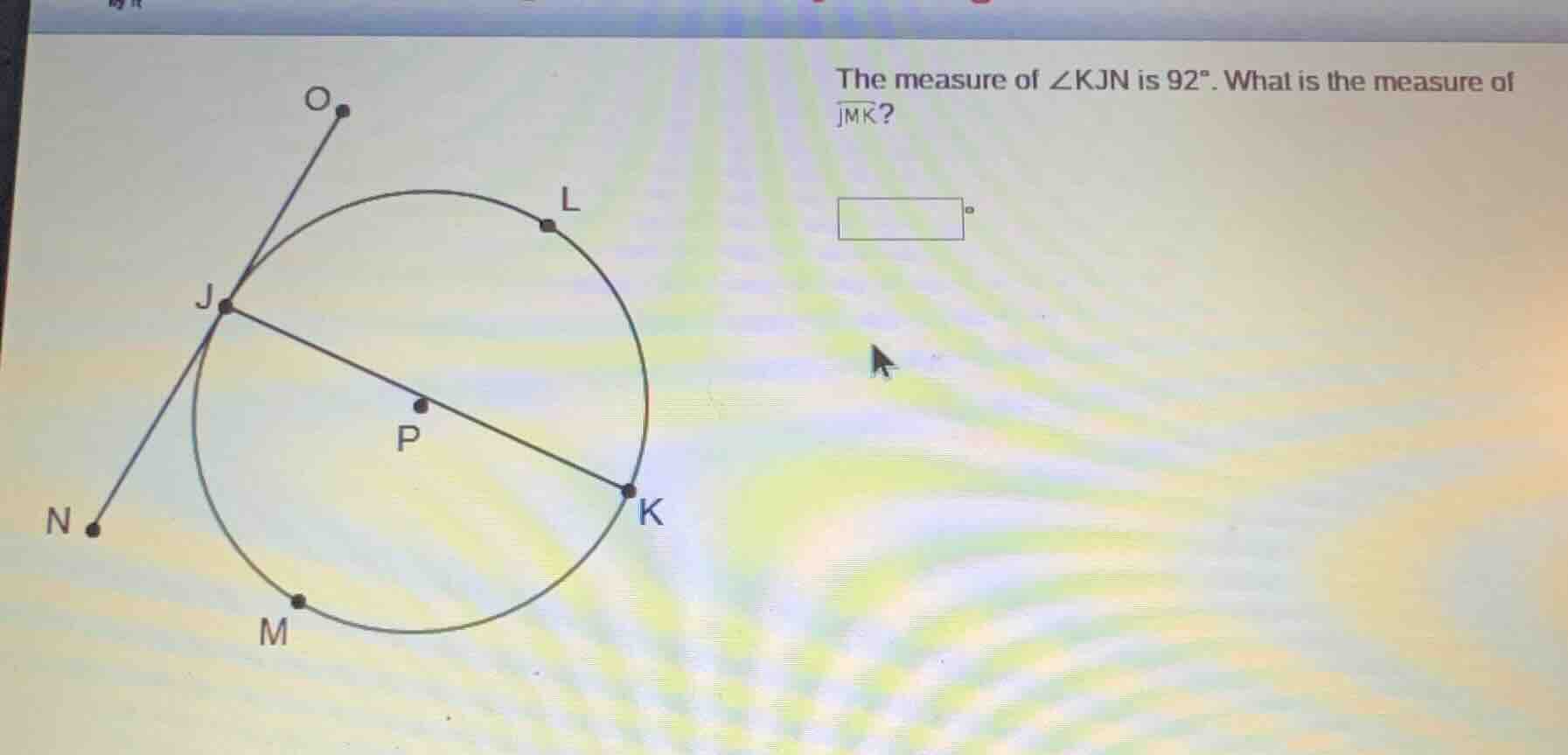
the measure of ∠kjn is 92°. what is the measure of widehat{jmk}?
(there is a diagram with a circle, center p, points j, k, m, l on the circle, and points o, n connected to j forming ∠kjn.)
Step1: Identify the tangent and secant
JN is a tangent to the circle at J, and JK is a secant (diameter, since P is the center). The measure of the angle between a tangent and a secant is half the difference of the measures of the intercepted arcs. Here, ∠KJN intercepts arc KJ (the major arc or minor arc? Wait, actually, the angle between tangent JN and secant JK: the formula is \( m\angle KJN=\frac{1}{2}(m\widehat{JKL}-m\widehat{JMK}) \)? Wait, no, correction: the measure of an angle formed by a tangent and a chord (here, JK is a chord, but since P is the center, JK is a diameter, so arc JMK is a semicircle? Wait, no, let's recall: the measure of an angle formed by a tangent and a chord is half the measure of the intercepted arc. Wait, no, if the angle is outside, but here JN is tangent at J, and JK is a chord (diameter). Wait, actually, ∠KJN is formed by tangent JN and chord JK. The measure of the angle between tangent and chord is equal to half the measure of the intercepted arc. Wait, no, the formula is: the measure of an angle formed by a tangent and a chord is half the measure of the intercepted arc. Wait, but here, if JN is tangent at J, and JK is a chord, then ∠KJN intercepts arc JMK? Wait, no, let's think again. The tangent at J, so the radius PJ is perpendicular to JN? Wait, no, POJ? Wait, the center is P, so PJ is a radius, so PJ ⊥ JN (tangent is perpendicular to radius at point of contact). Wait, but ∠KJN is 92°, so the angle between tangent JN and chord JK is 92°, so the angle between radius PJ and tangent JN is 90°, so the angle between PJ and JK is 92° - 90°? No, that can't be. Wait, maybe I made a mistake. Wait, the correct formula: the measure of an angle formed by a tangent and a chord is equal to half the measure of the intercepted arc. So ∠KJN is formed by tangent JN and chord JK, so \( m\angle KJN=\frac{1}{2}m\widehat{JMK} \)? No, wait, no: if the angle is outside, but here it's at the point of tangency. Wait, actually, the angle between tangent and chord is equal to half the measure of the intercepted arc. So if JN is tangent at J, and JK is a chord, then \( m\angle KJN = \frac{1}{2}m\widehat{JMK} \)? Wait, no, that would mean \( m\widehat{JMK}=2\times92°=184° \), but that's more than a semicircle. Wait, no, maybe the intercepted arc is the major arc or minor arc. Wait, actually, the angle between tangent and chord is equal to half the measure of the intercepted arc. So if the angle is 92°, then the intercepted arc (the arc that's opposite, the one not containing the angle) would be 292°=184°, but that can't be. Wait, no, I think I mixed up. Wait, the correct formula: the measure of an angle formed by a tangent and a chord is half the measure of the intercepted arc. So if JN is tangent at J, and JK is a chord, then the angle ∠KJN is equal to half the measure of the intercepted arc JMK. Wait, but if JK is a diameter, then arc JMK is a semicircle? No, wait, P is the center, so JK is a diameter, so arc JMK is a semicircle? No, arc JMK: points J, M, K. So if JK is a diameter, then the circle is 360°, so a semicircle is 180°. Wait, but ∠KJN is 92°, so if the angle between tangent and chord is half the intercepted arc, then the intercepted arc JMK would be 292°=184°, but that's more than 180°, which is a semicircle. Wait, that can't be. Wait, maybe the angle is supplementary? Wait, no, let's check the diagram again. The tangent is JN, chord is JK, center is P. So the radius PJ is perpendicular to JN, so ∠PJ N = 90°. Then ∠PJK = ∠KJN - ∠PJ N = 92° - 90° = 2°? No, that doesn't make sense. Wait, maybe I got the angl…

Snap & solve any problem in the app
Get step-by-step solutions on Sovi AI
Photo-based solutions with guided steps
Explore more problems and detailed explanations
184