QUESTION IMAGE
Question
2: mechanics
sentences, direct quotations
proof it
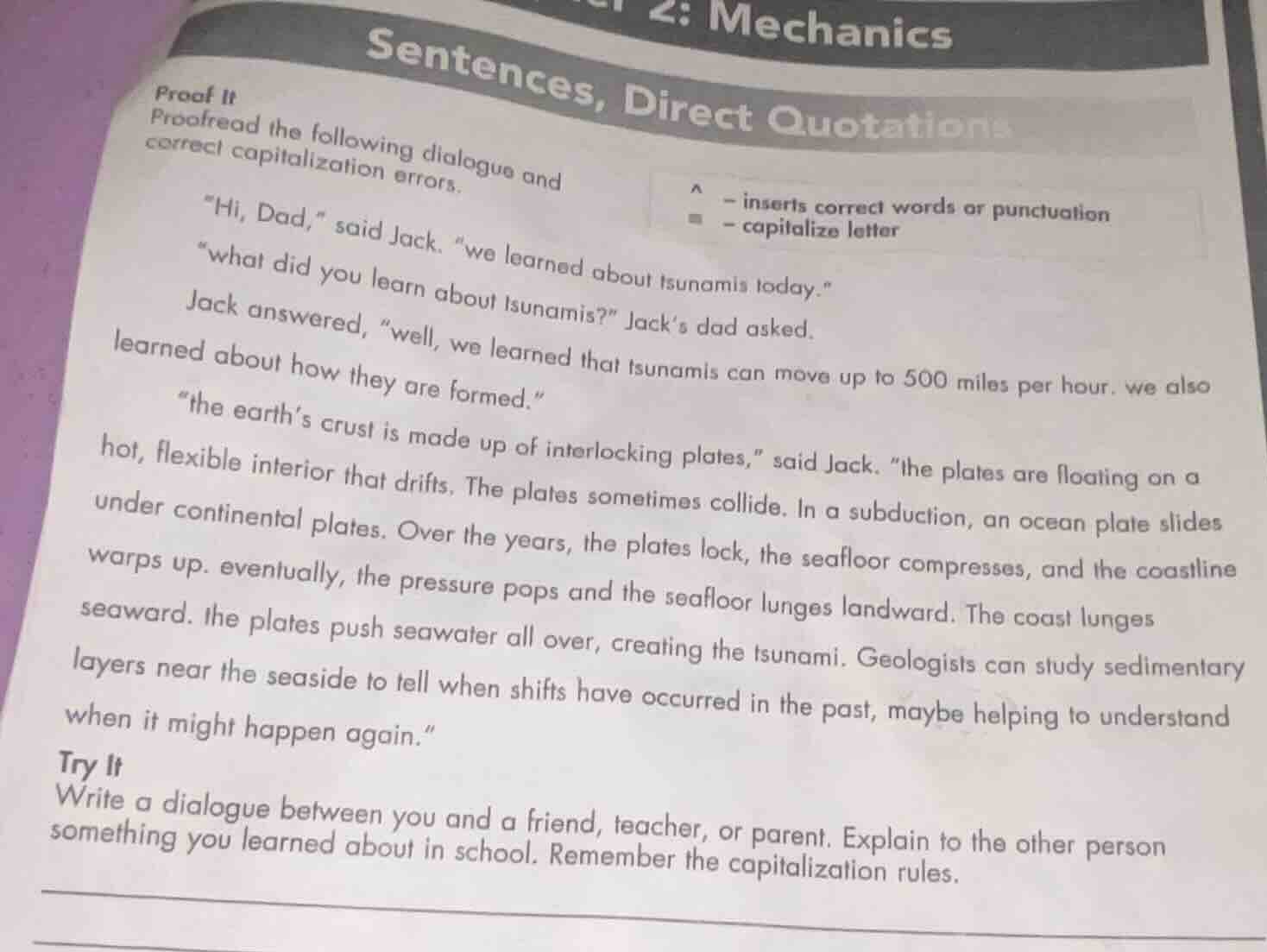
proofread the following dialogue and correct capitalization errors.
^ - inserts correct words or punctuation
- capitalize letter
\hi, dad,\ said jack. \we learned about tsunamis today.\
\what did you learn about tsunamis?\ jacks dad asked.
jack answered, \well, we learned that tsunamis can move up to 500 miles per hour. we also learned about how they are formed.\
\the earths crust is made up of interlocking plates,\ said jack. \the plates are floating on a hot, flexible interior that drifts. the plates sometimes collide. in a subduction, an ocean plate slides under continental plates. over the years, the plates lock, the seafloor compresses, and the coastline warps up. eventually, the pressure pops and the seafloor lunges landward. the coast lunges seaward. the plates push seawater all over, creating the tsunami. geologists can study sedimentary layers near the seaside to tell when shifts have occurred in the past, maybe helping to understand when it might happen again.\
try it
write a dialogue between you and a friend, teacher, or parent. explain to the other person something you learned about in school. remember the capitalization rules.
Proof It (Proofreading the Dialogue for Capitalization Errors)
- "Hi, Dad," said Jack. "We learned about tsunamis today." (Capitalize "W" in "we" as it starts a new sentence within the quotation.)
- "What did you learn about tsunamis?" Jack’s dad asked. (Capitalize "W" in "what" as it starts a question sentence.)
- Jack answered, "Well, we learned that tsunamis can move up to 500 miles per hour. We also learned about how they are formed." (Capitalize "W" in "well" (it's the start of a sentence in the quotation) and "W" in the second "we".)
- "The earth’s crust is made up of interlocking plates," said Jack. "The plates are floating on a hot, flexible interior that drifts. The plates sometimes collide. In a subduction, an ocean plate slides under continental plates. Over the years, the plates lock, the seafloor compresses, and the coastline warps up. Eventually, the pressure pops and the seafloor lunges landward. The coast lunges seaward. The plates push seawater all over, creating the tsunami. Geologists can study sedimentary layers near the seaside to tell when shifts have occurred in the past, maybe helping to understand when it might happen again." (Capitalize "T" in "the" (starts sentences in quotations), "E" in "eventually", and "T" in the last "the".)
Try It (Sample Dialogue)
Dialogue between Me and My Friend (Explaining What I Learned in School)
"Hi, Alex," I said. "I learned about photosynthesis in biology class today!"
Alex replied, "What’s photosynthesis? I’ve heard the word but don’t know what it means."
I explained, "Well, photosynthesis is how plants make their food. They use sunlight, carbon dioxide, and water to produce glucose and oxygen. Chlorophyll (the green pigment in leaves) helps capture the sun’s energy for this process."
Alex nodded, "That sounds interesting! Can you tell me more?"
I continued, "Sure! Plants release the oxygen into the air, which we breathe. And the glucose they make is used as energy for their growth. Without photosynthesis, most life on Earth wouldn’t be possible because we’d lack oxygen and food sources!"
(Note: The "Try It" dialogue follows capitalization rules: starting sentences with capital letters, proper nouns (like "Alex", "Chlorophyll") are capitalized, and scientific terms are used accurately.)

Snap & solve any problem in the app
Get step-by-step solutions on Sovi AI
Photo-based solutions with guided steps
Explore more problems and detailed explanations
Proof It (Proofreading the Dialogue for Capitalization Errors)
- "Hi, Dad," said Jack. "We learned about tsunamis today." (Capitalize "W" in "we" as it starts a new sentence within the quotation.)
- "What did you learn about tsunamis?" Jack’s dad asked. (Capitalize "W" in "what" as it starts a question sentence.)
- Jack answered, "Well, we learned that tsunamis can move up to 500 miles per hour. We also learned about how they are formed." (Capitalize "W" in "well" (it's the start of a sentence in the quotation) and "W" in the second "we".)
- "The earth’s crust is made up of interlocking plates," said Jack. "The plates are floating on a hot, flexible interior that drifts. The plates sometimes collide. In a subduction, an ocean plate slides under continental plates. Over the years, the plates lock, the seafloor compresses, and the coastline warps up. Eventually, the pressure pops and the seafloor lunges landward. The coast lunges seaward. The plates push seawater all over, creating the tsunami. Geologists can study sedimentary layers near the seaside to tell when shifts have occurred in the past, maybe helping to understand when it might happen again." (Capitalize "T" in "the" (starts sentences in quotations), "E" in "eventually", and "T" in the last "the".)
Try It (Sample Dialogue)
Dialogue between Me and My Friend (Explaining What I Learned in School)
"Hi, Alex," I said. "I learned about photosynthesis in biology class today!"
Alex replied, "What’s photosynthesis? I’ve heard the word but don’t know what it means."
I explained, "Well, photosynthesis is how plants make their food. They use sunlight, carbon dioxide, and water to produce glucose and oxygen. Chlorophyll (the green pigment in leaves) helps capture the sun’s energy for this process."
Alex nodded, "That sounds interesting! Can you tell me more?"
I continued, "Sure! Plants release the oxygen into the air, which we breathe. And the glucose they make is used as energy for their growth. Without photosynthesis, most life on Earth wouldn’t be possible because we’d lack oxygen and food sources!"
(Note: The "Try It" dialogue follows capitalization rules: starting sentences with capital letters, proper nouns (like "Alex", "Chlorophyll") are capitalized, and scientific terms are used accurately.)