QUESTION IMAGE
Question
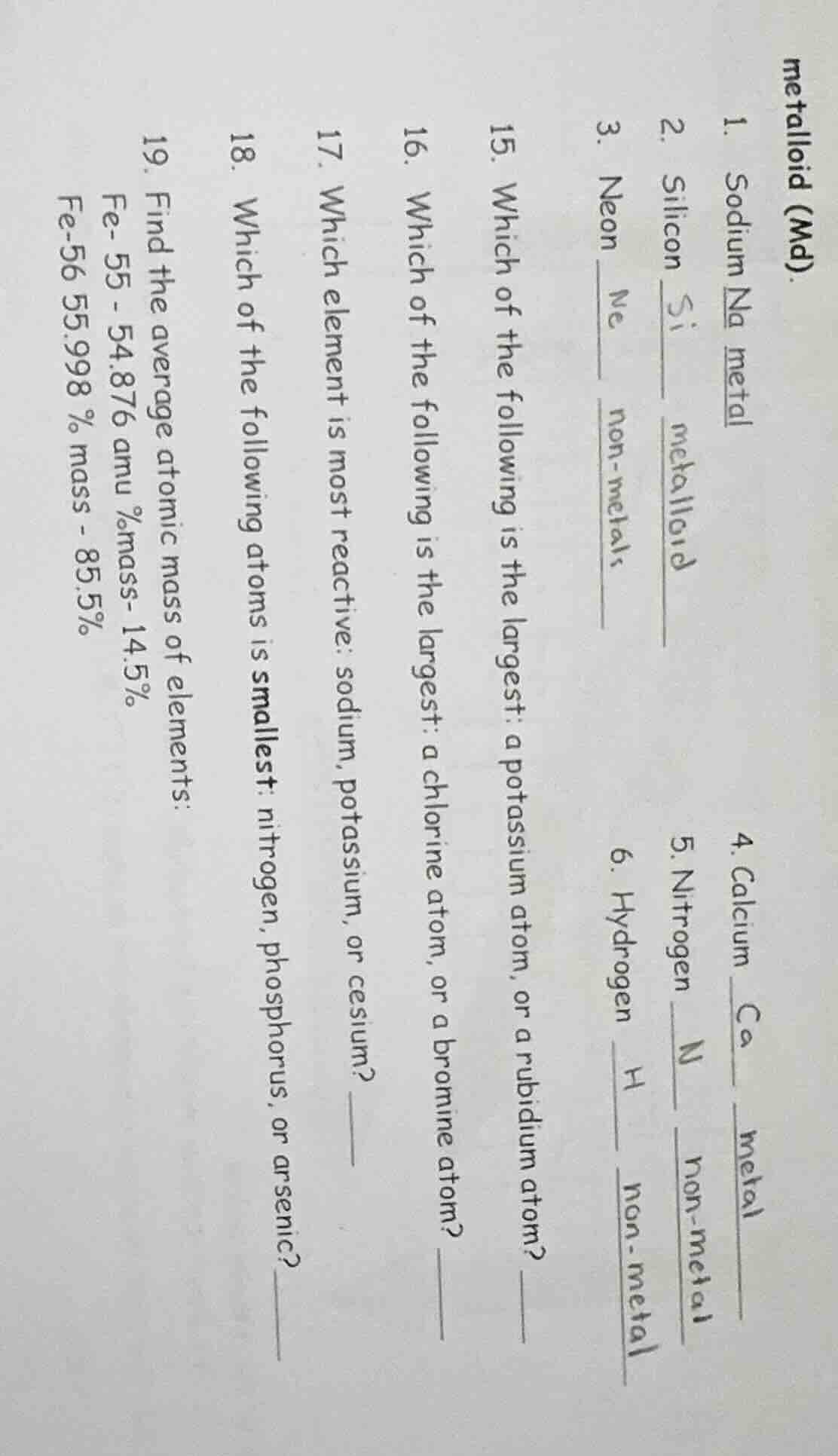
metalloid (md).
- sodium na metal
- silicon si metalloid
- neon ne non - metal;
- calcium ca metal
- nitrogen n non - metal
- hydrogen h non - metal
- which of the following is the largest: a potassium atom, or a rubidium atom?
- which of the following is the largest: a chlorine atom, or a bromine atom?
- which element is most reactive: sodium, potassium, or cesium?
- which of the following atoms is smallest: nitrogen, phosphorus, or arsenic?
- find the average atomic mass of elements:
fe - 55 - 54.876 amu %mass - 14.5%
fe - 56 55.998 %mass - 85.5%
Brief Explanations
- Sodium (Na) is a group 1 metal.
- Silicon (Si) is a metalloid (semi-metal) with properties of both metals and nonmetals.
- Neon (Ne) is a noble gas, a non-metal.
- Calcium (Ca) is a group 2 metal.
- Nitrogen (N) is a non-metal, a group 15 gas.
- Hydrogen (H) is a non-metal, a diatomic gas.
- Atomic radius increases down a group; rubidium is below potassium in group 1.
- Atomic radius increases down a group; bromine is below chlorine in group 17.
- Reactivity of group 1 metals increases down the group; cesium is the lowest among the three.
- Atomic radius decreases up a group; nitrogen is above phosphorus and arsenic in group 15.
- Average atomic mass is calculated by multiplying each isotope's mass by its percent abundance (in decimal form) and summing the results.
Step1: Convert % to decimals
$14.5\% = 0.145$, $85.5\% = 0.855$
Step2: Calculate isotope contributions
$54.876 \times 0.145 = 7.95702$
$55.998 \times 0.855 = 47.87829$
Step3: Sum contributions for average mass
$7.95702 + 47.87829 = 55.83531 \approx 55.847$

Snap & solve any problem in the app
Get step-by-step solutions on Sovi AI
Photo-based solutions with guided steps
Explore more problems and detailed explanations
- Sodium $\boldsymbol{Na}$ $\boldsymbol{metal}$
- Silicon $\boldsymbol{Si}$ $\boldsymbol{metalloid}$
- Neon $\boldsymbol{Ne}$ $\boldsymbol{non-metal}$
- Calcium $\boldsymbol{Ca}$ $\boldsymbol{metal}$
- Nitrogen $\boldsymbol{N}$ $\boldsymbol{non-metal}$
- Hydrogen $\boldsymbol{H}$ $\boldsymbol{non-metal}$
- $\boldsymbol{rubidium\ atom}$
- $\boldsymbol{bromine\ atom}$
- $\boldsymbol{cesium}$
- $\boldsymbol{nitrogen}$
- $\boldsymbol{55.847\ amu}$
---