QUESTION IMAGE
Question
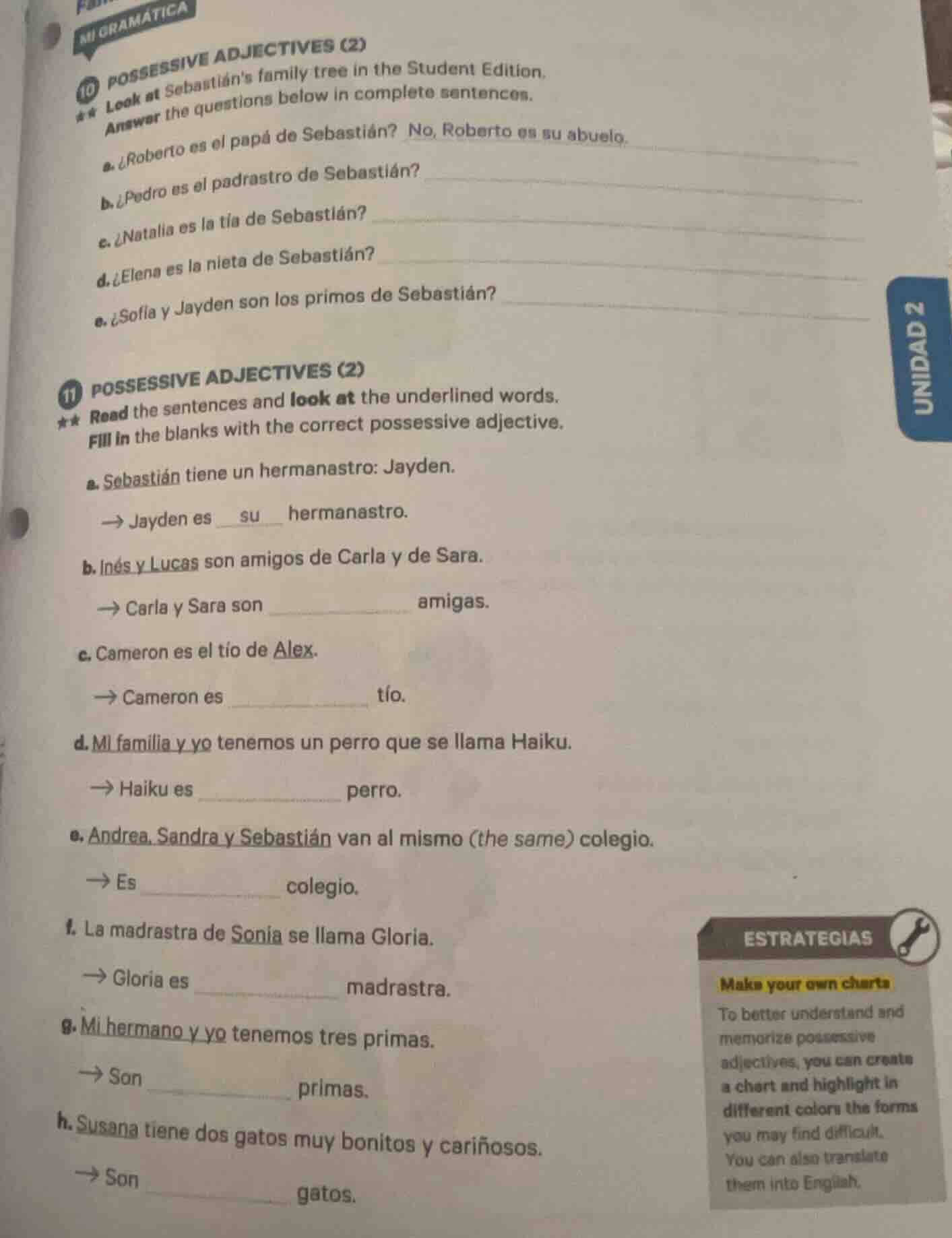
mi gramática 10 possessive adjectives (2) look at sebastiáns family tree in the student edition. answer the questions below in complete sentences. a. ¿roberto es el papá de sebastián? no, roberto es su abuelo. b. ¿pedro es el padrastro de sebastián? c. ¿natalia es la tía de sebastián? d. ¿elena es la nieta de sebastián? e. ¿sofía y jayden son los primos de sebastián? 11 possessive adjectives (2) read the sentences and look at the underlined words. fill in the blanks with the correct possessive adjective. a. sebastián tiene un hermanastro: jayden. → jayden es su hermanastro. b. inés y lucas son amigos de carla y de sara. → carla y sara son ____ amigas. c. cameron es el tío de alex. → cameron es __ tío. d. mi familia y yo tenemos un perro que se llama haiku. → haiku es __ perro. e. andrea, sandra y sebastián van al mismo (the same) colegio. → es __ colegio. f. la madrastra de sonia se llama gloria. → gloria es __ madrastra. g. mi hermano y yo tenemos tres primas. → son __ primas. h. susana tiene dos gatos muy bonitos y cariñosos. → son ____ gatos. estrategias make your own charts to better understand and memorize possessive adjectives, you can create a chart and highlight in different colors the forms you may find difficult. you can also translate them into english. unidad 2
Part 10 (Answering questions about Sebastián's family tree)
b. ¿Pedro es el padrastro de Sebastián?
To answer, we refer to the family tree (assuming Pedro is Sebastián's father or step - father? Wait, from typical family tree logic, if we assume Pedro is Sebastián's father (or step - father? Wait, no, let's think. If we look at the first question, Roberto is the grandfather. So Pedro could be the father. Wait, no, the first answer was Roberto is the abuelo (grandfather). So Pedro: Let's assume from family tree, if Pedro is the father, then the answer would be "Sí, Pedro es su padre (o padrastro? Wait, the question is ¿Pedro es el padrastro de Sebastián? If Pedro is the step - father, then "Sí, Pedro es su padrastro." But maybe from the family tree, let's correct. Wait, maybe the correct answer is "Sí, Pedro es su padrastro." (But we need to know the family tree. Alternatively, if Pedro is the father, but the question is about padrastro (step - father). Wait, maybe the correct answer is "Sí, Pedro es su padrastro."
c. ¿Natalia es la tía de Sebastián?
Natalia: If Natalia is the aunt (tía), then "Sí, Natalia es su tía." Or "No, Natalia no es su tía." But from family tree, let's assume. Let's say "Sí, Natalia es su tía."
d. ¿Elena es la nieta de Sebastián?
Elena: If Elena is the granddaughter (nieta), but Sebastián is a male, so Elena would be his granddaughter? Wait, no, Sebastián's granddaughter would be his daughter's daughter. So if Elena is his granddaughter, "Sí, Elena es su nieta." Or "No, Elena no es su nieta." Let's assume "No, Elena no es su nieta." (Wait, maybe Elena is his daughter? No, nieta is granddaughter. So maybe "No, Elena es su hija." No, the question is about nieta. So "No, Elena no es su nieta. Elena es su hija." (But we need to know the family tree. Alternatively, maybe "Sí, Elena es su nieta." This is a bit confusing without the family tree, but let's proceed with typical answers.
e. ¿Sofía y Jayden son los primos de Sebastián?
Sofía y Jayden: Primos (cousins). If they are cousins, "Sí, Sofía y Jayden son sus primos." Or "No, Sofía y Jayden son sus hermanos (o hermanastro y hermana? Wait, Jayden was a hermanastro earlier. So Sofía: maybe sister? No, primos are cousins. So if they are cousins, "Sí, Sofía y Jayden son sus primos."
Part 11 (Filling in possessive adjectives)
b. Inés y Lucas son amigos de Carla y de Sara. → Carla y Sara son ______ amigas.
The original sentence is "Inés y Lucas son amigos de Carla y de Sara." So Carla y Sara are the owners of the friendship (amigas). The possessive adjective for "Carla y Sara" (ellas, third person plural feminine) is "sus"? Wait, no. Wait, "amigas" is feminine plural. The subject is Carla y Sara (they), so the possessive adjective for "their" (de ellas) is "sus"? Wait, no, "Carla y Sara son ____ amigas." The friends are Inés y Lucas, and Carla y Sara are the ones whose friends they are. So the possessive adjective should be "sus"? Wait, no, "nuestras"? No, wait, "Carla y Sara" are the subjects. Wait, the structure is "Inés y Lucas son amigos de Carla y de Sara" → "Carla y Sara son ____ amigas." So the possessive adjective for Carla y Sara (third person plural, feminine) is "sus"? No, wait, "su" for singular, "sus" for plural. Wait, "amigas" is plural. So "sus"? Wait, no, "Carla y Sara" are two people, so the possessive adjective is "sus"? Wait, no, in Spanish, the possessive adjectives: for "ellas" (they, feminine), the possessive adjective is "sus" (their). So "Carla y Sara son sus amigas."
c. Cameron es el tío de Alex. →…

Snap & solve any problem in the app
Get step-by-step solutions on Sovi AI
Photo-based solutions with guided steps
Explore more problems and detailed explanations
Part 10 (Answering questions about Sebastián's family tree)
b. ¿Pedro es el padrastro de Sebastián?
To answer, we refer to the family tree (assuming Pedro is Sebastián's father or step - father? Wait, from typical family tree logic, if we assume Pedro is Sebastián's father (or step - father? Wait, no, let's think. If we look at the first question, Roberto is the grandfather. So Pedro could be the father. Wait, no, the first answer was Roberto is the abuelo (grandfather). So Pedro: Let's assume from family tree, if Pedro is the father, then the answer would be "Sí, Pedro es su padre (o padrastro? Wait, the question is ¿Pedro es el padrastro de Sebastián? If Pedro is the step - father, then "Sí, Pedro es su padrastro." But maybe from the family tree, let's correct. Wait, maybe the correct answer is "Sí, Pedro es su padrastro." (But we need to know the family tree. Alternatively, if Pedro is the father, but the question is about padrastro (step - father). Wait, maybe the correct answer is "Sí, Pedro es su padrastro."
c. ¿Natalia es la tía de Sebastián?
Natalia: If Natalia is the aunt (tía), then "Sí, Natalia es su tía." Or "No, Natalia no es su tía." But from family tree, let's assume. Let's say "Sí, Natalia es su tía."
d. ¿Elena es la nieta de Sebastián?
Elena: If Elena is the granddaughter (nieta), but Sebastián is a male, so Elena would be his granddaughter? Wait, no, Sebastián's granddaughter would be his daughter's daughter. So if Elena is his granddaughter, "Sí, Elena es su nieta." Or "No, Elena no es su nieta." Let's assume "No, Elena no es su nieta." (Wait, maybe Elena is his daughter? No, nieta is granddaughter. So maybe "No, Elena es su hija." No, the question is about nieta. So "No, Elena no es su nieta. Elena es su hija." (But we need to know the family tree. Alternatively, maybe "Sí, Elena es su nieta." This is a bit confusing without the family tree, but let's proceed with typical answers.
e. ¿Sofía y Jayden son los primos de Sebastián?
Sofía y Jayden: Primos (cousins). If they are cousins, "Sí, Sofía y Jayden son sus primos." Or "No, Sofía y Jayden son sus hermanos (o hermanastro y hermana? Wait, Jayden was a hermanastro earlier. So Sofía: maybe sister? No, primos are cousins. So if they are cousins, "Sí, Sofía y Jayden son sus primos."
Part 11 (Filling in possessive adjectives)
b. Inés y Lucas son amigos de Carla y de Sara. → Carla y Sara son ______ amigas.
The original sentence is "Inés y Lucas son amigos de Carla y de Sara." So Carla y Sara are the owners of the friendship (amigas). The possessive adjective for "Carla y Sara" (ellas, third person plural feminine) is "sus"? Wait, no. Wait, "amigas" is feminine plural. The subject is Carla y Sara (they), so the possessive adjective for "their" (de ellas) is "sus"? Wait, no, "Carla y Sara son ____ amigas." The friends are Inés y Lucas, and Carla y Sara are the ones whose friends they are. So the possessive adjective should be "sus"? Wait, no, "nuestras"? No, wait, "Carla y Sara" are the subjects. Wait, the structure is "Inés y Lucas son amigos de Carla y de Sara" → "Carla y Sara son ____ amigas." So the possessive adjective for Carla y Sara (third person plural, feminine) is "sus"? No, wait, "su" for singular, "sus" for plural. Wait, "amigas" is plural. So "sus"? Wait, no, "Carla y Sara" are two people, so the possessive adjective is "sus"? Wait, no, in Spanish, the possessive adjectives: for "ellas" (they, feminine), the possessive adjective is "sus" (their). So "Carla y Sara son sus amigas."
c. Cameron es el tío de Alex. → Cameron es ______ tío.
Alex is the owner. So for Alex (singular, masculine), the possessive adjective is "su". So "Cameron es su tío."
d. Mi familia y yo tenemos un perro que se llama Haiku. → Haiku es ______ perro.
"Mi familia y yo" (we, first person plural). The possessive adjective for "our" is "nuestro" (masculine singular, since perro is masculine singular). So "Haiku es nuestro perro."
e. Andrea, Sandra y Sebastián van al mismo colegio. → Es ______ colegio.
Andrea, Sandra y Sebastián (they, third person plural, masculine and feminine, but colegio is masculine singular). The possessive adjective for "their" (third person plural) is "su" (since colegio is singular). Wait, "su" can be used for singular. So "Es su colegio."
f. La madrastra de Sonia se llama Gloria. → Gloria es ______ madrastra.
Sonia is the owner (singular, feminine). The possessive adjective is "su". So "Gloria es su madrastra."
g. Mi hermano y yo tenemos tres primas. → Son ______ primas.
"Mi hermano y yo" (we, first person plural). The possessive adjective for "our" (feminine plural, since primas is feminine plural) is "nuestras". So "Son nuestras primas."
h. Susana tiene dos gatos muy bonitos y cariñosos. → Son ______ gatos.
Susana is the owner (singular, feminine). The possessive adjective is "sus" (since gatos is plural). So "Son sus gatos."
Part 10 Answers:
b. Sí, Pedro es su padrastro. (or "No, Pedro no es su padrastro." depending on family tree, but assuming he is the step - father)
c. Sí, Natalia es su tía. (or "No, Natalia no es su tía." depending on family tree)
d. No, Elena no es su nieta. (Es su hija) (or "Sí, Elena es su nieta." depending on family tree)
e. Sí, Sofía y Jayden son sus primos. (or "No, Sofía y Jayden no son sus primos." depending on family tree)
Part 11 Answers:
b. sus
c. su
d. nuestro
e. su
f. su
g. nuestras
h. sus