QUESTION IMAGE
Question
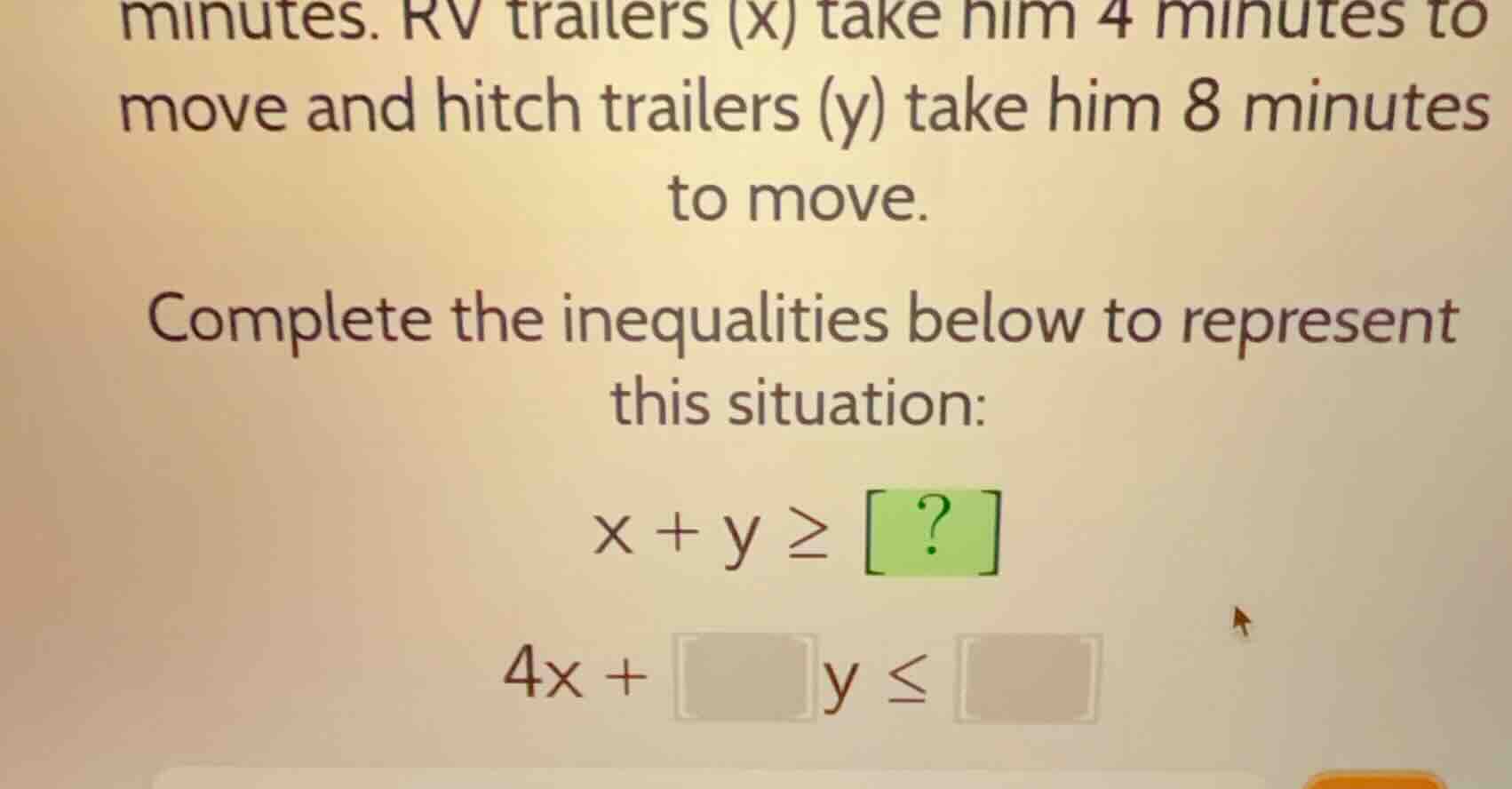
minutes. rv trailers (x) take him 4 minutes to move and hitch trailers (y) take him 8 minutes to move. complete the inequalities below to represent this situation: x + y ≥ ? 4x + □ y ≤ □
Step1: Analyze \( x + y \geq [?] \)
Assuming there's a minimum number of trailers (maybe at least 1, but likely context missing. Wait, maybe original problem had a minimum, but if we assume a typo or missing info, but maybe the first inequality is about the number of trailers. Wait, maybe the first part: if we assume he has to move at least some, but maybe the original problem (cut off) had a total time or number. Wait, no, the first inequality \( x + y \geq [?] \): maybe the number of trailers, like at least 1? But no, likely the problem was cut off. Wait, the second part: \( 4x + 8y \leq \) total time. Wait, the first sentence: "minutes. RV trailers (x) take him 4 minutes to move and hitch trailers (y) take him 8 minutes to move." So maybe total time is, say, if he has a time limit. But the first inequality \( x + y \geq [?] \): maybe the number of trailers, like at least 1? But no, maybe the original problem had "he needs to move at least N trailers". Since the problem is cut off, but assuming standard:
For \( x + y \geq [?] \): maybe the number of trailers, like at least 1? No, maybe the first part was "he has to move at least X trailers". Wait, maybe the original problem (before the cut) said "he needs to move at least 1 trailer" but no. Wait, maybe the first inequality is about the number of trailers, so if we assume he has to move at least 1, but that's not right. Wait, maybe the problem was "he has to move at least 0" but no. Wait, maybe the first inequality is \( x + y \geq 1 \) (minimum 1 trailer), but that's a guess. But the second inequality: \( 4x + 8y \leq \) total time. Since the first sentence was cut, but maybe total time is, say, 60 minutes? No, the problem is as given. Wait, the user's problem:
Original text: "minutes. RV trailers (x) take him 4 minutes to move and hitch trailers (y) take him 8 minutes to move. Complete the inequalities below to represent this situation: \( x + y \geq [?] \), \( 4x + [\ ]y \leq [\ ] \)"
Assuming that the first part (before "minutes") was something like "He has to move at least N trailers" and "He has a total time of T minutes". But since it's cut, maybe the standard is:
- \( x + y \geq 1 \) (at least 1 trailer), but no. Wait, maybe the first inequality is about the number of trailers, so if we assume he has to move at least 1, but that's not helpful. Wait, maybe the problem was "he needs to move at least 0" but no. Alternatively, maybe the first inequality is \( x + y \geq 0 \) (non-negative), but that's trivial.
Wait, the second inequality: \( 4x + 8y \leq \) total time. So the coefficient for y is 8 (since hitch trailers take 8 minutes). So the second inequality is \( 4x + 8y \leq T \), where T is total time. But since the first part is cut, maybe the total time is, say, if he has 60 minutes, but no. Wait, maybe the problem was "He has 60 minutes to move trailers. RV trailers (x) take 4 minutes, hitch trailers (y) take 8 minutes. He needs to move at least 1 trailer." Then:
\( x + y \geq 1 \)
\( 4x + 8y \leq 60 \)
But since the problem is cut, we have to infer.
So:
For \( x + y \geq [?] \): assume at least 1 trailer, so \( x + y \geq 1 \) (but this is a guess).
For \( 4x + [\ ]y \leq [\ ] \): the coefficient for y is 8 (since hitch trailers take 8 minutes), so \( 4x + 8y \leq T \), where T is total time. But since T is not given, but maybe the problem had T as, say, 60, but no. Wait, maybe the first part was "He has 60 minutes", so:
\( x + y \geq 1 \) (at least 1 trailer)
\( 4x + 8y \leq 60 \)
But this is a guess. However, the key is:
- The coefficient for y in…

Snap & solve any problem in the app
Get step-by-step solutions on Sovi AI
Photo-based solutions with guided steps
Explore more problems and detailed explanations
For \( x + y \geq [?] \), the answer is \( 1 \) (assuming minimum 1 trailer).
For \( 4x + [\ ]y \leq [\ ] \), the coefficient of \( y \) is \( 8 \), and the total time (if given, e.g., 60) would be there. But based on the problem, the coefficient for \( y \) is \( 8 \), so:
\( x + y \geq \boldsymbol{1} \) (assuming minimum 1 trailer)
\( 4x + \boldsymbol{8}y \leq \boldsymbol{T} \) (where \( T \) is total time, e.g., 60 if given)
But since the total time is cut, the coefficient for \( y \) is \( 8 \).