QUESTION IMAGE
Question
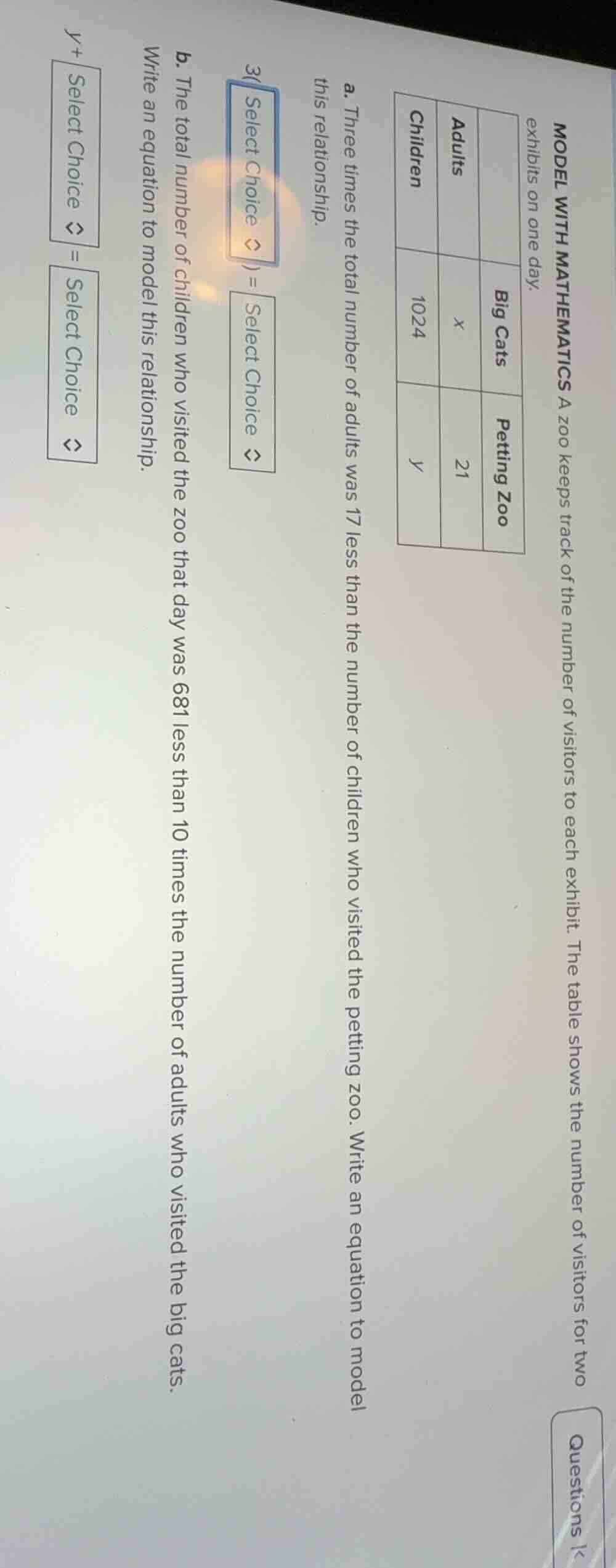
model with mathematics a zoo keeps track of the number of visitors to each exhibit. the table shows the number of visitors for two exhibits on one day.
| adults | children | |
|---|---|---|
| petting zoo | 21 | ( y ) |
a. three times the total number of adults was 17 less than the number of children who visited the petting zoo. write an equation to model this relationship.
3(select choice) = (select choice)
b. the total number of children who visited the zoo that day was 681 less than 10 times the number of adults who visited the big cats. write an equation to model this relationship.
( y + ) (select choice) = (select choice)
Part a
Step 1: Identify the relationship
The problem states "Three times the total number of adults was 17 less than the number of children who visited the petting zoo". Let the number of adults at the petting zoo be 21 (from the table) and the number of children be \( y \). Three times the number of adults is \( 3\times21 \), and this is 17 less than \( y \). So the equation should represent that \( 3\times21=y - 17 \). But if we consider the general case with the variables given (adults at big cats is \( x \), but for petting zoo adults are 21, children are \( y \)), the relationship is \( 3\times21=y - 17 \) or in terms of the variables, if we take the adults at petting zoo as 21, then \( 3\times21=y - 17 \), which can be written as \( y=3\times21 + 17 \). But maybe the question is about the general form with the table. Wait, the table has Adults: Big Cats (\( x \)), Petting Zoo (21); Children: Big Cats (1024), Petting Zoo (\( y \)). The first part (a) says "Three times the total number of adults was 17 less than the number of children who visited the petting zoo". Total number of adults: \( x + 21 \)? Wait, no, maybe "total number of adults" refers to adults at petting zoo? Wait, the problem says "Three times the total number of adults was 17 less than the number of children who visited the petting zoo". So total number of adults (maybe at petting zoo? The petting zoo has 21 adults). So three times 21 is 17 less than \( y \). So \( 3\times21=y - 17 \), so \( y=3\times21 + 17 \). But the blanks are "Select Choice = Select Choice". So maybe the left side is \( 3\times21 \) and the right side is \( y - 17 \), so the equation is \( 3\times21=y - 17 \), so filling the blanks: first select choice (left) is \( 3\times21 \), then "=", then select choice (right) is \( y - 17 \).
Step 2: Form the equation
From the problem statement: Three times the total number of adults (adults at petting zoo is 21) is 17 less than the number of children at petting zoo (\( y \)). So three times 21 is \( 3\times21 \), and this is equal to \( y - 17 \). So the equation is \( 3\times21=y - 17 \).
Step 1: Identify the relationship
The total number of children who visited the zoo that day: total children are children at big cats (1024) plus children at petting zoo (\( y \)), so \( 1024 + y \). This was 681 less than 10 times the number of adults who visited the big cats (\( 10x \)). So "total number of children" (\( 1024 + y \)) is 681 less than \( 10x \), which means \( 1024 + y=10x - 681 \).
Step 2: Form the equation
Total children: \( 1024 + y \). 10 times the number of adults at big cats: \( 10x \). The total children are 681 less than \( 10x \), so \( 1024 + y=10x - 681 \).

Snap & solve any problem in the app
Get step-by-step solutions on Sovi AI
Photo-based solutions with guided steps
Explore more problems and detailed explanations
First "Select Choice" (left) should be \( 3 \times 21 \), then "=", then "Select Choice" (right) should be \( y - 17 \). So the equation is \( 3 \times 21 = y - 17 \) (or in boxed form, but as per instructions, no boxed, just the equation).