QUESTION IMAGE
Question
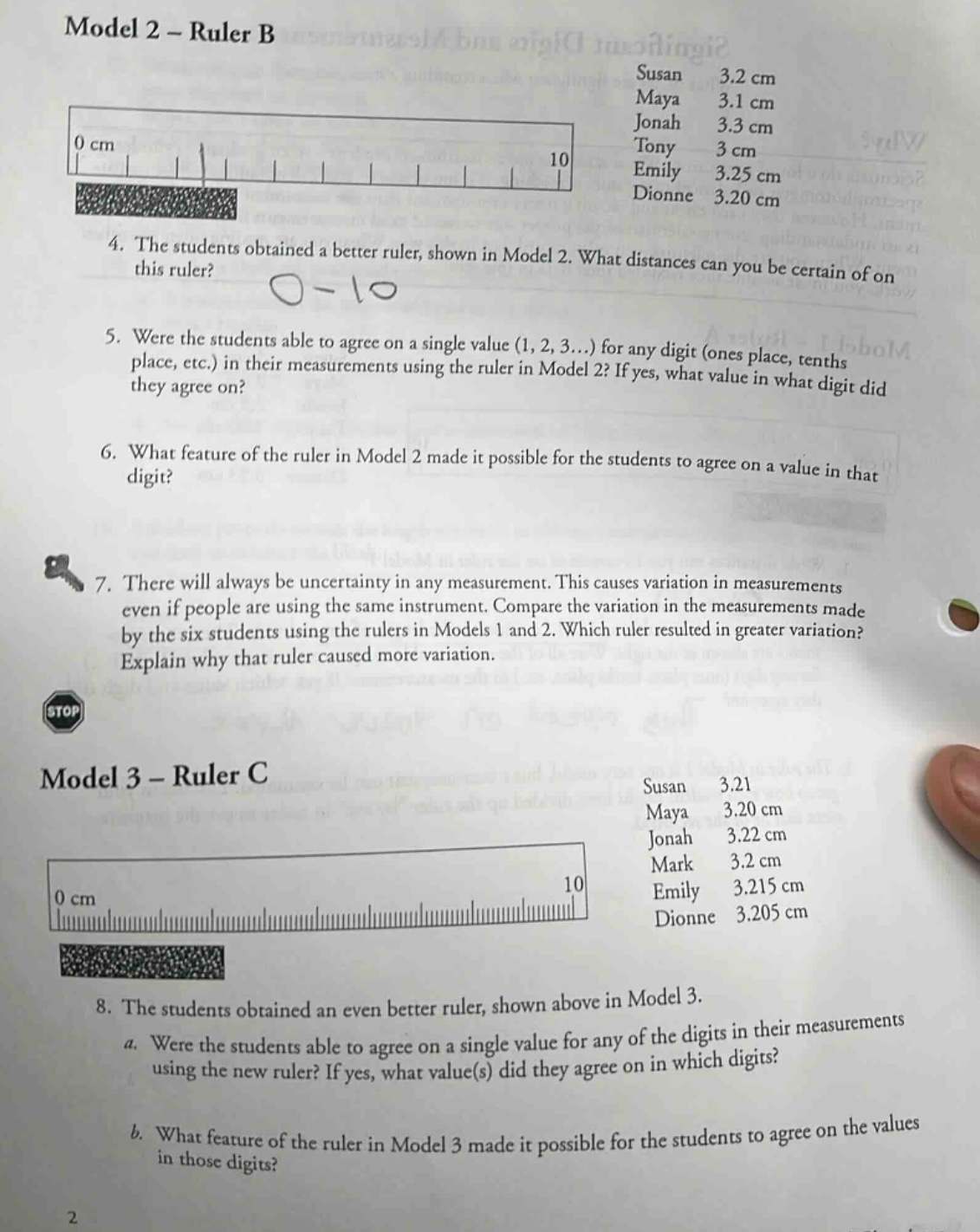
model 2 – ruler b
susan 3.2 cm
maya 3.1 cm
jonah 3.3 cm
tony 3 cm
emily 3.25 cm
dionne 3.20 cm
- the students obtained a better ruler, shown in model 2. what distances can you be certain of on this ruler?
- were the students able to agree on a single value (1, 2, 3...) for any digit (ones place, tenths place, etc.) in their measurements using the ruler in model 2? if yes, what value in what digit did they agree on?
- what feature of the ruler in model 2 made it possible for the students to agree on a value in that digit?
- there will always be uncertainty in any measurement. this causes variation in measurements even if people are using the same instrument. compare the variation in the measurements made by the six students using the rulers in models 1 and 2. which ruler resulted in greater variation? explain why that ruler caused more variation.
model 3 – ruler c
susan 3.21
maya 3.20 cm
jonah 3.22 cm
mark 3.2 cm
emily 3.215 cm
dionne 3.205 cm
- the students obtained an even better ruler, shown above in model 3.
a. were the students able to agree on a single value for any of the digits in their measurements using the new ruler? if yes, what value(s) did they agree on in which digits?
b. what feature of the ruler in model 3 made it possible for the students to agree on the values in those digits?
Question 4
Step1: Analyze Ruler B's markings
The ruler in Model 2 (Ruler B) has major markings (like 0, and then intervals up to 10 cm). The visible part shows 0 to 10 cm, and the smaller intervals (sub - divisions) are such that we can see the whole - number and tenths - place? Wait, no, looking at the ruler's diagram, the ruler has markings where the main scale is in cm, and the sub - divisions: let's see the measurements. The students' measurements are around 3 cm (Tony has 3 cm, others have 3.1, 3.2, etc.). Wait, the ruler in Model 2: from the diagram, the ruler is marked from 0 to 10 cm, with some sub - divisions. But the key is, what distances can we be certain of? The ruler's range is 0 to 10 cm, but for the object being measured, looking at the measurements, all the measurements have a 3 in the ones place (3.2, 3.1, 3.3, 3, 3.25, 3.20). Wait, no, the question is "What distances can you be certain of on this ruler?". The ruler itself: the minimum and maximum? Wait, the ruler is a 0 - 10 cm ruler? Wait, the diagram shows 0 cm at the left and 10 cm at the right. So the ruler can measure distances from 0 cm up to 10 cm, but more precisely, looking at the sub - divisions. Wait, maybe the ruler has markings that allow us to be certain about the ones place (the whole number of cm) and maybe the tenths? Wait, no, let's re - read. The students' measurements: Tony has 3 cm, others have 3.1, 3.2, etc. So the ruler in Model 2: the key is that the ones place (the digit before the decimal) is 3 for the object? No, the ruler's own markings. Wait, the ruler is a 0 - 10 cm ruler, so we can be certain that the ruler can measure distances from 0 cm to 10 cm, but for the object being measured (the shaded rectangle), looking at the measurements, all the measurements have a 3 in the ones place (the integer part). Wait, maybe the answer is that we can be certain of the ones place (the digit 3 for the object's length's ones place) or more generally, the ruler allows us to be certain about the whole - number centimeter and maybe the tenths? Wait, no, let's think again. The ruler in Model 2: from the diagram, the ruler has markings where the main scale is in cm, and the sub - divisions are such that we can see that the object's length is between 3 and 4 cm? No, the students' measurements are all around 3 cm (Tony: 3 cm, others: 3.1, 3.2, etc.). So the distance we can be certain of is that the length of the object is in the 3 - cm range (the ones place is 3). Wait, no, the question is about the ruler, not the object. Wait, "What distances can you be certain of on this ruler?". The ruler's scale: it is marked from 0 to 10 cm, so we can be certain that the ruler can measure distances from 0 cm up to 10 cm, and more precisely, looking at the sub - divisions, the ones place (the whole number of cm) and the tenths place? Wait, no, the correct approach: the ruler in Model 2 (Ruler B) has a scale where the major unit is 1 cm, and there are sub - divisions? Wait, the measurements given: Tony has 3 cm, others have 3.1, 3.2, 3.3, 3.25, 3.20. So the ones place (the digit 3) is consistent across all measurements (even Tony's 3 cm is 3.0 cm in decimal). So we can be certain that the distance (of the object) has a 3 in the ones place (i.e., the length is 3 cm plus some decimal part). But the question is about the ruler: what distances can we be certain of on the ruler? The ruler itself can measure distances from 0 to 10 cm, but the sub - divisions: looking at the ruler's diagram, the ruler has markings that allow us to determine the ones place (whole cm) and maybe the tenth…
Step1: Analyze the digits in the measurements
Let's list the measurements: Susan: 3.2 cm, Maya: 3.1 cm, Jonah: 3.3 cm, Tony: 3 cm (which is 3.0 cm), Emily: 3.25 cm, Dionne: 3.20 cm. Now, look at the ones place (the digit to the left of the decimal point). For all measurements, the digit in the ones place is 3 (Tony's 3 cm is 3.0, so the ones place is 3; Susan's 3.2 has 3 in the ones place, etc.). Now check the tenths place: Susan: 2, Maya: 1, Jonah: 3, Tony: 0, Emily: 2, Dionne: 2. So the tenths place varies. The hundredths place: Emily has 5, Dionne has 0, Susan and Maya and Jonah and Tony don't have a hundredths place (or we can consider it as 0 for Susan: 3.20, Maya: 3.10, Jonah: 3.30, Tony: 3.00). Wait, no, Tony's measurement is 3 cm (so 3.0 cm), Susan's is 3.2 cm (3.20 cm), Maya's is 3.1 cm (3.10 cm), Jonah's is 3.3 cm (3.30 cm), Emily's is 3.25 cm, Dionne's is 3.20 cm. Now, the ones place: all measurements have 3 in the ones place (3.2, 3.1, 3.3, 3.0, 3.25, 3.20). The tenths place: 2,1,3,0,2,2 – varies. The hundredths place: 0 (for Susan, Maya, Jonah, Tony, Dionne has 0, Emily has 5) – varies.
Step2: Determine the agreed - upon digit
Since all the measurements have 3 in the ones place (the digit representing the number of centimeters), the students were able to agree on a single value (3) for the ones place (the digit in the ones place of the length measurement).
Step1: Analyze Ruler B's features
Ruler B (Model 2) has markings that define the whole - centimeter (ones - place) scale clearly. The ruler has a main scale where the major divisions are in centimeters (the ones - place units). When measuring, the object's length is clearly within the 3 - cm to 4 - cm range (as seen from the measurements all having 3 in the ones place). The ruler's scale has well - defined whole - centimeter markings, which means that when measuring the length of the object, the number of whole centimeters (the ones place) is easily determinable and consistent across different measurements. For example, the ruler shows the 3 - cm mark clearly, so all students can see that the object's length is at least 3 cm and less than 4 cm, leading to agreement on the ones - place digit (3).
Step2: Relate the feature to the agreement
The key feature is that the ruler has distinct, well - defined whole - centimeter (ones - place) markings. These markings make it clear that the object's length is in the 3 - cm range (between 3 cm and 4 cm), so all students can agree on the ones - place digit (3) of the length measurement.

Snap & solve any problem in the app
Get step-by-step solutions on Sovi AI
Photo-based solutions with guided steps
Explore more problems and detailed explanations
We can be certain that the length of the measured object has a 3 in the ones place (e.g., the distance is 3 cm plus a decimal component), and the ruler can measure distances from 0 cm to 10 cm. (More precisely, for the object being measured, the ones - place digit of its length is 3, which we can be certain of.)