QUESTION IMAGE
Question
modifying momentum
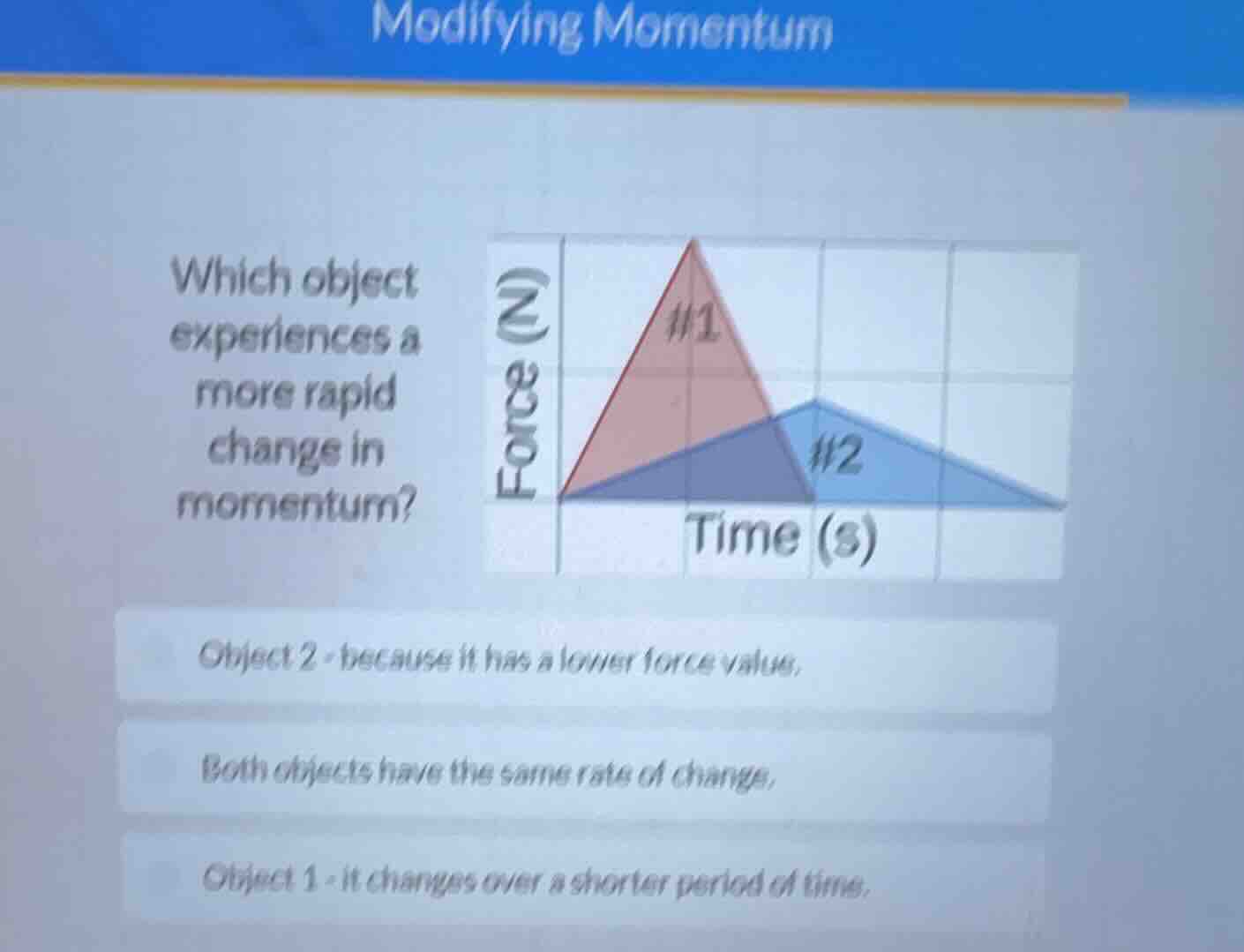
which object experiences a more rapid change in momentum?
force - time chart with two objects #1 (red triangle) and #2 (blue shape)
options:
object 2 - because it has a lower force value.
both objects have the same rate of change.
object 1 - it changes over a shorter period of time.
The change in momentum is equal to the impulse, which is the area under the force - time graph. For Object 1, the force - time graph is a triangle. For Object 2, the force - time graph is also a combination of triangles or trapezoids. But we know that the rate of change of momentum is related to the force (from Newton's second law, $F=\frac{\Delta p}{\Delta t}$, so $\frac{\Delta p}{\Delta t}=F$). However, when looking at the area (impulse, $\Delta p$) and the time taken, if we consider the rate of change of momentum ($\frac{\Delta p}{\Delta t}$), we can also think about the slope or the average force over time. But more importantly, the area under the force - time graph for both objects: let's assume the base (time) for the first part of Object 1 and Object 2. Wait, actually, the key here is that the rate of change of momentum is the force (since $F = \frac{\Delta p}{\Delta t}$). But when we look at the graphs, the area under the force - time graph is the change in momentum ($\Delta p=\int Fdt$). But the question is about the rate of change of momentum, which is $\frac{\Delta p}{\Delta t}$. Let's analyze the two objects:
- For Object 1: The force - time graph is a triangle with a certain height (force) and base (time). The change in momentum $\Delta p_1$ is the area of the red triangle. The time taken for Object 1 to undergo this change in momentum is $t_1$.
- For Object 2: The force - time graph is a triangle (or a combination) with a lower height (force) but a longer time? Wait, no. Wait, the rate of change of momentum is $\frac{\Delta p}{\Delta t}$. Let's consider the average force. But actually, the correct way is to look at the area (impulse) and the time. Wait, no, the rate of change of momentum is the force (instantaneous rate) or the average force (average rate). But in the graph, the area under the force - time curve is the total change in momentum. However, the question is about the "more rapid change", which is the rate of change of momentum, i.e., $\frac{\Delta p}{\Delta t}$.
Wait, another approach: From Newton's second law, $F=\frac{\Delta p}{\Delta t}$, so the rate of change of momentum is equal to the force. But when we look at the force - time graphs, the area under the graph is $\Delta p=\int Fdt$. But the rate of change of momentum is $\frac{\Delta p}{\Delta t}$. Let's assume that the total change in momentum (area) for Object 1 and Object 2: Wait, maybe the areas are equal? No, looking at the graph, the red triangle (Object 1) and the blue triangle (Object 2) - wait, no, the blue area for Object 2 is extended. Wait, no, the key is that the rate of change of momentum is $\frac{\Delta p}{\Delta t}$. Let's take the time interval during which both objects are experiencing force. Wait, maybe the first option is wrong because a lower force would mean a slower rate of change. The second option says both have the same rate of change. Let's check the area: if the area (change in momentum) is the same, but the time taken for Object 1 is less, then the rate of change of momentum ($\frac{\Delta p}{\Delta t}$) for Object 1 would be higher. Wait, the third option says "Object 1 - it changes over a shorter period of time". Let's think: if the change in momentum (area) is the same (or maybe not, but let's assume that the area for Object 1 and Object 2: Wait, maybe the areas are equal? No, the red triangle and the blue triangle - maybe the areas are equal? Wait, no, the red triangle (Object 1) has a higher peak force but a shorter time, and the blue triangle (Object 2) has a lower peak force but a longer time. But the area (chang…

Snap & solve any problem in the app
Get step-by-step solutions on Sovi AI
Photo-based solutions with guided steps
Explore more problems and detailed explanations
Object 1 - it changes over a shorter period of time.