QUESTION IMAGE
Question
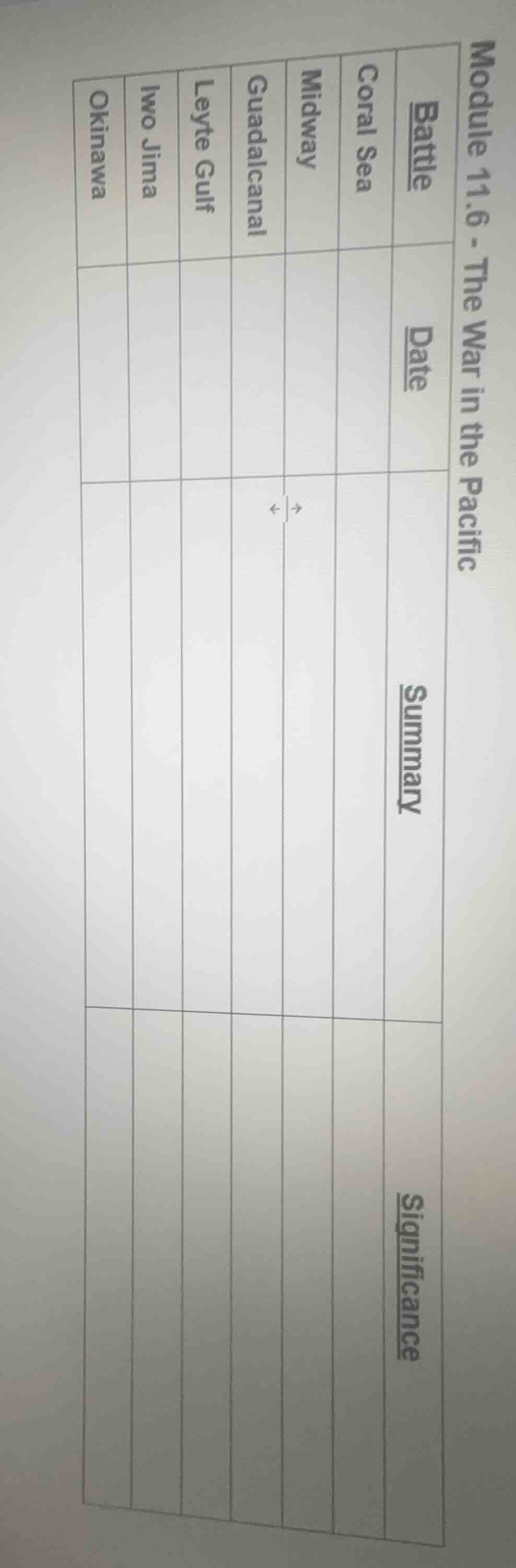
module 11.6 - the war in the pacific
battle | coral sea | midway | guadalcanal | leyte gulf | iwo jima | okinawa
date
summary
significance
Brief Explanations
This table requires filling in key details of major Pacific Theater battles of WWII. Dates are the historical timeframes of each battle; summaries are concise overviews of the fighting; significance covers the strategic impact of each engagement.

Snap & solve any problem in the app
Get step-by-step solutions on Sovi AI
Photo-based solutions with guided steps
Explore more problems and detailed explanations
| Battle | Date | Summary | Significance |
|---|---|---|---|
| Midway | June 4–7, 1942 | U.S. intelligence cracked Japanese codes, ambushing their carrier fleet. U.S. destroyed 4 Japanese aircraft carriers, losing 1 of their own. | Turned the tide of the Pacific War; eliminated Japan's carrier air power superiority, putting the Allies on the offensive for the rest of the war. |
| Guadalcanal | August 1942–February 1943 | U.S. Marines launched the first major Allied amphibious landing in the Pacific; months of brutal land, sea, and air combat ended with Japanese forces evacuating the island. | Secured a critical airfield (Henderson Field); marked the start of the Allied "island-hopping" campaign, pushing Japanese forces back toward their home islands. |
| Leyte Gulf | October 23–26, 1944 | Largest naval battle in history; U.S. forces invaded Leyte, triggering a massive Japanese counterattack. U.S. destroyed much of Japan's remaining surface fleet, including battleships and cruisers. | Destroyed Japan's ability to conduct large-scale naval operations; enabled the U.S. to retake the Philippines, cutting Japan off from vital Southeast Asian resources. |
| Iwo Jima | February 19–March 26, 1945 | U.S. Marines invaded the small volcanic island; Japanese forces fought from underground tunnels and bunkers in suicidal resistance. U.S. captured the island after heavy casualties on both sides. | Secured two airfields for U.S. B-29 bombers, allowing emergency landings and shorter-range bombing raids on Japan; became a symbol of U.S. Marine Corps valor (seen in the iconic flag-raising photograph). |
| Okinawa | April 1–June 22, 1945 | Last major Pacific island battle; U.S. forces faced fierce Japanese resistance, including widespread kamikaze attacks. Over 100,000 Japanese soldiers and tens of thousands of Okinawan civilians died. | Provided a staging ground for a potential invasion of Japan (which never happened due to the atomic bombings); showed the high cost of invading the Japanese home islands, influencing U.S. use of atomic weapons. |