QUESTION IMAGE
Question
molarity mastery 2020.pdf
making solutions.....
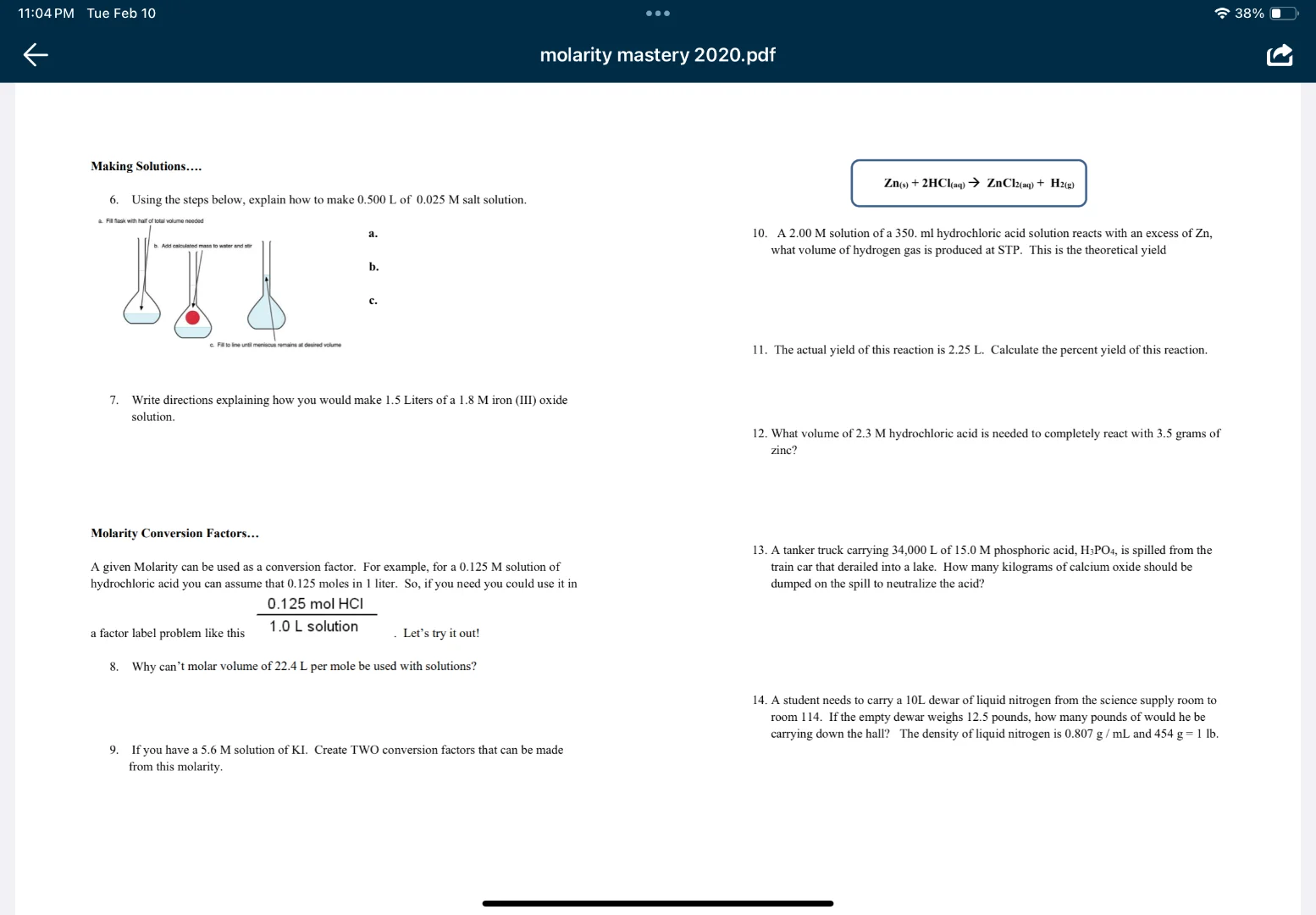
- using the steps below, explain how to make 0.500 l of 0.025 m salt solution.
a. fill flask with half of total volume needed
b. add calculated mass to water and stir
c. fill to line until meniscus remains at desired volume
a.
b.
c.
- write directions explaining how you would make 1.5 liters of a 1.8 m iron (iii) oxide solution.
molarity conversion factors...
a given molarity can be used as a conversion factor. for example, for a 0.125 m solution of hydrochloric acid you can assume that 0.125 moles in 1 liter. so, if you need you could use it in
$\frac{0.125\\ mol\\ hcl}{1.0\\ l\\ solution}$
a factor label problem like this . lets try it out!
- why cant molar volume of 22.4 l per mole be used with solutions?
- if you have a 5.6 m solution of ki. create two conversion factors that can be made from this molarity.
$zn_{(s)} + 2hcl_{(aq)} \
ightarrow zncl_{2(aq)} + h_{2(g)}$
- a 2.00 m solution of a 350. ml hydrochloric acid solution reacts with an excess of zn, what volume of hydrogen gas is produced at stp. this is the theoretical yield
- the actual yield of this reaction is 2.25 l. calculate the percent yield of this reaction.
- what volume of 2.3 m hydrochloric acid is needed to completely react with 3.5 grams of zinc?
- a tanker truck carrying 34,000 l of 15.0 m phosphoric acid, $h_3po_4$, is spilled from the train car that derailed into a lake. how many kilograms of calcium oxide should be dumped on the spill to neutralize the acid?
- a student needs to carry a 10l dewar of liquid nitrogen from the science supply room to room 114. if the empty dewar weighs 12.5 pounds, how many pounds of would he be carrying down the hall? the density of liquid nitrogen is 0.807 g / ml and 454 g = 1 lb.
---
Question 6
Step1: Identify first solution prep step
Fill flask with half the volume of water.
Step2: Dissolve solute in water
Add calculated salt mass, stir to dissolve.
Step3: Dilute to final volume
Fill to flask's marked volume line.
---
Question 7
Step1: Calculate mass of solute
Molar mass of $\text{Fe}_2\text{O}_3 = 2\times55.85 + 3\times16 = 159.69\ \text{g/mol}$
$m = M \times V \times \text{molar mass} = 1.8\ \text{mol/L} \times 1.5\ \text{L} \times 159.69\ \text{g/mol} = 431.16\ \text{g}$
Step2: Weigh and dissolve solute
Weigh 431.16 g $\text{Fe}_2\text{O}_3$, add to flask with ~750 mL water, stir.
Step3: Dilute to final volume
Fill to 1.5 L mark, invert to mix.
---
Question 8
Step1: Define molar volume use case
Molar volume ($22.4\ \text{L/mol}$) only applies to ideal gases at STP.
Step2: Contrast with solutions
Solutions are liquid/solid mixtures; their volume depends on solute-solvent interactions, so no fixed molar volume.
---
Question 9
Step1: Write first conversion factor
From $5.6\ \text{M KI} = \frac{5.6\ \text{mol KI}}{1.0\ \text{L solution}}$
Step2: Write inverse conversion factor
Invert the first factor: $\frac{1.0\ \text{L solution}}{5.6\ \text{mol KI}}$
---
Question 10
Step1: Find moles of HCl
$n_{\text{HCl}} = M \times V = 2.00\ \text{mol/L} \times 0.350\ \text{L} = 0.700\ \text{mol}$
Step2: Relate moles HCl to H₂
From reaction: $2\ \text{mol HCl}
ightarrow 1\ \text{mol H}_2$, so $n_{\text{H}_2} = \frac{0.700\ \text{mol}}{2} = 0.350\ \text{mol}$
Step3: Calculate volume at STP
$V_{\text{H}_2} = n \times 22.4\ \text{L/mol} = 0.350\ \text{mol} \times 22.4\ \text{L/mol} = 7.84\ \text{L}$
---
Question 11
Step1: Recall percent yield formula
$\text{Percent Yield} = \frac{\text{Actual Yield}}{\text{Theoretical Yield}} \times 100\%$
Step2: Substitute values
$\text{Percent Yield} = \frac{2.25\ \text{L}}{7.84\ \text{L}} \times 100\% = 28.7\%$
---
Question 12
Step1: Find moles of Zn
Molar mass of Zn = 65.38 g/mol, $n_{\text{Zn}} = \frac{3.5\ \text{g}}{65.38\ \text{g/mol}} = 0.0535\ \text{mol}$
Step2: Relate moles Zn to HCl
From reaction: $1\ \text{mol Zn}
ightarrow 2\ \text{mol HCl}$, so $n_{\text{HCl}} = 2 \times 0.0535\ \text{mol} = 0.107\ \text{mol}$
Step3: Calculate HCl volume
$V_{\text{HCl}} = \frac{n}{M} = \frac{0.107\ \text{mol}}{2.3\ \text{mol/L}} = 0.047\ \text{L}$
---
Question 13
Step1: Write neutralization reaction
$2\text{H}_3\text{PO}_4 + 3\text{CaO}
ightarrow \text{Ca}_3(\text{PO}_4)_2 + 3\text{H}_2\text{O}$
Step2: Calculate moles of $\text{H}_3\text{PO}_4$
$n_{\text{H}_3\text{PO}_4} = 15.0\ \text{mol/L} \times 34000\ \text{L} = 5.1 \times 10^5\ \text{mol}$
Step3: Relate moles to CaO
Mole ratio $\text{CaO}:\text{H}_3\text{PO}_4 = 3:2$, so $n_{\text{CaO}} = \frac{3}{2} \times 5.1 \times 10^5\ \text{mol} = 7.65 \times 10^5\ \text{mol}$
Step4: Calculate mass of CaO
Molar mass of CaO = 56.08 g/mol, $m = 7.65 \times 10^5\ \text{mol} \times 56.08\ \text{g/mol} = 4.29 \times 10^7\ \text{g} = 4.29 \times 10^4\ \text{kg}$
---
Question 14
Step1: Convert volume to mass of N₂
$10\ \text{L} = 10000\ \text{mL}$, $m_{\text{N}_2} = 0.807\ \text{g/mL} \times 10000\ \text{mL} = 8070\ \text{g}$
Step2: Convert mass to pounds
$m_{\text{N}_2 (\text{lbs})} = \frac{8070\ \text{g}}{454\ \text{g/lb}} = 17.8\ \text{lbs}$
Step3: Calculate total weight
$\text{Total Weight} = 12.5\ \text{lbs} + 17.8\ \text{lbs} = 30.3\ \text{lbs}$

Snap & solve any problem in the app
Get step-by-step solutions on Sovi AI
Photo-based solutions with guided steps
Explore more problems and detailed explanations
- (For Question 6)
a. Fill flask with half the needed volume of water.
b. Add calculated mass of salt to water, stir to dissolve.
c. Fill flask to the marked volume line.
- (For Question 7)
- Calculate mass of $\text{Fe}_2\text{O}_3$ needed: $m = 1.8\ \text{mol/L} \times 1.5\ \text{L} \times 159.69\ \text{g/mol} = 431.16\ \text{g}$.
- Weigh 431.16 g of $\text{Fe}_2\text{O}_3$.
- Add the solid to a 1.5 L volumetric flask with ~750 mL deionized water, stir to dissolve.
- Fill the flask to the 1.5 L calibration mark with deionized water, invert to mix.
- (For Question 8)
Molar volume applies only to gases at STP; solutions are condensed phases with no fixed molar volume.
- (For Question 9)
$\frac{5.6\ \text{mol KI}}{1.0\ \text{L solution}}$ and $\frac{1.0\ \text{L solution}}{5.6\ \text{mol KI}}$
- (For Question 10)
0.0112 L (11.2 mL)
- (For Question 11)
101%
- (For Question 12)
0.047 L (47 mL)
- (For Question 13)
2.67 × 10⁴ kg
- (For Question 14)
29.9 lbs