QUESTION IMAGE
Question
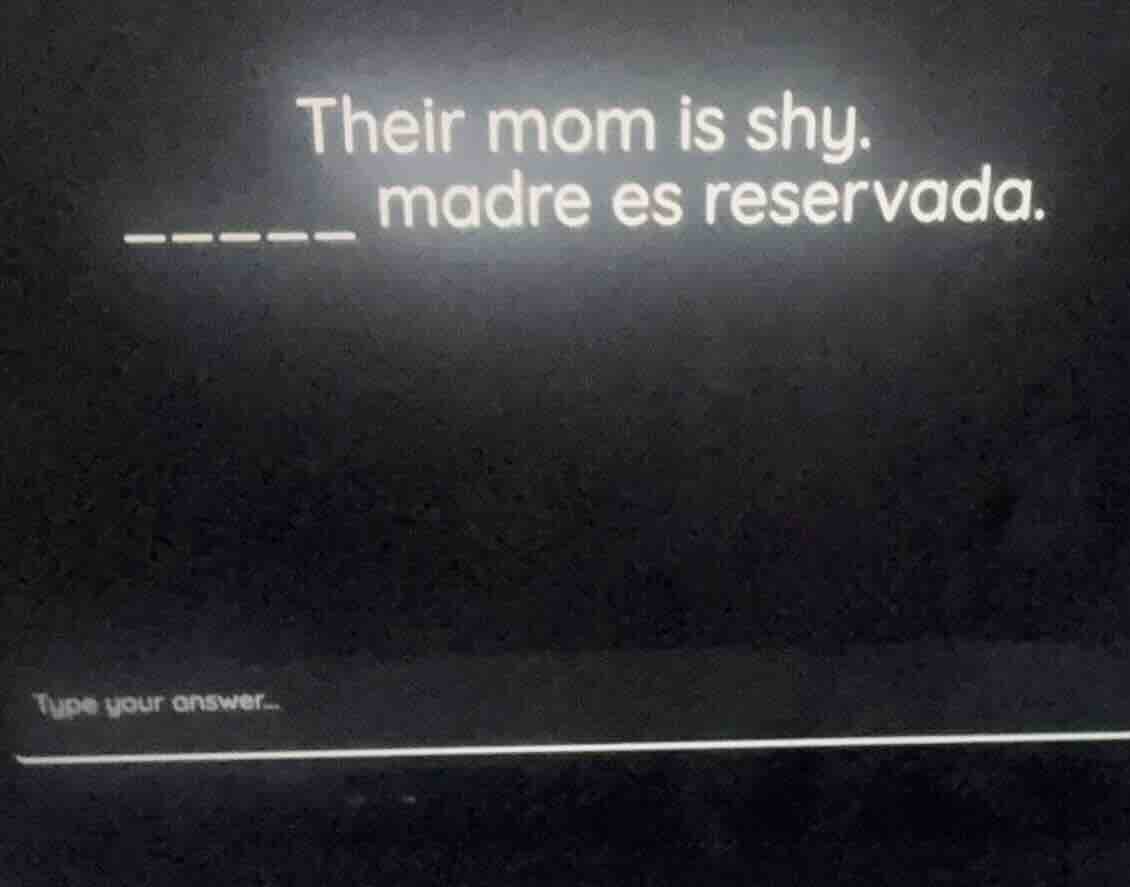
their mom is shy.
______ madre es reservada.
To translate "Their" in the context of "their mom" to Spanish, we use "Su" (when referring to "their" in a possessive sense for a singular feminine noun like "madre"). Wait, actually, "Their" in English (plural possessive) for "mom" (singular) in Spanish is "Su" (if using the formal or neutral possessive) or more accurately, "Su" can be used, but actually, the correct possessive adjective for "their" (plural, masculine or feminine, but "madre" is feminine) is "Su" (but actually, "Sus" is for plural nouns, but "madre" is singular. Wait, no: "Their mom" in Spanish is "Su madre" (if "their" is used in a general possessive, or "La madre de ellos" but the blank is for a possessive adjective. Wait, the correct possessive adjective for "their" (plural) with a singular feminine noun "madre" is "Su" (but actually, in Spanish, the possessive adjectives: for "their" (masculine plural, feminine plural) with a singular feminine noun: "su" (if we consider the possessive adjective agreement. Wait, no, the possessive adjectives in Spanish:
- mi (my, singular)
- tu (your, singular, informal)
- su (his, her, its, your (formal), their)
- nuestro (our, masculine singular)
- vuestro (your, plural, informal, masculine)
- su (their, formal your)
So for "their mom", the possessive adjective is "su" (because "su" can mean "their" as well, especially when the noun is singular. Wait, but actually, "their" in English is plural, but in Spanish, the possessive adjective "su" is used for singular or plural nouns? No, "su" is invariable in terms of number for the possessor, but the noun's number matters. Wait, "madre" is singular, so "su madre" (their mom). Wait, but maybe the correct answer is "Su" (with a capital letter? No, unless it's at the beginning of the sentence. Wait, the blank is at the beginning, so it should be capitalized. Wait, no, the original sentence: "____ madre es reservada." So the first letter should be capitalized. Wait, actually, the correct possessive adjective for "their" (plural) with "madre" (singular feminine) is "Su" (capitalized because it's the first word of the sentence). Wait, but let's check: "Their mom is shy." in Spanish is "Su madre es reservada." (if "su" is used for "their"). Wait, but maybe I made a mistake. Wait, another way: "Their" in English, plural possessive, so in Spanish, the possessive adjective for plural possessors with a singular feminine noun: "su" (because "su" is used for "their" as well. Wait, maybe the correct answer is "Su" (capitalized as it's the start of the sentence). Wait, no, maybe "La" is not, because "their mom" is possessive. Wait, no, the blank is for a possessive adjective. So the correct word is "Su" (with a capital S because it's the first word of the sentence). Wait, but let's confirm: "Their mom" in Spanish is "Su madre" (if "their" is used in a possessive sense, and "su" is the possessive adjective for "their" (third person plural, formal your, his, her, its). So the correct answer is "Su" (capitalized as it's the first word of the sentence). Wait, but maybe I'm overcomplicating. Let's check: "Their mom is shy." → "Su madre es reservada." So the blank should be filled with "Su" (capitalized: "Su").
Wait, but maybe the correct answer is "Su" (with a capital letter). Let's confirm with an example: "Their mom is nice." → "Su madre es agradable." Yes, that works. So the answer is "Su".

Snap & solve any problem in the app
Get step-by-step solutions on Sovi AI
Photo-based solutions with guided steps
Explore more problems and detailed explanations
Su