QUESTION IMAGE
Question
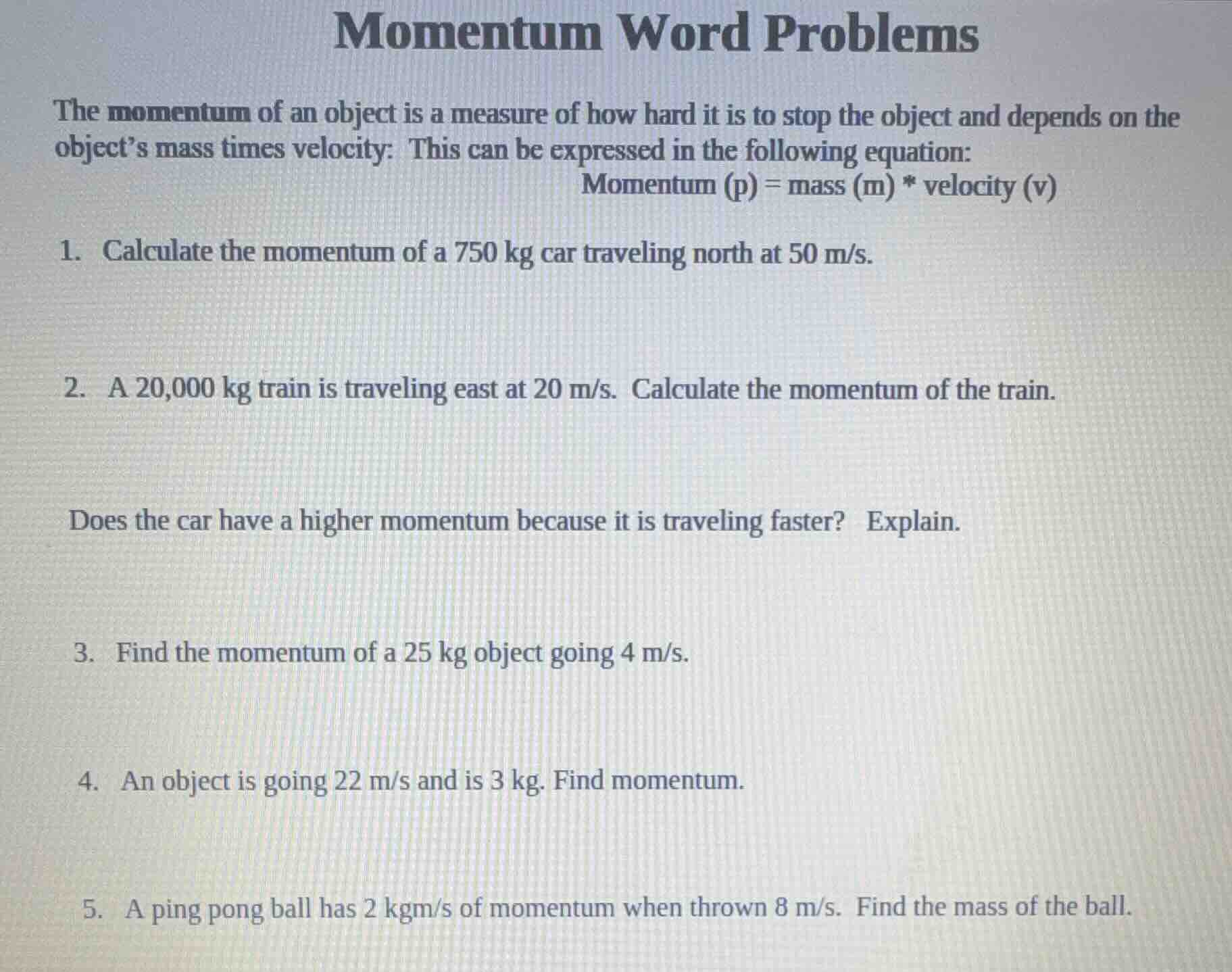
momentum word problems
the momentum of an object is a measure of how hard it is to stop the object and depends on the object’s mass times velocity: this can be expressed in the following equation:
momentum (p) = mass (m) * velocity (v)
- calculate the momentum of a 750 kg car traveling north at 50 m/s.
- a 20,000 kg train is traveling east at 20 m/s. calculate the momentum of the train.
does the car have a higher momentum because it is traveling faster? explain.
- find the momentum of a 25 kg object going 4 m/s.
- an object is going 22 m/s and is 3 kg. find momentum.
- a ping pong ball has 2 kgm/s of momentum when thrown 8 m/s. find the mass of the ball.
Step1: Use momentum formula for car
$p = m \times v = 750\ \text{kg} \times 50\ \text{m/s}$
Step2: Calculate car's momentum
$p = 37500\ \text{kg·m/s north}$
Step3: Use momentum formula for train
$p = m \times v = 20000\ \text{kg} \times 20\ \text{m/s}$
Step4: Calculate train's momentum
$p = 400000\ \text{kg·m/s east}$
Step5: Compare car and train momentum
The car does not have higher momentum. Momentum depends on both mass and velocity; the train's much larger mass results in a far greater momentum despite its lower speed.
Step6: Use momentum formula for 25 kg object
$p = m \times v = 25\ \text{kg} \times 4\ \text{m/s}$
Step7: Calculate 25 kg object's momentum
$p = 100\ \text{kg·m/s}$
Step8: Use momentum formula for 3 kg object
$p = m \times v = 3\ \text{kg} \times 22\ \text{m/s}$
Step9: Calculate 3 kg object's momentum
$p = 66\ \text{kg·m/s}$
Step10: Rearrange formula for mass
$m = \frac{p}{v}$
Step11: Calculate ping pong ball mass
$m = \frac{2\ \text{kg·m/s}}{8\ \text{m/s}} = 0.25\ \text{kg}$

Snap & solve any problem in the app
Get step-by-step solutions on Sovi AI
Photo-based solutions with guided steps
Explore more problems and detailed explanations
- $37500\ \text{kg·m/s north}$
- $400000\ \text{kg·m/s east}$
No, the car does not have higher momentum. Momentum depends on both mass and velocity, and the train's extremely large mass gives it a much greater momentum than the car, even though the car is faster.
- $100\ \text{kg·m/s}$
- $66\ \text{kg·m/s}$
- $0.25\ \text{kg}$