QUESTION IMAGE
Question
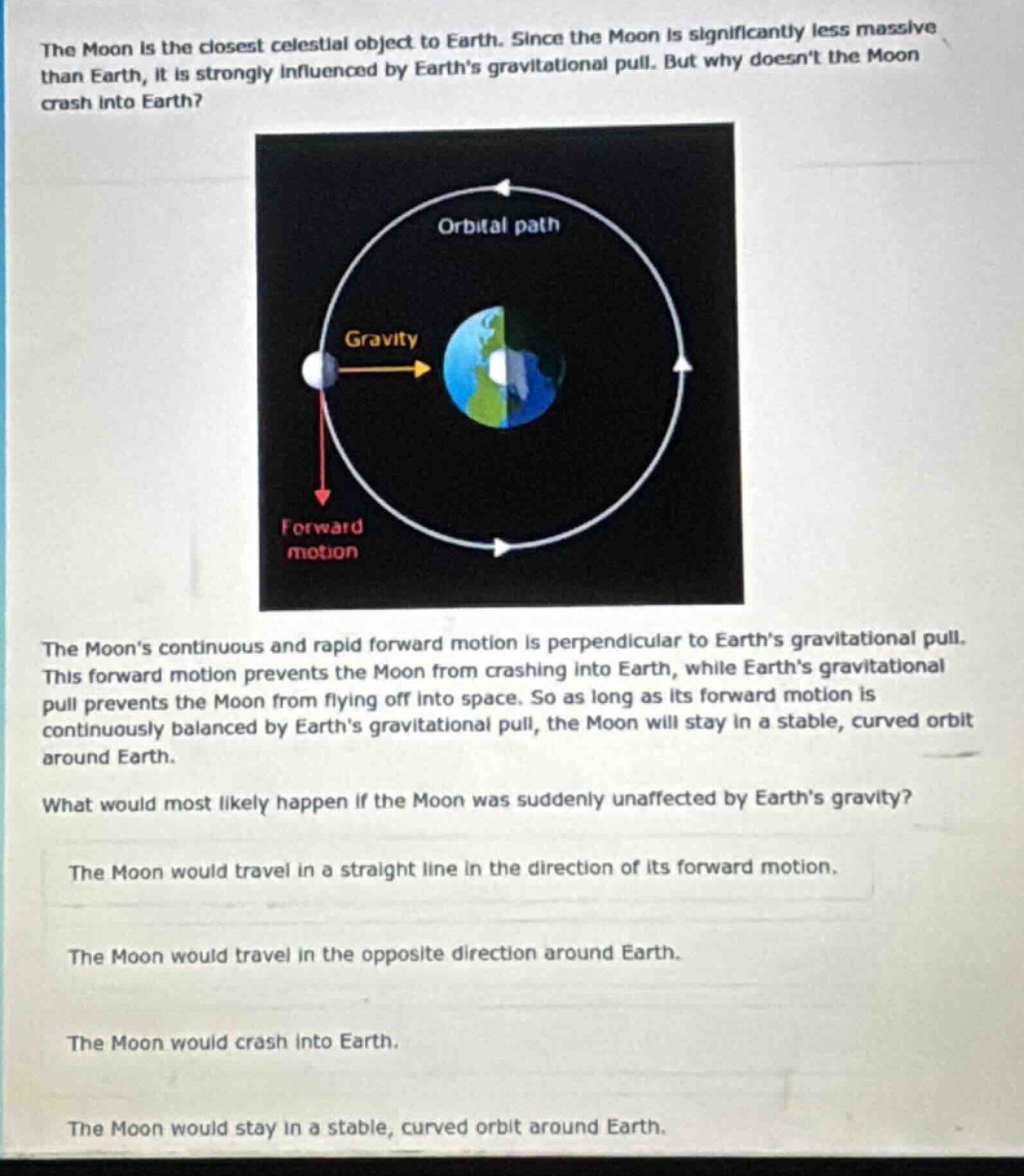
the moon is the closest celestial object to earth. since the moon is significantly less massive than earth, it is strongly influenced by earths gravitational pull. but why doesnt the moon crash into earth? image of moons orbit around earth with labels for gravity, forward motion, and orbital path the moons continuous and rapid forward motion is perpendicular to earths gravitational pull. this forward motion prevents the moon from crashing into earth, while earths gravitational pull prevents the moon from flying off into space. so as long as its forward motion is continuously balanced by earths gravitational pull, the moon will stay in a stable, curved orbit around earth. what would most likely happen if the moon was suddenly unaffected by earths gravity? the moon would travel in a straight line in the direction of its forward motion. the moon would travel in the opposite direction around earth. the moon would crash into earth. the moon would stay in a stable, curved orbit around earth.
Según el texto, la gravedad de la Tierra evita que la Luna vuele al espacio, mientras que su movimiento forward evita que choque con la Tierra. Si la Luna dejara de verse afectada por la gravedad terrestre, solo tendría su movimiento forward, que es perpendicular a la fuerza gravitacional. Sin la gravedad para curvar su trayectoria, la Luna seguiría una línea recta en la dirección de su movimiento forward. La segunda opción es incorrecta porque no hay razón para que cambie de dirección. La tercera es incorrecta porque el choque se evita por el movimiento forward, y sin gravedad, no habría fuerza que la tire hacia la Tierra. La cuarta es incorrecta porque la órbita estable depende del equilibrio entre la gravedad y el movimiento forward; sin gravedad, no habría equilibrio.

Snap & solve any problem in the app
Get step-by-step solutions on Sovi AI
Photo-based solutions with guided steps
Explore more problems and detailed explanations
The Moon would travel in a straight line in the direction of its forward motion.