QUESTION IMAGE
Question
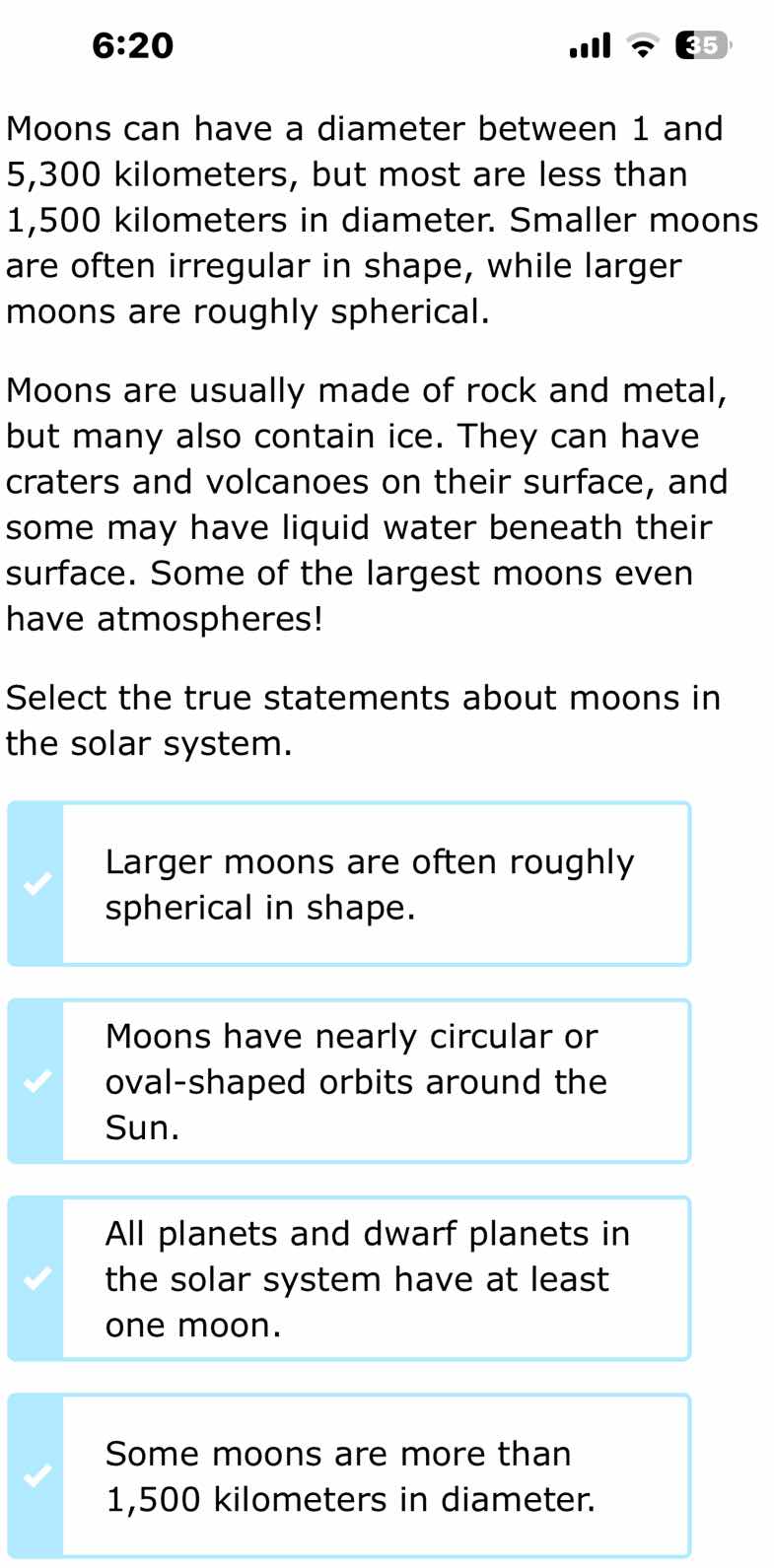
moons can have a diameter between 1 and 5,300 kilometers, but most are less than 1,500 kilometers in diameter. smaller moons are often irregular in shape, while larger moons are roughly spherical.
moons are usually made of rock and metal, but many also contain ice. they can have craters and volcanoes on their surface, and some may have liquid water beneath their surface. some of the largest moons even have atmospheres!
select the true statements about moons in the solar system.
- larger moons are often roughly spherical in shape.
- moons have nearly circular or oval - shaped orbits around the sun.
- all planets and dwarf planets in the solar system have at least one moon.
- some moons are more than 1,500 kilometers in diameter.
Brief Explanations
- For "Larger moons are often roughly spherical in shape": The text states "larger moons are roughly spherical", so this is true.
- For "Moons have nearly circular or oval - shaped orbits around the Sun": The given text about moons does not mention their orbits around the Sun, so we can't confirm this from the provided information.
- For "All planets and dwarf planets in the solar system have at least one moon": The text does not provide information about whether all planets and dwarf planets have moons, so we can't confirm this.
- For "Some moons are more than 1,500 kilometers in diameter": The text says "Moons can have a diameter between 1 and 5,300 kilometers, but most are less than 1,500 kilometers in diameter", which implies that some moons (the ones with diameter between 1500 - 5300 km) are more than 1500 km in diameter, so this is true.

Snap & solve any problem in the app
Get step-by-step solutions on Sovi AI
Photo-based solutions with guided steps
Explore more problems and detailed explanations
A. Larger moons are often roughly spherical in shape.
D. Some moons are more than 1,500 kilometers in diameter.