QUESTION IMAGE
Question
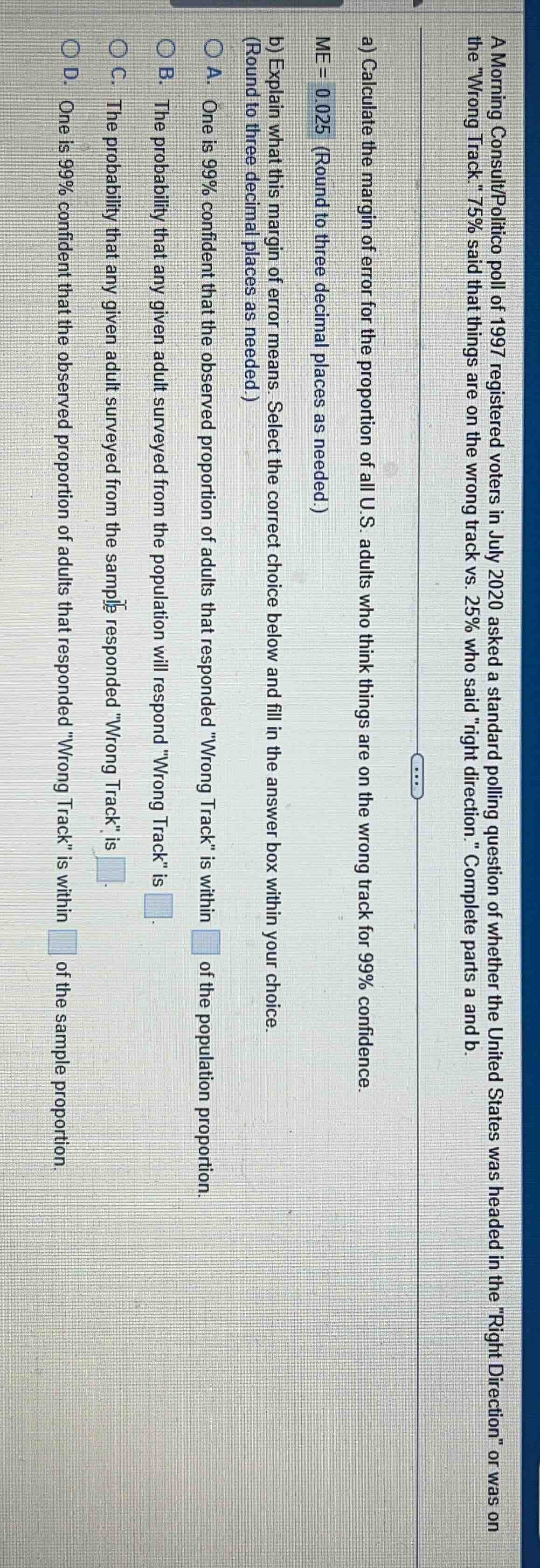
a morning consult/polltico poll of 1997 registered voters in july 2020 asked a standard polling question of whether the united states was headed in the
ight direction\ or was on the \wrong track.\ 75% said that things are on the wrong track vs. 25% who said
ight direction.\ complete parts a and b. a) calculate the margin of error for the proportion of all u.s. adults who think things are on the wrong track for 99% confidence. me = 0.025 (round to three decimal places as needed.) b) explain what this margin of error means. select the correct choice below and fill in the answer box within your choice. (round to three decimal places as needed.) a. one is 99% confident that the observed proportion of adults that responded \wrong track\ is within \boxed{} of the population proportion b. the probability that any given adult surveyed from the population will respond \wrong track\ is \boxed{} c. the probability that any given adult surveyed from the sample responded \wrong track\ is \boxed{} d. one is 99% confident that the observed proportion of adults that responded \wrong track\ is within \boxed{} of the sample proportion
Step1: Identify key values
Sample size $n=1997$, sample proportion $\hat{p}=0.75$, 99% confidence level corresponds to $z^*=2.576$
Step2: Apply margin of error formula
$$ME = z^* \times \sqrt{\frac{\hat{p}(1-\hat{p})}{n}}$$
$$ME = 2.576 \times \sqrt{\frac{0.75(1-0.75)}{1997}}$$
Step3: Calculate intermediate values
First compute $\frac{0.75\times0.25}{1997}=\frac{0.1875}{1997}\approx0.00009389$
Then $\sqrt{0.00009389}\approx0.00969$
Step4: Compute final margin of error
$$ME = 2.576 \times 0.00969 \approx 0.025$$
Step5: Interpret margin of error
The margin of error describes the range around the sample proportion where we are confident the true population proportion lies, for a 99% confidence level.

Snap & solve any problem in the app
Get step-by-step solutions on Sovi AI
Photo-based solutions with guided steps
Explore more problems and detailed explanations
a) $0.025$
b) A. One is 99% confident that the observed proportion of adults that responded "Wrong Track" is within $0.025$ of the population proportion.