QUESTION IMAGE
Question
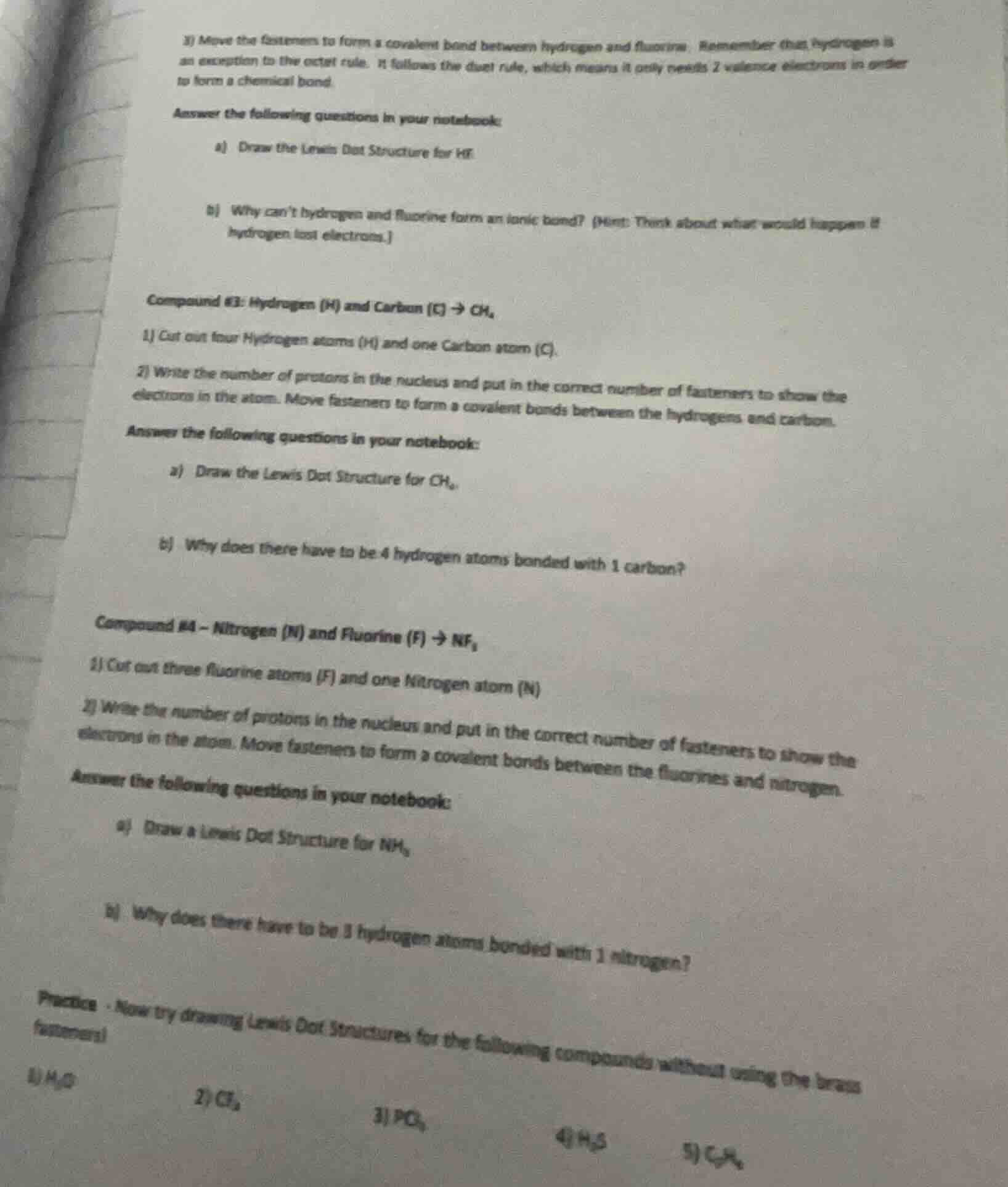
- move the fasteners to form a covalent bond between hydrogen and fluorine. remember that hydrogen is an exception to the octet rule. it follows the duet rule, which means it only needs 2 valence electrons in order to form a chemical bond.
answer the following questions in your notebook:
a) draw the lewis dot structure for hf.
b) why cant hydrogen and fluorine form an ionic bond? (hint: think about what would happen if hydrogen lost electrons.)
compound #3: hydrogen (h) and carbon (c) → ch₄
- cut out four hydrogen atoms (h) and one carbon atom (c).
- write the number of protons in the nucleus and put in the correct number of fasteners to show the electrons in the atom. move fasteners to form a covalent bonds between the hydrogens and carbon.
answer the following questions in your notebook:
a) draw the lewis dot structure for ch₄.
b) why does there have to be 4 hydrogen atoms bonded with 1 carbon?
compound #4 - nitrogen (n) and fluorine (f) → nf₃
- cut out three fluorine atoms (f) and one nitrogen atom (n)
- write the number of protons in the nucleus and put in the correct number of fasteners to show the electrons in the atom. move fasteners to form a covalent bonds between the fluorines and nitrogen.
answer the following questions in your notebook:
a) draw a lewis dot structure for nh₃
b) why does there have to be 3 hydrogen atoms bonded with 1 nitrogen?
practice - now try drawing lewis dot structures for the following compounds without using the brass fasteners!
- h₂o 2) cf₄ 3) pcl₃ 4) h₂s 5) c₂h₄
For HF:
a) Hydrogen has 1 valence electron, fluorine has 7. They share 1 electron pair to satisfy H's duet rule and F's octet rule.
b) Hydrogen would have to lose its only electron to form a cation, leaving it with no electrons, which is unstable. Both elements are nonmetals with relatively high electronegativity differences that are not large enough to form an ionic bond (they share electrons instead).
For CH₄:
a) Carbon has 4 valence electrons, each H has 1. Carbon shares one electron with each H to satisfy the octet rule for C and duet rule for each H.
b) Carbon has 4 valence electrons; it needs 4 more to fill its octet. Each hydrogen can provide 1 shared electron, so 4 hydrogens are required to give carbon a full octet.
For NF₃ (note: the question incorrectly writes NH₃ in part a, it should be NF₃):
a) Nitrogen has 5 valence electrons, each F has 7. Nitrogen shares one electron with each F, leaving N with one lone pair, and each F satisfies the octet rule.
b) Nitrogen has 5 valence electrons; it needs 3 more to fill its octet. Each fluorine can provide 1 shared electron, so 3 fluorines are required to give nitrogen a full octet.
Practice Lewis Structures:
- H₂O: Oxygen has 6 valence electrons, each H has 1. O shares one electron with each H, leaving O with two lone pairs.
- CF₄: Carbon has 4 valence electrons, each F has 7. C shares one electron with each F, satisfying octet rules for all atoms.
- PCl₃: Phosphorus has 5 valence electrons, each Cl has 7. P shares one electron with each Cl, leaving P with one lone pair, and each Cl has 3 lone pairs.
- H₂S: Sulfur has 6 valence electrons, each H has 1. S shares one electron with each H, leaving S with two lone pairs.
- C₂H₄: Each C has 4 valence electrons, each H has 1. The two Cs form a double bond, and each C bonds to 2 H atoms, satisfying octet rules for Cs and duet rules for Hs.

Snap & solve any problem in the app
Get step-by-step solutions on Sovi AI
Photo-based solutions with guided steps
Explore more problems and detailed explanations
HF Questions:
a) Lewis Dot Structure: $\ce{H:}\!\!\!\!\underset{\Large\sdot\sdot}{\overset{\Large\sdot\sdot}{\ce{F}}}\!\!\!\!:$
b) Hydrogen cannot stably lose its only electron, and the electronegativity difference between H and F is not large enough to form an ionic bond; they share electrons instead.
CH₄ Questions:
a) Lewis Dot Structure:
b) Carbon needs 4 more electrons to fill its octet, and each hydrogen provides 1 shared electron, so 4 hydrogens are required.
NF₃ Questions (corrected from NH₃):
a) Lewis Dot Structure:
b) Nitrogen needs 3 more electrons to fill its octet, and each fluorine provides 1 shared electron, so 3 fluorines are required.
Practice Lewis Structures:
- H₂O: $\ce{H:}\!\!\!\!\underset{\Large\sdot\sdot}{\overset{\Large\sdot\sdot}{\ce{O}}}\!\!\!\!:\ce{H}$
- CF₄:
- PCl₃:
- H₂S: $\ce{H:}\!\!\!\!\underset{\Large\sdot\sdot}{\overset{\Large\sdot\sdot}{\ce{S}}}\!\!\!\!:\ce{H}$
- C₂H₄: