QUESTION IMAGE
Question
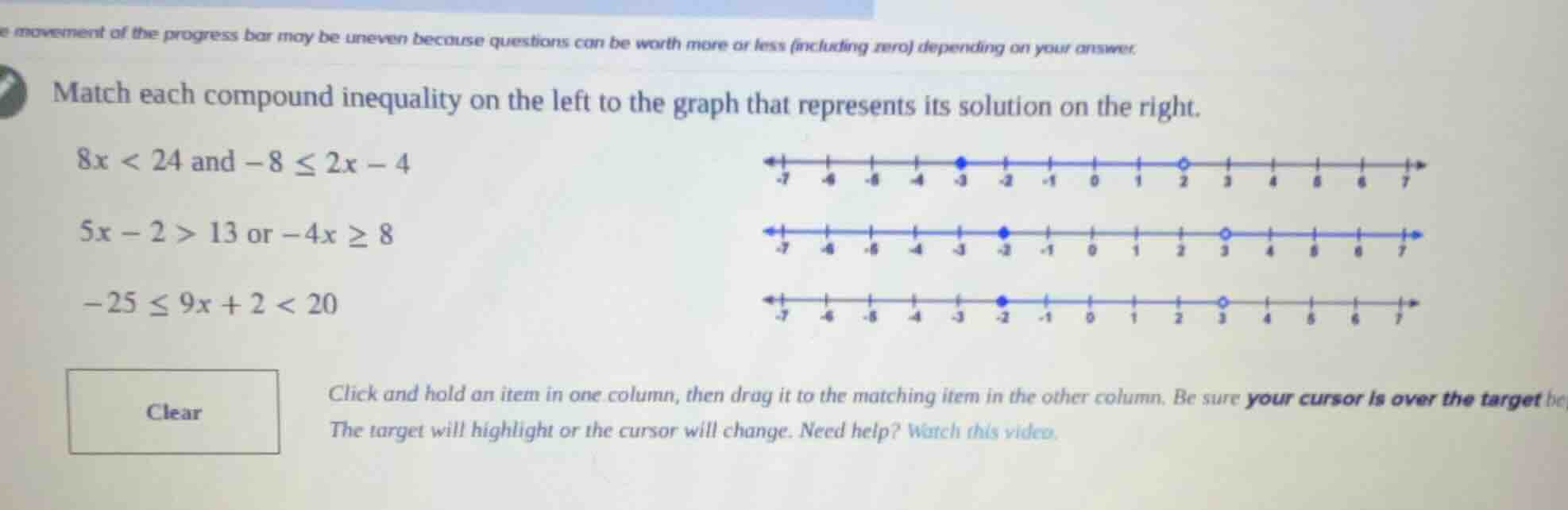
the movement of the progress bar may be uneven because questions can be worth more or less (including zero) depending on your answer. match each compound inequality on the left to the graph that represents its solution on the right. 8x < 24 and -8 ≤ 2x - 4; 5x - 2 > 13 or -4x ≥ 8; -25 ≤ 9x + 2 < 20. there are three number line graphs on the right. clear: click and hold an item in one column, then drag it to the matching item in the other column. be sure your cursor is over the target be the target will highlight or the cursor will change. need help? watch this video.
Step1: Solve \(8x < 24\) and \(-8 \leq 2x - 4\)
- Solve \(8x < 24\): Divide both sides by 8, \(x < 3\) (since \(8x\div8 < 24\div8\), so \(x < 3\)).
- Solve \(-8 \leq 2x - 4\): Add 4 to both sides, \(-4 \leq 2x\), then divide by 2, \(-2 \leq x\).
- Combine: \(-2 \leq x < 3\). The graph should have a closed dot at \(-2\) and open at \(3\).
Step2: Solve \(5x - 2 > 13\) or \(-4x \geq 8\)
- Solve \(5x - 2 > 13\): Add 2, \(5x > 15\), divide by 5, \(x > 3\).
- Solve \(-4x \geq 8\): Divide by \(-4\) (reverse inequality), \(x \leq -2\).
- Combine (or means union): \(x \leq -2\) or \(x > 3\). The graph has closed at \(-2\), open at \(3\), and lines in both directions.
Step3: Solve \(-25 \leq 9x + 2 < 20\)
- Subtract 2 from all parts: \(-27 \leq 9x < 18\).
- Divide by 9: \(-3 \leq x < 2\). The graph has closed dot at \(-3\) and open at \(2\).
Now match:
- \(8x < 24\) and \(-8 \leq 2x - 4\) (\(-2 \leq x < 3\)) matches the graph with closed at \(-2\), open at \(3\) (middle graph? Wait, looking at the graphs: first graph has closed at \(-3\)? Wait no, recheck. Wait the three graphs:
First graph: closed at \(-3\), open at \(2\)? Wait no, the first graph (top right) has closed at \(-3\)? Wait no, the x - axis: first graph (top) has closed at \(-3\), open at \(2\)? Wait no, let's re - express the solutions:
Wait for \(8x < 24\) and \(-8 \leq 2x - 4\): solution \(-2 \leq x < 3\). So closed at \(-2\), open at \(3\). Which graph has closed at \(-2\), open at \(3\)? The second graph (middle) has closed at \(-2\), open at \(3\)? Wait no, the three graphs:
First graph (top right): closed at \(-3\), open at \(2\)
Second graph (middle right): closed at \(-2\), open at \(3\)
Third graph (bottom right): closed at \(-3\), open at \(2\)? Wait no, maybe I misread the graphs. Wait the first compound inequality solution is \(-2 \leq x < 3\), so closed at \(-2\), open at \(3\). So the middle graph (with closed at \(-2\), open at \(3\)) matches \(8x < 24\) and \(-8 \leq 2x - 4\).
\(5x - 2 > 13\) or \(-4x \geq 8\) has solution \(x \leq -2\) or \(x > 3\), which should have closed at \(-2\), open at \(3\), and lines extending left from \(-2\) and right from \(3\). The third graph? Wait no, the second graph (middle) is \(-2 \leq x < 3\), the first graph (top) has closed at \(-3\), open at \(2\) (for \(-25 \leq 9x + 2 < 20\) solution \(-3 \leq x < 2\)), and the third graph (bottom) has closed at \(-2\), open at \(3\) but with the line going left from \(-2\) and right from \(3\) (for \(5x - 2 > 13\) or \(-4x \geq 8\)).
Wait let's re - assign:
- \(8x < 24\) and \(-8 \leq 2x - 4\): \(-2 \leq x < 3\) → middle graph (closed at \(-2\), open at \(3\))
- \(5x - 2 > 13\) or \(-4x \geq 8\): \(x \leq -2\) or \(x > 3\) → bottom graph (closed at \(-2\), open at \(3\), with lines left and right)
- \(-25 \leq 9x + 2 < 20\): \(-3 \leq x < 2\) → top graph (closed at \(-3\), open at \(2\))

Snap & solve any problem in the app
Get step-by-step solutions on Sovi AI
Photo-based solutions with guided steps
Explore more problems and detailed explanations
- \(8x < 24\) and \(-8 \leq 2x - 4\) matches the graph with closed circle at \(-2\) and open circle at \(3\) (middle graph in the right - hand column).
- \(5x - 2 > 13\) or \(-4x \geq 8\) matches the graph with closed circle at \(-2\), open circle at \(3\), and lines extending left from \(-2\) and right from \(3\) (bottom graph in the right - hand column).
- \(-25 \leq 9x + 2 < 20\) matches the graph with closed circle at \(-3\) and open circle at \(2\) (top graph in the right - hand column).