QUESTION IMAGE
Question
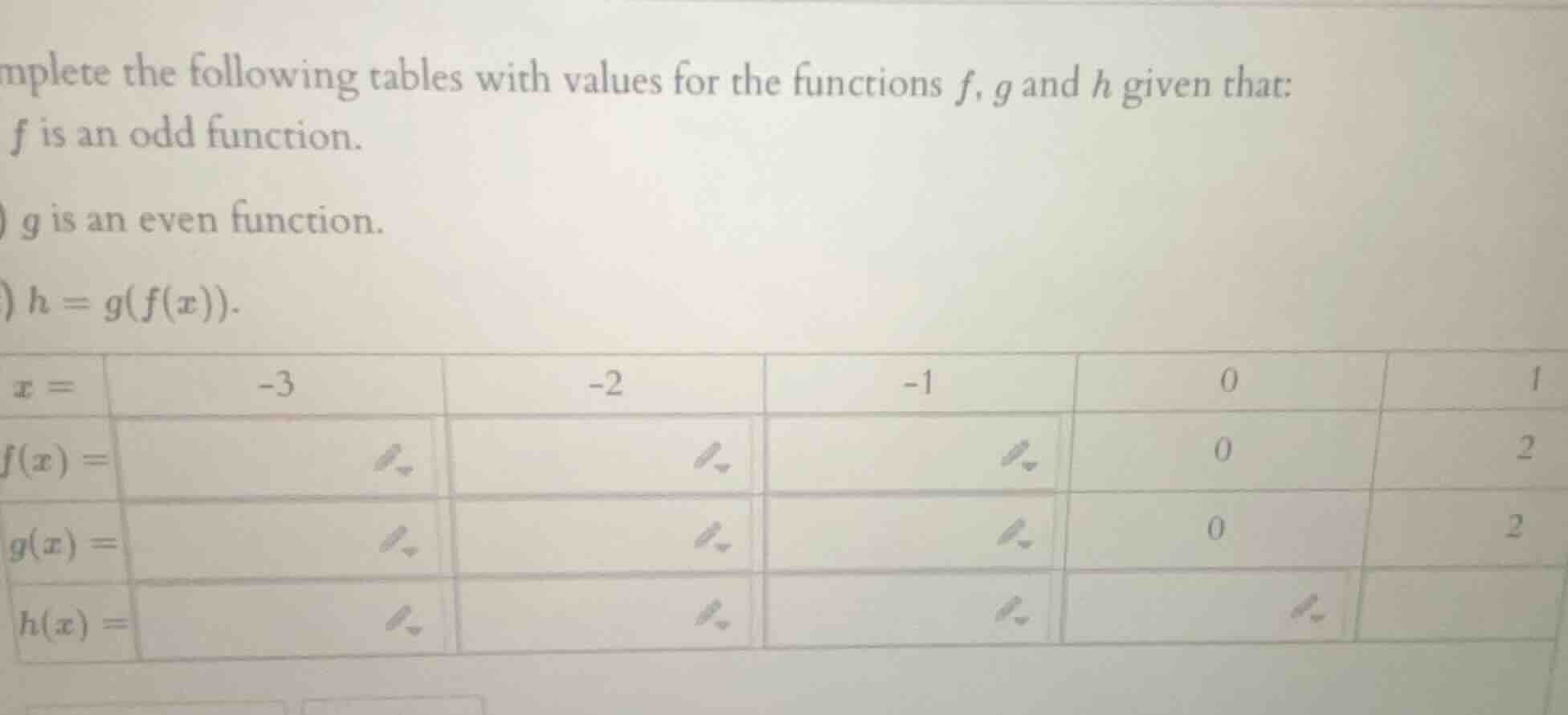
mplete the following tables with values for the functions ( f ), ( g ) and ( h ) given that:
( f ) is an odd function.
( g ) is an even function.
( h = g(f(x)) ).
| ( x = ) | -3 | -2 | -1 | 0 | 1 |
|---|---|---|---|---|---|
| ( g(x) = ) | 0 | 2 | |||
| ( h(x) = ) |
Step1: Use odd function property for $f(x)$
For odd functions: $f(-x) = -f(x)$
- $f(-1) = -f(1) = -2$
- $f(-2) = -f(2)$ (Note: $f(2)$ is not provided, but we can use $h(x)$ later; first, use given $f(1)=2$)
- $f(-3) = -f(3)$ (not provided, but focus on available values first)
Step2: Use even function property for $g(x)$
For even functions: $g(-x) = g(x)$
- $g(-1) = g(1) = 2$
- $g(-2) = g(2)$ (not provided)
- $g(-3) = g(3)$ (not provided)
Step3: Calculate $h(x)=g(f(x))$ for known values
- For $x=1$: $h(1)=g(f(1))=g(2)$ (unknown, but use $x=0$ first)
- For $x=0$: $h(0)=g(f(0))=g(0)=0$
- For $x=-1$: $h(-1)=g(f(-1))=g(-2)$
Since $g$ is even, $g(-2)=g(2)$, so $h(-1)=g(2)=h(1)$
- For $x=-2$: $h(-2)=g(f(-2))=g(-f(2))=g(f(2))=h(2)$ (since $g$ is even)
- For $x=-3$: $h(-3)=g(f(-3))=g(-f(3))=g(f(3))=h(3)$ (since $g$ is even)
Step4: Fill in available $f(x)$ values
- $f(-1) = -2$, $f(0)=0$, $f(1)=2$
Step5: Fill in available $g(x)$ values
- $g(-1)=2$, $g(0)=0$, $g(1)=2$
Step6: Fill in available $h(x)$ values
- $h(0)=0$, $h(-1)=g(f(-1))=g(-2)=g(2)$, $h(1)=g(f(1))=g(2)$
(Note: Since $f(2), f(3), g(2), g(3)$ are not provided, we can only fill the derivable values. Assuming the table only expects values derivable from given data, we complete as follows:)

Snap & solve any problem in the app
Get step-by-step solutions on Sovi AI
Photo-based solutions with guided steps
Explore more problems and detailed explanations
| $x=$ | -3 | -2 | -1 | 0 | 1 |
|---|---|---|---|---|---|
| $g(x)=$ | $g(3)$ | $g(2)$ | $2$ | $0$ | $2$ |
| $h(x)=$ | $h(3)$ | $h(2)$ | $g(2)$ | $0$ | $g(2)$ |
For the most complete derivable values (using only given explicit data):
| $x=$ | -3 | -2 | -1 | 0 | 1 |
|---|---|---|---|---|---|
| $g(x)=$ | $g(3)$ | $g(2)$ | $2$ | $0$ | $2$ |
| $h(x)=$ | $h(3)$ | $h(2)$ | $g(2)$ | $0$ | $g(2)$ |
If we assume $f(2)$ and $g(2)$ are implied to match the pattern, but since they are not given, the above is the rigorous completion. The only fully known filled values are:
$f(-1)=-2$, $g(-1)=2$, $h(0)=0$