QUESTION IMAGE
Question
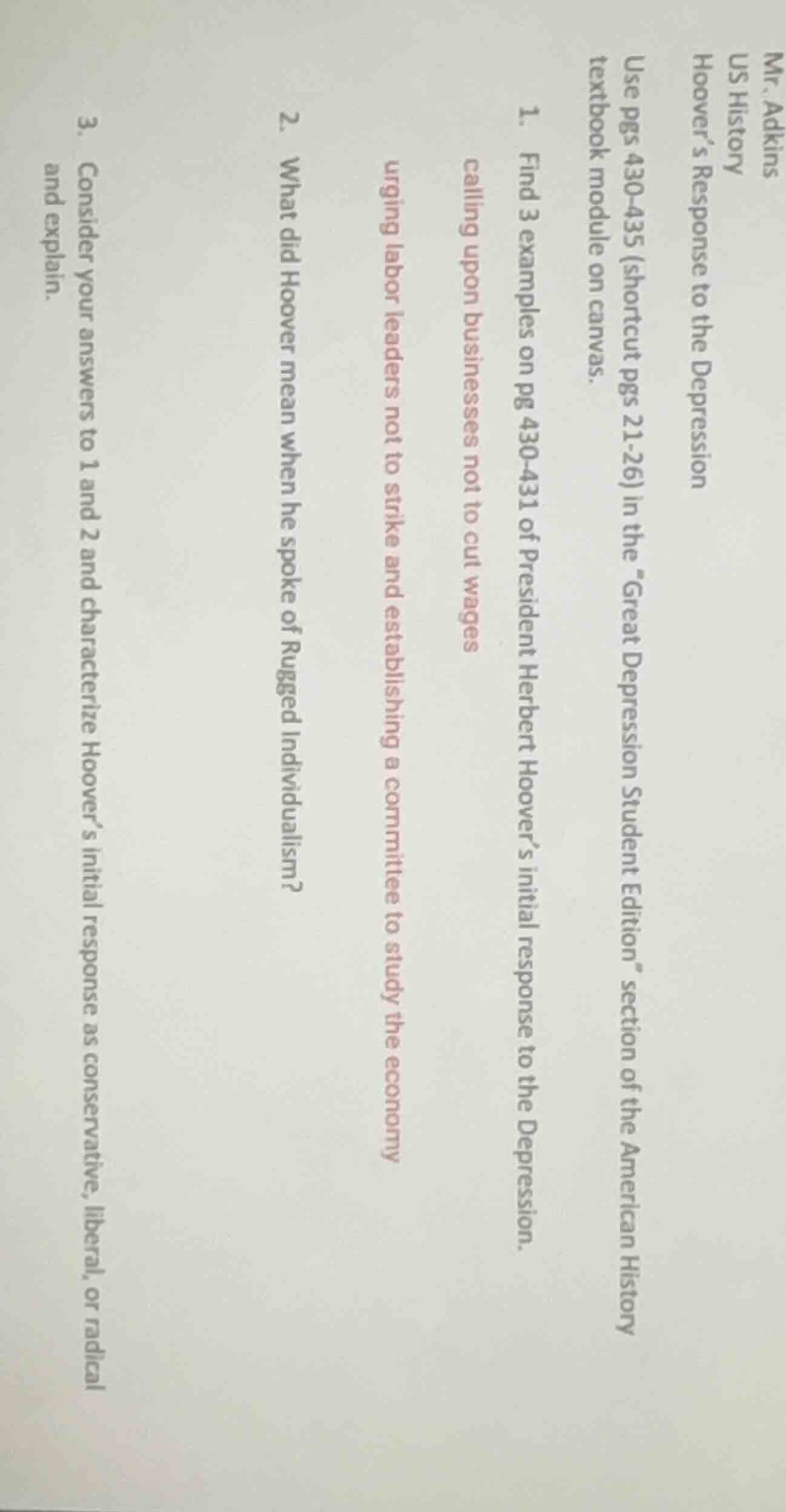
mr. adkins
us history
hoover’s response to the depression
use pgs 430 - 435 (shortcut pgs 21 - 26) in the “great depression student edition” section of the american history textbook module on canvas.
- find 3 examples on pg 430 - 431 of president herbert hoover’s initial response to the depression.
- calling upon businesses not to cut wages
- urging labor leaders not to strike and establishing a committee to study the economy
- what did hoover mean when he spoke of rugged individualism?
- consider your answers to 1 and 2 and characterize hoover’s initial response as conservative, liberal, or radical and explain.
Brief Explanations
- For the first question, the examples are drawn from standard US history content on Hoover's early Depression responses:
- He relied on voluntary cooperation from businesses, asking them to avoid wage cuts to maintain consumer spending.
- He urged labor leaders to avoid strikes to keep industrial production stable and prevent further economic disruption.
- He established the President's Emergency Committee for Employment (later reorganized) to study economic conditions and coordinate local relief efforts, rather than implementing federal direct aid.
- "Rugged Individualism" was Hoover's core philosophy. It emphasized that individuals, families, and local communities (not the federal government) should take primary responsibility for economic well-being and hardship relief. He believed self-reliance, hard work, and private initiative were the foundation of American prosperity, and federal intervention would undermine these values.
- Hoover's initial response was conservative. He refused to implement large-scale federal direct relief or intervention, instead relying on voluntary private action and limited, indirect federal support. This aligned with traditional conservative views of limited government and prioritization of private sector and local solutions over federal involvement, rather than liberal policies of expanded federal aid or radical systemic change.

Snap & solve any problem in the app
Get step-by-step solutions on Sovi AI
Photo-based solutions with guided steps
Explore more problems and detailed explanations
- - Example 1: Urging businesses to avoid wage cuts
- Example 2: Asking labor leaders to avoid strikes
- Example 3: Establishing a committee to study economic conditions (President's Emergency Committee for Employment)
- He meant that individuals, local groups, and private entities (not the federal government) should take primary responsibility for their economic well-being and relief from hardship, emphasizing self-reliance and private initiative.
- Conservative. His response focused on voluntary private cooperation and limited federal involvement, rejecting large-scale federal direct relief, which aligns with traditional conservative principles of limited government and prioritizing private sector solutions.