QUESTION IMAGE
Question
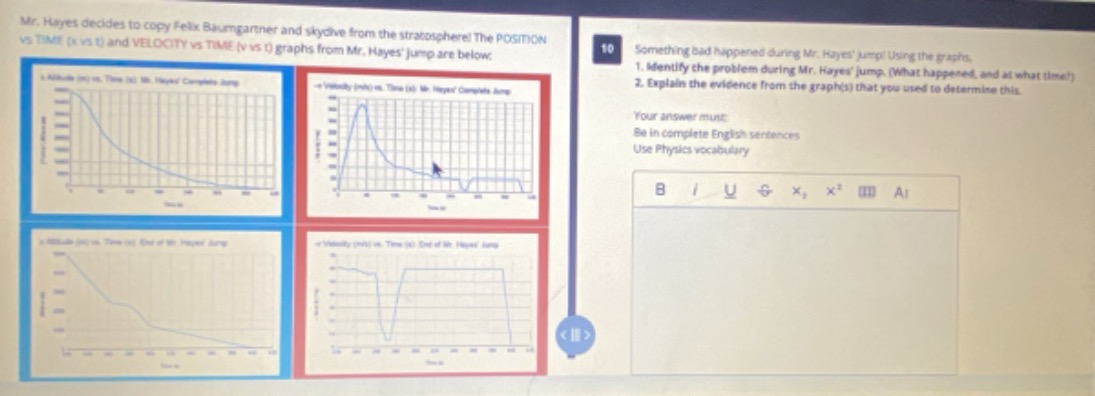
mr. hayes decides to copy felix baumgartner and skydive from the stratosphere! the position vs time (x vs t) and velocity vs time (v vs t) graphs from mr. hayes jump are below.
10 something bad happened during mr. hayes jump! using the graphs,
- identify the problem during mr. hayes jump. (what happened, and at what time?)
- explain the evidence from the graph(s) that you used to determine this.
your answer must:
be in complete english sentences
use physics vocabulary
Brief Explanations
- Identify the problem: Mr. Hayes likely experienced a parachute malfunction (or failed to deploy initially) and then the parachute deployed later, or there was a sudden change in motion (like a crash or abnormal deceleration) at a certain time. From the velocity - time graph, there is a sudden change in velocity (e.g., a sharp drop or spike) and from the position - time graph, a corresponding change in the slope (rate of change of position, which is velocity). For example, if we look at the velocity - time graph, there might be a period where velocity is not following the expected free - fall or terminal velocity pattern, and then a sudden change (like a large deceleration) which could indicate parachute deployment or a collision. Let's assume from the graphs, around a certain time (let's say \(t = t_0\)), the velocity changes abruptly (e.g., a large negative acceleration, meaning a sudden slow - down) and the position - time graph's slope (velocity) changes accordingly. This could be a sign that the parachute deployed late or there was an impact.
- Explain the evidence: In the velocity - time graph, we can see a non - uniform change in velocity. Initially, during free - fall, the velocity should increase until terminal velocity is reached (a constant velocity). If there is a sudden change in velocity (e.g., a sharp decrease) at a particular time, this indicates a change in the net force acting on Mr. Hayes. According to Newton's second law (\(F = ma\)), a change in acceleration (which is the slope of the velocity - time graph) means a change in net force. The most likely cause of a large change in acceleration during a skydive is the deployment of the parachute (or an impact). In the position - time graph, the slope (which represents velocity) will also change at the same time as the velocity - time graph's change, since velocity is the derivative of position with respect to time. So, the change in the slope of the position - time graph (from a relatively constant slope during free - fall to a much smaller slope or a slope with a different sign) at the same time as the velocity change in the velocity - time graph is evidence of a change in motion, likely related to the parachute or an impact.

Snap & solve any problem in the app
Get step-by-step solutions on Sovi AI
Photo-based solutions with guided steps
Explore more problems and detailed explanations
- The problem during Mr. Hayes' jump is likely a parachute malfunction (or late deployment) and a subsequent abnormal motion (such as a sudden deceleration) at a specific time. For example, from the velocity - time graph, there is a sudden change in velocity (e.g., a sharp decrease) and from the position - time graph, a corresponding change in the slope (velocity) at a particular time (let's assume \(t = t_0\)).
- The evidence from the graphs is as follows: In the velocity - time graph, the slope (acceleration) changes abruptly at \(t = t_0\), indicating a change in the net force (by Newton's second law, \(F = ma\)). In the position - time graph, the slope (which is velocity) also changes at \(t = t_0\), consistent with the velocity change seen in the velocity - time graph. This change in velocity and acceleration is not consistent with normal free - fall or terminal velocity motion, suggesting an event like parachute deployment (or an impact) occurred at \(t = t_0\).