QUESTION IMAGE
Question
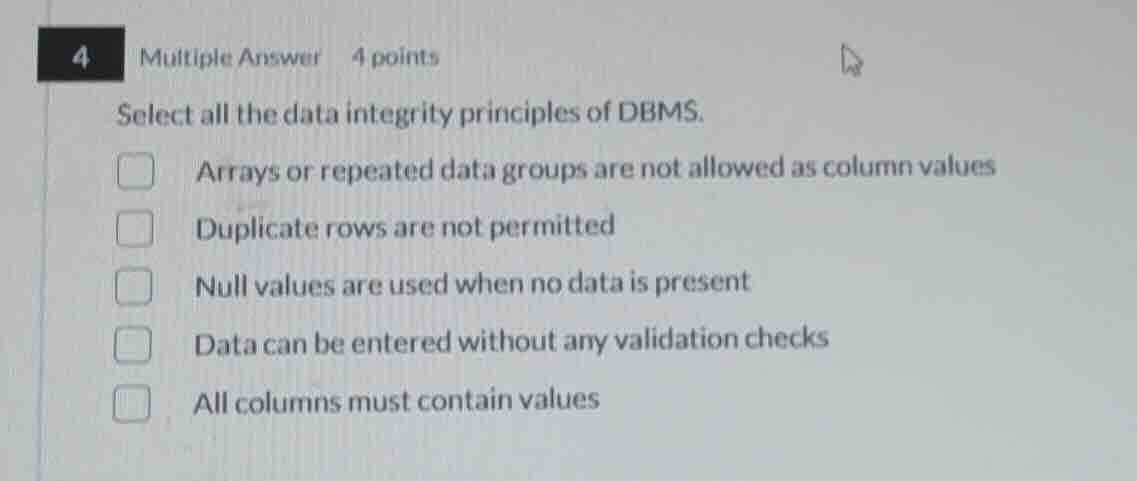
4 multiple answer 4 points select all the data integrity principles of dbms. arrays or repeated data groups are not allowed as column values duplicate rows are not permitted null values are used when no data is present data can be entered without any validation checks all columns must contain values
Brief Explanations
- For "Arrays or repeated data groups are not allowed as column values": In DBMS, column values follow certain data structure rules, and arrays/repeated data groups as column values violate data integrity (e.g., in a relational DB, each column has a specific data type and structure).
- For "Duplicate rows are not permitted": In a relational database, duplicate rows would lead to inconsistent and redundant data, so this is a data integrity principle (to maintain uniqueness and consistency).
- For "Null values are used when no data is present": Null values are a valid way to represent the absence of data in DBMS, which is part of data integrity (handling missing data appropriately instead of incorrect or arbitrary values).
- For "Data can be entered without any validation checks": This is incorrect. Data integrity requires validation checks (like type checks, range checks) to ensure data is correct, so this is not a data integrity principle.
- For "All columns must contain values": This is incorrect. Null values are allowed when data is absent, so not all columns must have non - null values.

Snap & solve any problem in the app
Get step-by-step solutions on Sovi AI
Photo-based solutions with guided steps
Explore more problems and detailed explanations
A. Arrays or repeated data groups are not allowed as column values
B. Duplicate rows are not permitted
C. Null values are used when no data is present