QUESTION IMAGE
Question
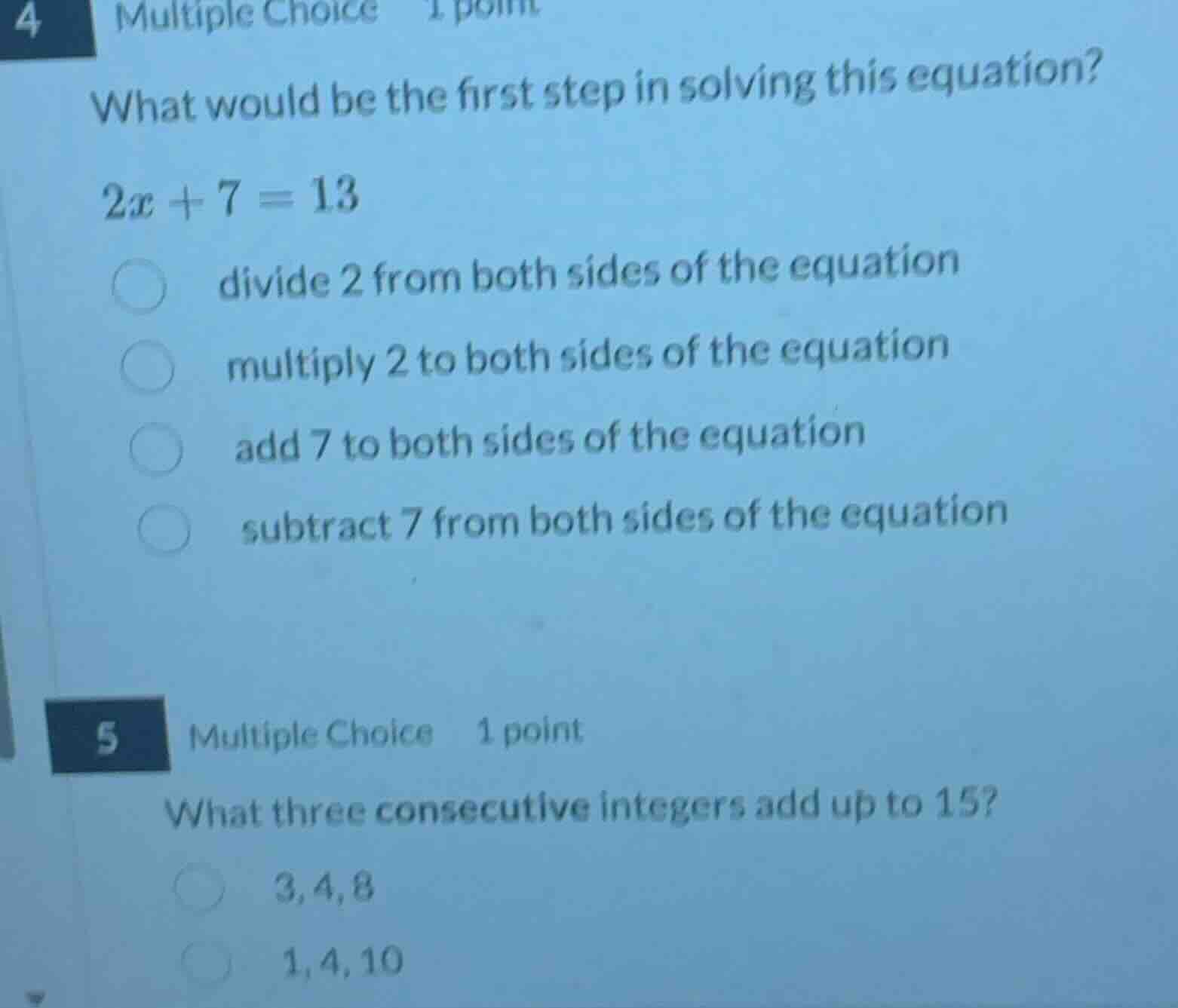
4 multiple choice 1 point
what would be the first step in solving this equation?
$2x + 7 = 13$
\bigcirc\\; divide 2 from both sides of the equation
\bigcirc\\; multiply 2 to both sides of the equation
\bigcirc\\; add 7 to both sides of the equation
\bigcirc\\; subtract 7 from both sides of the equation
5 multiple choice 1 point
what three consecutive integers add up to 15?
\bigcirc\\; 3,4,8
\bigcirc\\; 1,4,10
Step1: Analyze linear equation first step
To isolate $2x$, eliminate the constant term.
Step2: Verify first equation step
For $2x + 7 = 13$, subtract 7 from both sides: $2x + 7 - 7 = 13 - 7$, simplifying to $2x = 6$.
Step3: Define consecutive integers
Let first integer be $n$, next two are $n+1$, $n+2$.
Step4: Set up sum equation
$$n + (n+1) + (n+2) = 15$$
Step5: Simplify and solve for $n$
Combine like terms: $3n + 3 = 15$. Subtract 3: $3n = 12$. Divide by 3: $n=4$. The integers are 4, 5, 6 (note: the visible options for question 5 are incorrect, the correct set is 4, 5, 6).

Snap & solve any problem in the app
Get step-by-step solutions on Sovi AI
Photo-based solutions with guided steps
Explore more problems and detailed explanations
Question 4: subtract 7 from both sides of the equation
Question 5: 4, 5, 6 (the provided visible options are not valid consecutive integers that sum to 15)