QUESTION IMAGE
Question
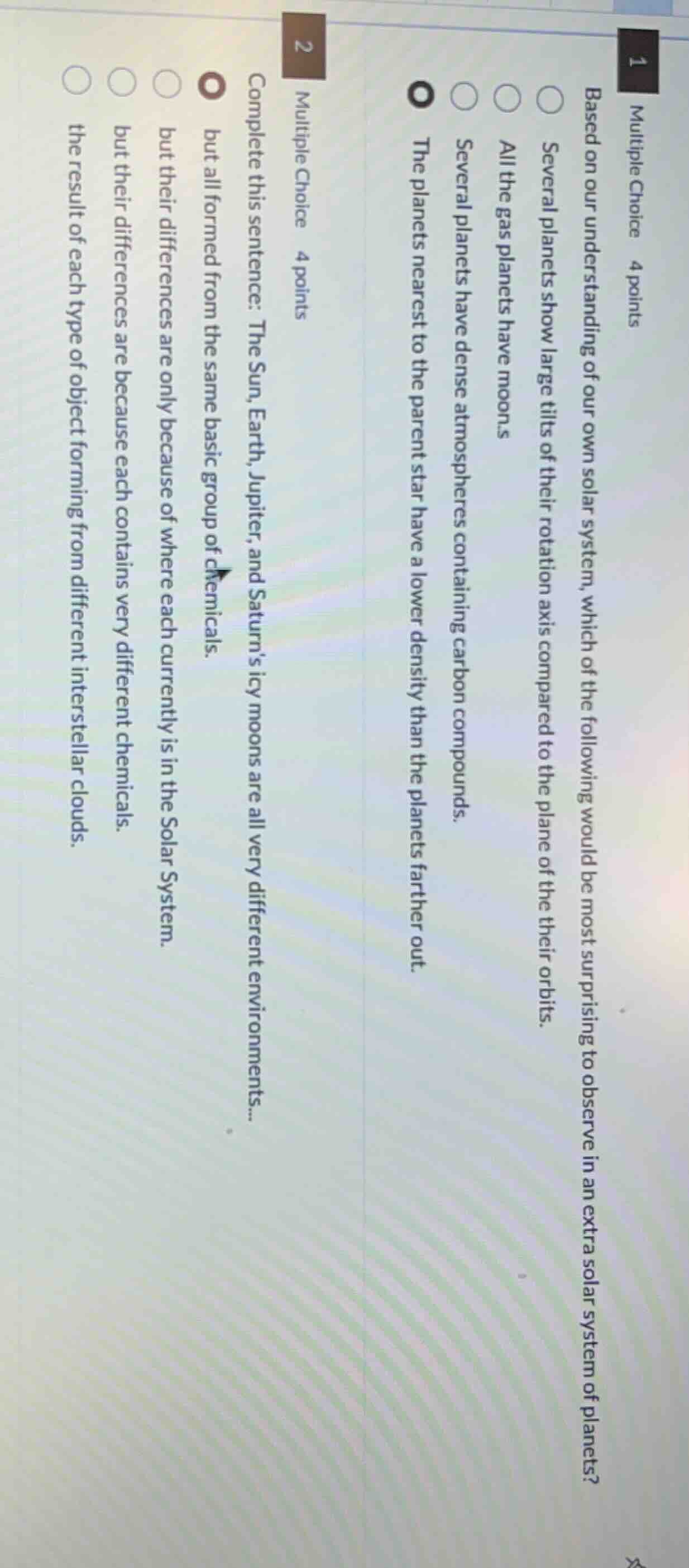
1 multiple choice 4 points based on our understanding of our own solar system, which of the following would be most surprising to observe in an extra solar system of planets? several planets show large tilts of their rotation axis compared to the plane of their orbits. all the gas planets have moons. several planets have dense atmospheres containing carbon compounds. the planets nearest to the parent star have a lower density than the planets farther out. 2 multiple choice 4 points complete this sentence: the sun, earth, jupiter, and saturn’s icy moons are all very different environments... but all formed from the same basic group of chemicals. but their differences are only because of where each currently is in the solar system. but their differences are because each contains very different chemicals. the result of each type of object forming from different interstellar clouds.
- For question 1: In our solar system, inner planets are rocky/high density, outer gas giants are low density. Finding the opposite (inner low density, outer high) would be highly surprising. The other options are consistent with or less unexpected than this reversal.
- For question 2: All solar system objects form from the same initial interstellar cloud with the same basic chemical composition; differences come from position/processing, not different starting chemicals.

Snap & solve any problem in the app
Get step-by-step solutions on Sovi AI
Photo-based solutions with guided steps
Explore more problems and detailed explanations
- The planets nearest to the parent star have a lower density than the planets farther out.
- but all formed from the same basic group of chemicals.