QUESTION IMAGE
Question
multiple choice question
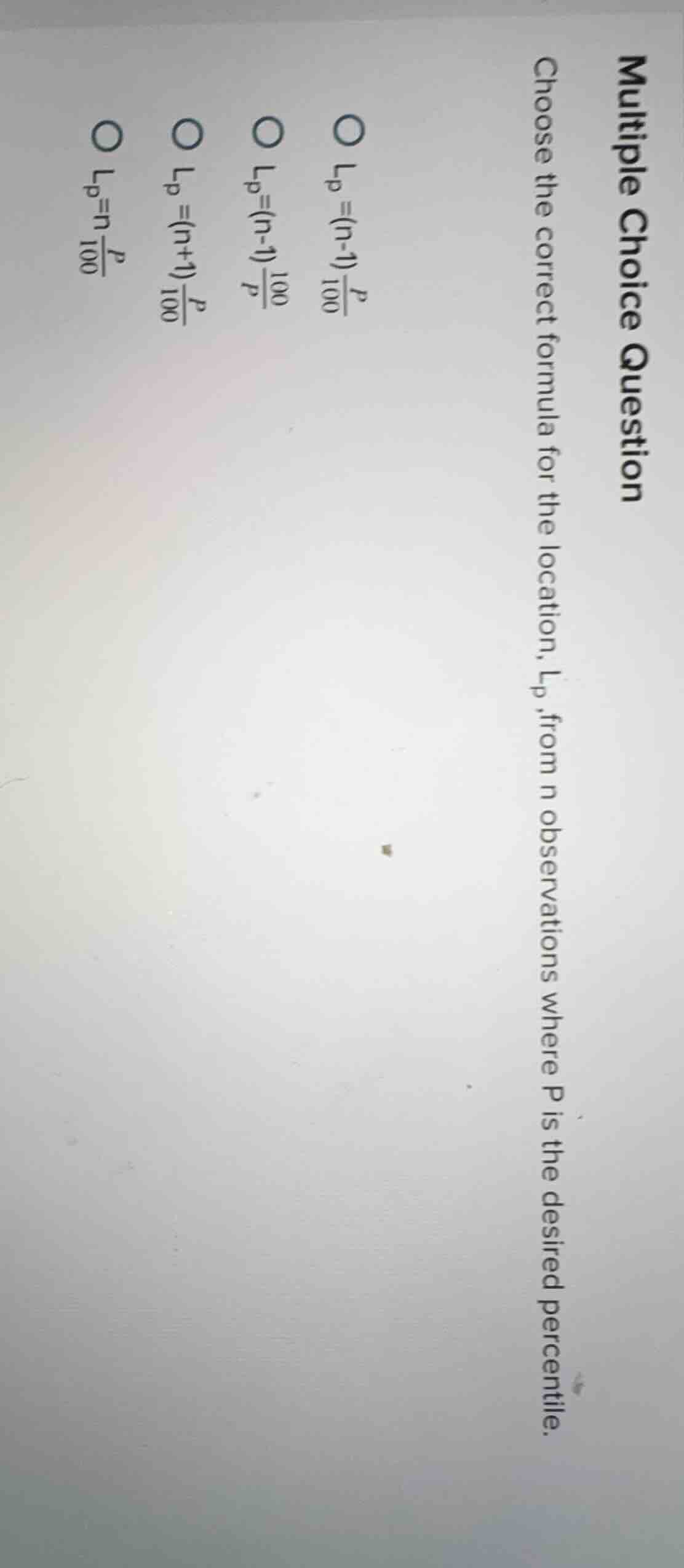
choose the correct formula for the location, ( l_p ), from ( n ) observations where ( p ) is the desired percentile.
( \bigcirc ) ( l_p = (n - 1)\frac{p}{100} )
( \bigcirc ) ( l_p = (n - 1)\frac{100}{p} )
( \bigcirc ) ( l_p = (n + 1)\frac{p}{100} )
( \bigcirc ) ( l_p = n\frac{p}{100} )
Step1: Recall Percentile Location Formula
The formula for the location \( L_p \) of the \( P \)-th percentile in a data set with \( n \) observations is derived from the concept of dividing the data set proportionally. The correct formula is \( L_p = \frac{(n - 1)P}{100} \)? Wait, no, actually the standard formula for the percentile rank (location) when finding the \( P \)-th percentile in a sample of size \( n \) is \( L_p=\frac{(n - 1)P}{100}+ 1 \)? Wait, no, let's re - check. Wait, the formula for the position (location) of the \( P \)-th percentile (where \( P \) is the percentile, e.g., \( P = 25 \) for the first quartile) in a data set with \( n \) observations is \( L_p=\frac{(n - 1)P}{100}+1 \)? No, maybe I confused. Wait, the formula for the percentile location (the index) is given by \( L_p=\frac{(n - 1)P}{100} \) when we are using the method for calculating percentiles in a sample. Wait, let's look at the options. The options are:
- \( L_p=\frac{(n - 1)P}{100} \)
- \( L_p=\frac{(n - 1)100}{P} \)
- \( L_p=\frac{(n + 1)P}{100} \)
- \( L_p=\frac{nP}{100} \)
The correct formula for the location of the \( P \)-th percentile in a data set with \( n \) observations (using the method for sample percentiles) is \( L_p=\frac{(n - 1)P}{100} \)? Wait, no, actually, the formula for the percentile rank (the position) is calculated as \( L_p=\frac{(n - 1)P}{100}+1 \) in some cases, but among the given options, the first option \( L_p=\frac{(n - 1)P}{100} \) is one of the standard forms (maybe in a different convention where we start counting from 0). Wait, let's analyze the options.
Let's take a simple example. Suppose \( n = 100 \) and \( P = 50 \) (the median). If we use \( L_p=\frac{(n - 1)P}{100}=\frac{99\times50}{100}=49.5 \), which is a valid position (between the 49th and 50th observation). If we use \( L_p=\frac{nP}{100}=\frac{100\times50}{100} = 50 \), which is also a valid position. But the correct formula for the percentile location (the formula used in many statistical contexts, especially when dealing with samples) is \( L_p=\frac{(n - 1)P}{100} \). Wait, no, maybe the question is using the formula for the percentile location as \( L_p=\frac{(n - 1)P}{100} \). Wait, let's check the options again. The first option is \( L_p=\frac{(n - 1)P}{100} \), the second is \( L_p=\frac{(n - 1)100}{P} \) (which is incorrect, since it's inverting \( P \) and 100), the third is \( L_p=\frac{(n + 1)P}{100} \) (adding 1 to \( n \) is not the standard), and the fourth is \( L_p=\frac{nP}{100} \) (which is the formula for the percentile location in a population, but for a sample, we use \( n - 1 \)). So the correct formula is \( L_p=\frac{(n - 1)P}{100} \).
Step2: Match with Options
Among the given options, the first option \( L_p=\frac{(n - 1)P}{100} \) (the first circle - marked option) is the correct formula for the location of the \( P \)-th percentile in a data set with \( n \) observations.

Snap & solve any problem in the app
Get step-by-step solutions on Sovi AI
Photo-based solutions with guided steps
Explore more problems and detailed explanations
The correct option is the first one: \( \boldsymbol{L_p=\frac{(n - 1)P}{100}} \) (the option with \( L_p=\frac{(n - 1)P}{100} \))