QUESTION IMAGE
Question
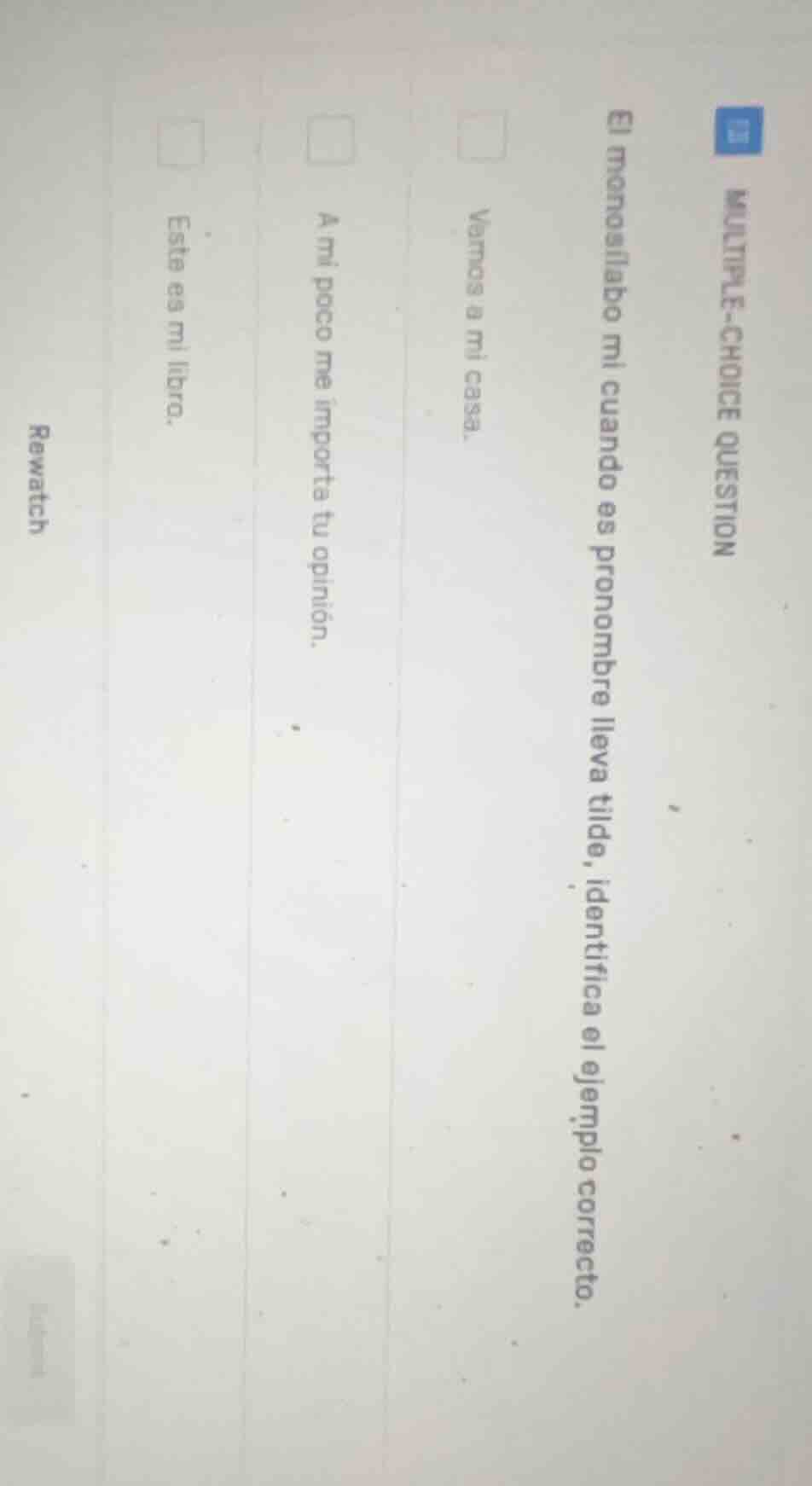
multiple-choice question el monosílabo mi cuando es pronombre lleva tilde, identifica el ejemplo correcto. vamos a mi casa. a mi poco me importa tu opinión. este es mi libro. rewatch
In Spanish, the monosyllabic pronoun "mí" (with accent) is used when it is the object of a preposition, while "mi" (without accent) is a possessive adjective.
- In "Vamos a mi casa", "mi" is a possessive adjective (modifying "casa"), so no accent is correct here.
- In "A mi poco me importa tu opinión", the pronoun after the preposition "a" should be accented "mí" to show it's the object, so this sentence is incorrect as written.
- In "Este es mi libro", "mi" is a possessive adjective (modifying "libro"), so no accent is correct here.
Wait, correction: The question states the monosyllabic pronoun takes an accent. The correct case is when "mí" is the object of a preposition. The only option that uses the accented pronoun correctly (if we fix the error, but the question asks which example is correct when the pronoun has a tilde): actually, the correct sentence where the pronoun needs an accent is when it's the object of a preposition. The sentence "A mí poco me importa tu opinión" should have the accented "mí", so this is the example where the monosyllabic pronoun requires a tilde. The other sentences use "mi" as a possessive adjective, which never takes an accent.

Snap & solve any problem in the app
Get step-by-step solutions on Sovi AI
Photo-based solutions with guided steps
Explore more problems and detailed explanations
B. A mi poco me importa tu opinión. (Note: The correct written form is "A mí poco me importa tu opinión", which is the only option where the monosyllabic pronoun needs an accent mark.)