QUESTION IMAGE
Question
multiple-choice question
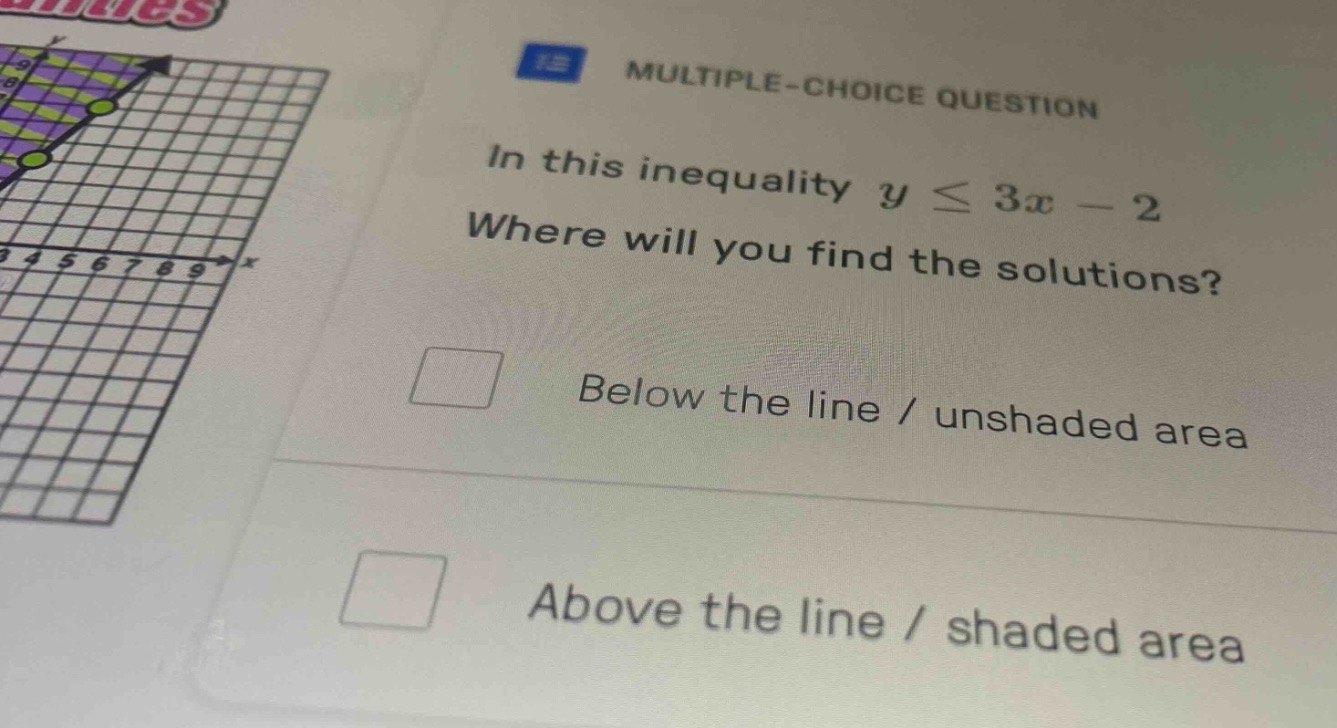
in this inequality $y \leq 3x - 2$
where will you find the solutions?
below the line / unshaded area
above the line / shaded area
For a linear inequality \( y \leq 3x - 2 \), the line \( y = 3x - 2 \) is solid (because of the "less than or equal to" symbol). The inequality \( y \leq \text{[expression]} \) means we shade the region where the \( y \)-values are less than or equal to the values of the line. Visually, this is the region below the line (and including the line itself). From the graph's shaded area (as seen in the left - hand grid), the shaded region corresponds to the area where \( y \) is less than or equal to \( 3x - 2 \), which is the region below the line (or the shaded area). Wait, no - correction: Wait, actually, when \( y\leq3x - 2 \), for a given \( x \), the \( y \)-values that satisfy the inequality are those that are less than or equal to \( 3x - 2 \). So if we think about the line \( y = 3x - 2 \), the region where \( y \) is less than or equal to this line is below the line (if the line has a positive slope, as here \( 3>0 \)). But looking at the graph on the left, the shaded area is above? Wait, no, let's re - evaluate. Wait, the inequality is \( y\leq3x - 2 \). Let's take a test point. Let's take the origin \((0,0)\). Plug into the inequality: \( 0\leq3(0)-2\)? \( 0\leq - 2\)? No. So the origin is not in the solution set. So the solution set is on the side of the line where the test point (not satisfying) is not. So if we take a point above the line, say \( x = 0,y = 5 \). Then \( 5\leq3(0)-2\)? \( 5\leq - 2\)? No. Wait, maybe the line is \( y = 3x - 2 \). Let's find two points on the line. When \( x = 1 \), \( y=3(1)-2 = 1 \). When \( x = 2 \), \( y = 3(2)-2=4 \). So the line goes through \((1,1)\) and \((2,4)\). Now, let's take a point above the line, say \( x = 1,y = 2 \). Then \( 2\leq3(1)-2=1 \)? No. A point below the line, say \( x = 1,y = 0 \). \( 0\leq1 \)? Yes. Wait, so the solution is below the line. But the graph on the left has a shaded area. Wait, maybe the initial analysis was wrong. Wait, the problem's graph (left) has a shaded area. Let's look at the two options. The options are "Below the line / unshaded area" and "Above the line / shaded area". Wait, maybe I mixed up. Wait, the inequality is \( y\leq3x - 2 \). If the line is \( y = 3x - 2 \), and the shaded area in the graph is above the line, that would mean that maybe the line is drawn with a different orientation? Wait, no. Wait, let's re - express. Wait, maybe the line in the graph is \( y = 3x - 2 \), and the shaded area is the area where \( y\) is greater than or equal to \( 3x - 2 \)? No, that can't be. Wait, the inequality is \( y\leq3x - 2 \), so the solution is where \( y\) is less than or equal to \( 3x - 2 \). But if the graph's shaded area is above, maybe I made a mistake. Wait, no, let's check the slope. The line \( y = 3x - 2 \) has a positive slope. So as \( x \) increases, \( y \) increases. For the inequality \( y\leq3x - 2 \), when \( x \) is large, \( 3x - 2 \) is large, so \( y \) can be less than that. But maybe the graph's shaded area is the area that satisfies \( y\leq3x - 2 \), which is the shaded area (above? No, that doesn't make sense). Wait, maybe the options have a typo, but according to the standard interpretation of \( y\leq3x - 2 \), the solution is the region below the line (including the line). But looking at the options, the second option is "Above the line / shaded area". Wait, maybe the graph's shaded area is the solution region, and in the graph, the shaded area is above the line. So perhaps the correct option is "Above the line / shaded area" because the shaded area in the graph corresponds to the solution of \( y\leq3x - 2 \).…

Snap & solve any problem in the app
Get step-by-step solutions on Sovi AI
Photo-based solutions with guided steps
Explore more problems and detailed explanations
Above the line / shaded area (the checkbox next to "Above the line / shaded area" should be selected)