QUESTION IMAGE
Question
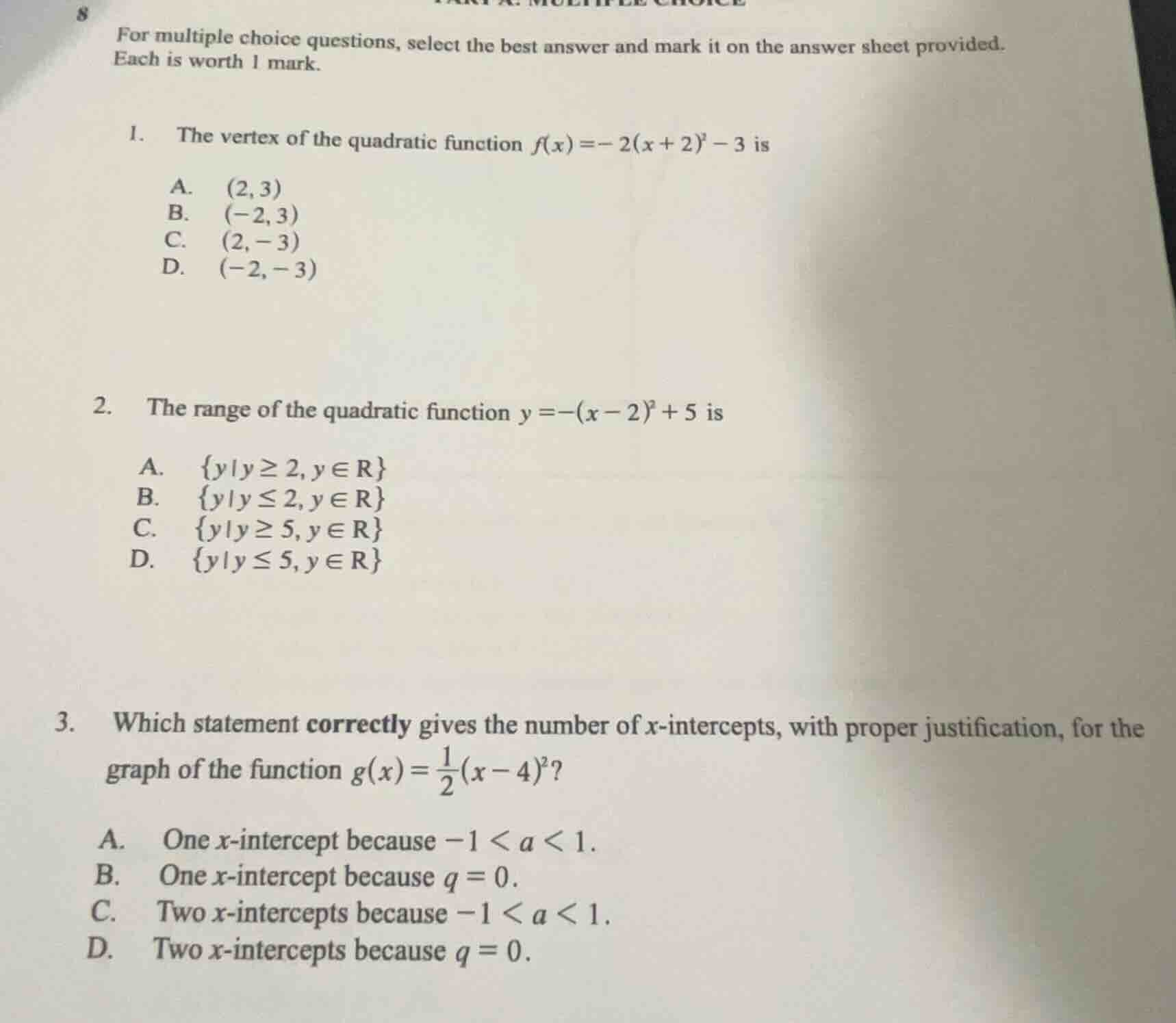
for multiple choice questions, select the best answer and mark it on the answer sheet provided. each is worth 1 mark.
- the vertex of the quadratic function $f(x) = -2(x + 2)^2 - 3$ is
a. $(2, 3)$
b. $(-2, 3)$
c. $(2, -3)$
d. $(-2, -3)$
- the range of the quadratic function $y = -(x - 2)^2 + 5$ is
a. ${y | y \geq 2, y \in \mathbb{r}}$
b. ${y | y \leq 2, y \in \mathbb{r}}$
c. ${y | y \geq 5, y \in \mathbb{r}}$
d. ${y | y \leq 5, y \in \mathbb{r}}$
- which statement correctly gives the number of $x$-intercepts, with proper justification, for the graph of the function $g(x) = \frac{1}{2}(x - 4)^2$?
a. one $x$-intercept because $-1 < a < 1$.
b. one $x$-intercept because $q = 0$.
c. two $x$-intercepts because $-1 < a < 1$.
d. two $x$-intercepts because $q = 0$.
Question 1
Step1: Recall vertex form of quadratic function
The vertex form of a quadratic function is \( f(x) = a(x - h)^2 + k \), where \((h, k)\) is the vertex.
Step2: Identify \(h\) and \(k\) from given function
Given \( f(x) = -2(x + 2)^2 - 3 \), we can rewrite \( (x + 2) \) as \( (x - (-2)) \). So comparing with \( a(x - h)^2 + k \), we have \( h = -2 \) and \( k = -3 \).
Step1: Recall properties of vertex form for range
For a quadratic function in the form \( y = a(x - h)^2 + k \), if \( a < 0 \), the parabola opens downward, and the maximum value of \( y \) is \( k \).
Step2: Analyze given function
Given \( y = -(x - 2)^2 + 5 \), here \( a = -1 < 0 \), so the parabola opens downward, and the maximum value of \( y \) is \( 5 \). Thus, the range is all real numbers \( y \) such that \( y \leq 5 \).
Step1: Recall x - intercepts of quadratic function
To find the x - intercepts, we set \( g(x)=0 \). For the function \( g(x)=\frac{1}{2}(x - 4)^2 \), set \( \frac{1}{2}(x - 4)^2=0 \).
Step2: Solve for x
Multiply both sides by 2: \( (x - 4)^2 = 0 \). Taking square roots, we get \( x - 4 = 0 \), so \( x = 4 \). This is a repeated root, meaning there is one x - intercept. The general form of a quadratic function can also be thought of in terms of the discriminant or the vertex form. In the vertex form \( y=a(x - h)^2+k \), the x - intercepts occur when \( y = 0 \), i.e., \( a(x - h)^2+k=0 \), or \( (x - h)^2=-\frac{k}{a} \). In our case, \( k = 0 \) (since \( g(x)=\frac{1}{2}(x - 4)^2+0 \)), so \( (x - 4)^2=0 \), which gives one solution (a repeated root). The justification "because \( q = 0 \)" (assuming \( q\) is related to the constant term or the value of \( k\) in the vertex form context) is correct for having one x - intercept.

Snap & solve any problem in the app
Get step-by-step solutions on Sovi AI
Photo-based solutions with guided steps
Explore more problems and detailed explanations
D. \((-2, -3)\)