QUESTION IMAGE
Question
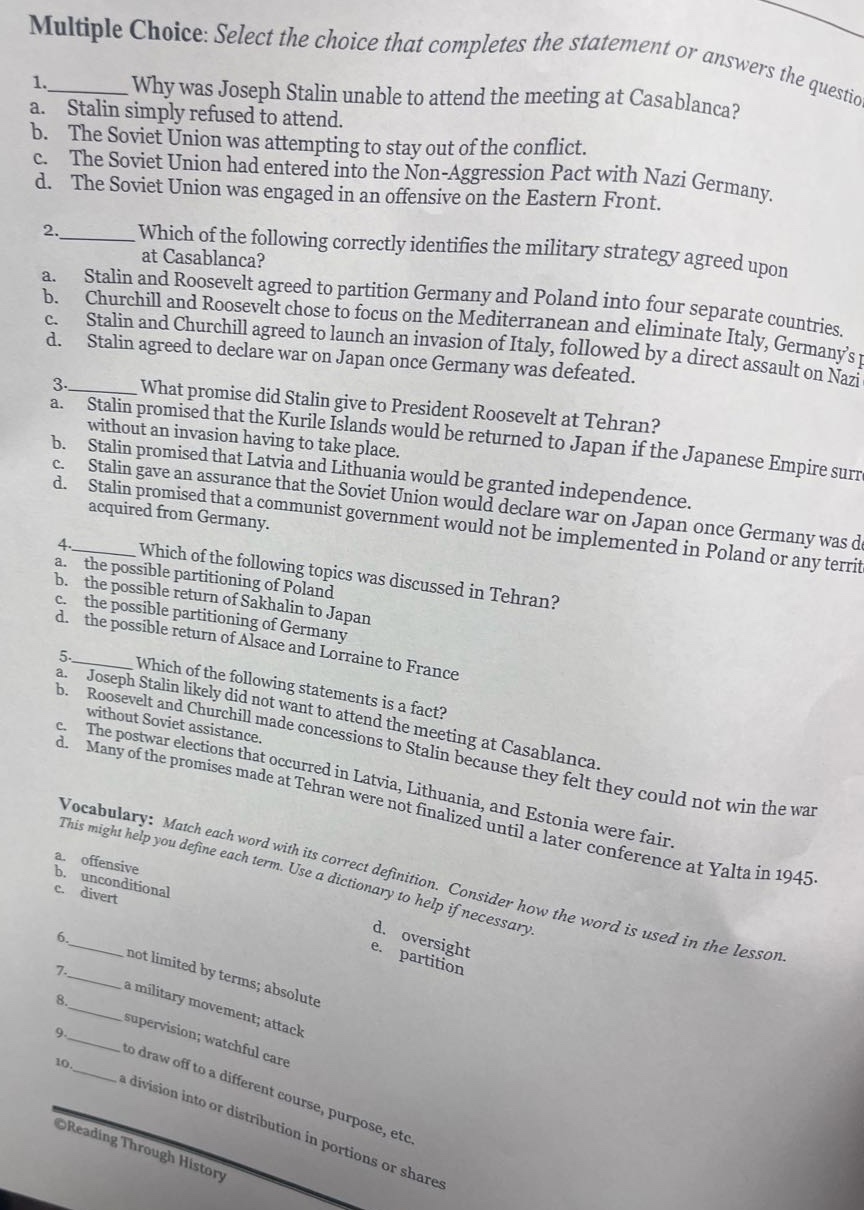
multiple choice: select the choice that completes the statement or answers the questio
- ______ why was joseph stalin unable to attend the meeting at casablanca?
a. stalin simply refused to attend.
b. the soviet union was attempting to stay out of the conflict.
c. the soviet union had entered into the non - aggression pact with nazi germany.
d. the soviet union was engaged in an offensive on the eastern front.
- ______ which of the following correctly identifies the military strategy agreed upon at casablanca?
a. stalin and roosevelt agreed to partition germany and poland into four separate countries.
b. churchill and roosevelt chose to focus on the mediterranean and eliminate italy, germanys
c. stalin and churchill agreed to launch an invasion of italy, followed by a direct assault on nazi
d. stalin agreed to declare war on japan once germany was defeated.
- ______ what promise did stalin give to president roosevelt at tehran?
a. stalin promised that the kurile islands would be returned to japan if the japanese empire surr without an invasion having to take place.
b. stalin promised that latvia and lithuania would be granted independence.
c. stalin gave an assurance that the soviet union would declare war on japan once germany was d
d. stalin promised that a communist government would not be implemented in poland or any territ acquired from germany.
- ______ which of the following topics was discussed in tehran?
a. the possible partitioning of poland
b. the possible return of sakhalin to japan
c. the possible partitioning of germany
d. the possible return of alsace and lorraine to france
- ______ which of the following statements is a fact?
a. joseph stalin likely did not want to attend the meeting at casablanca.
b. roosevelt and churchill made concessions to stalin because they felt they could not win the war without soviet assistance.
c. the postwar elections that occurred in latvia, lithuania, and estonia were fair.
d. many of the promises made at tehran were not finalized until a later conference at yalta in 1945.
vocabulary: match each word with its correct definition. consider how the word is used in the lesson. this might help you define each term. use a dictionary to help if necessary.
a. offensive
b. unconditional
c. divert
d. oversight
e. partition
- ______ not limited by terms; absolute
- ______ a military movement; attack
- ______ supervision; watchful care
- ______ to draw off to a different course, purpose, etc.
- ______ a division into or distribution in portions or shares
Question 1
To determine why Stalin couldn't attend Casablanca, we analyze the options. The Casablanca Conference was in 1943. The Soviet Union was fighting the Eastern Front (against Nazi Germany) at that time, so Stalin was engaged in that offensive. Option a is incorrect as refusal isn't the reason. Option b is wrong because the Soviet Union was actively in the war. Option c: the Non - Aggression Pact was broken in 1941, so this isn't relevant. So the correct answer is d.
For the Casablanca military strategy, we recall the conference. Churchill and Roosevelt focused on the Mediterranean, aiming to eliminate Italy (Germany's ally) as part of the strategy. Option a: partitioning Germany and Poland into four was at Potsdam/Yalta - related, not Casablanca. Option c: Stalin wasn't at Casablanca, so this is wrong. Option d: Stalin declaring war on Japan after Germany's defeat was at Tehran, not Casablanca. So the correct answer is b.
At the Tehran Conference, Stalin promised to declare war on Japan once Germany was defeated. Option a: returning Kurile Islands to Japan is incorrect. Option b: Latvia and Lithuania's independence promise isn't related to Tehran. Option d: the communist government in Poland assurance isn't the main promise at Tehran. So the correct answer is c.

Snap & solve any problem in the app
Get step-by-step solutions on Sovi AI
Photo-based solutions with guided steps
Explore more problems and detailed explanations
d. The Soviet Union was engaged in an offensive on the Eastern Front.