QUESTION IMAGE
Question
multiple select question
select all that apply
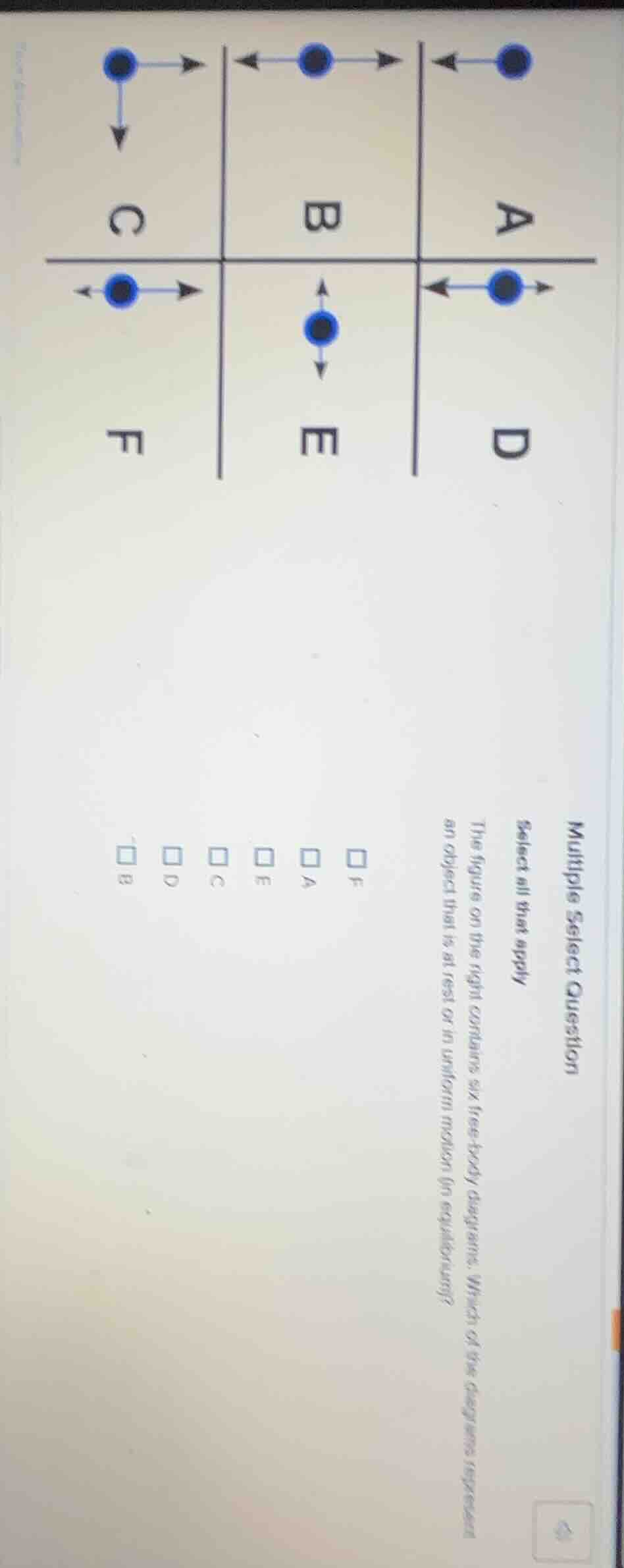
the figure on the right contains six free-body diagrams. which of the diagrams represent an object that is at rest or in uniform motion (in equilibrium)?
□ f
□ a
□ e
□ c
□ d
□ b
Step1: Define equilibrium condition
An object is in equilibrium (at rest or uniform motion) when the net force acting on it is zero, meaning forces in each direction cancel out.
Step2: Analyze Diagram A
Leftward force, no opposing rightward force; net force ≠ 0. Not in equilibrium.
Step3: Analyze Diagram B
Equal leftward and rightward forces; net horizontal force = 0. No vertical forces. Net force = 0. In equilibrium.
Step4: Analyze Diagram C
Rightward and downward forces, no opposing forces; net force ≠ 0. Not in equilibrium.
Step5: Analyze Diagram D
Equal leftward and rightward forces; net horizontal force = 0. No vertical forces. Net force = 0. In equilibrium.
Step6: Analyze Diagram E
Upward and downward forces, no opposing horizontal forces; net vertical force = 0, but this is balanced vertical force, net force = 0. In equilibrium.
Step7: Analyze Diagram F
Equal leftward and rightward forces; net horizontal force = 0. No vertical forces. Net force = 0. In equilibrium.

Snap & solve any problem in the app
Get step-by-step solutions on Sovi AI
Photo-based solutions with guided steps
Explore more problems and detailed explanations
B. Diagram B, D. Diagram D, E. Diagram E, F. Diagram F