QUESTION IMAGE
Question
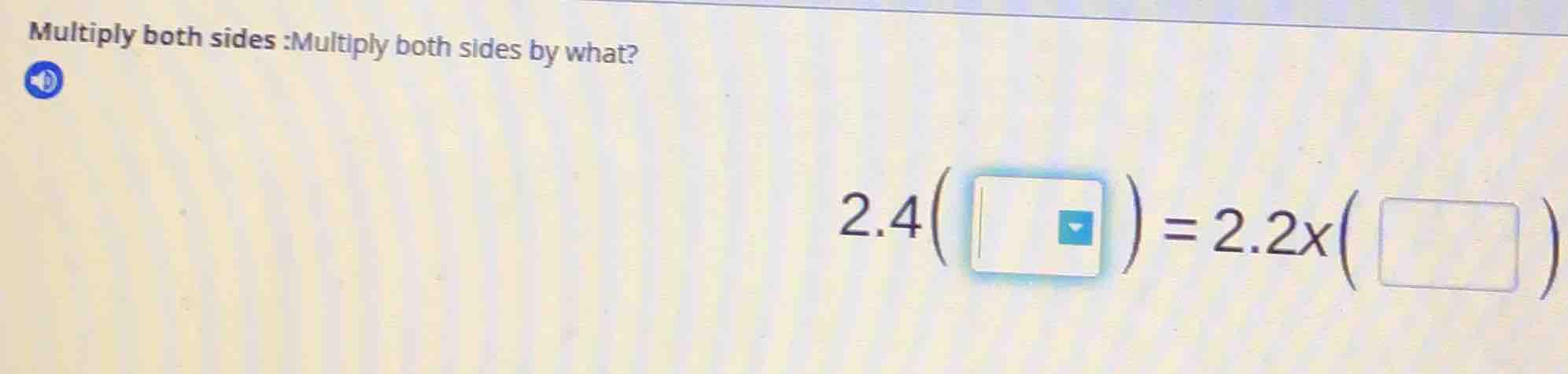
multiply both sides :multiply both sides by what?
2.4\big(\\ \big)=2.2x\big(\\ \big)
Step1: Identify the goal
We want to eliminate the decimals or make the coefficients easier to work with. To do this, we can multiply both sides by a number that will clear the decimals. The decimals are 2.4 and 2.2, which have one decimal place, so multiplying by 10 (or a common multiple) will work. But also, to solve for \(x\), we can multiply both sides by the reciprocal or a number to isolate \(x\). Alternatively, to make the equation have integer coefficients, we can multiply both sides by 10, but also, if we want to solve for \(x\), we can multiply both sides by the same number to get rid of the coefficients. Wait, actually, the equation here is probably part of a larger problem, like solving \(2.4 = 2.2x\) (assuming the original equation was \(2.4 = 2.2x\)). So to solve for \(x\), we multiply both sides by the reciprocal of 2.2, but maybe the problem is to clear decimals. Wait, the given equation is \(2.4(\square)=2.2x(\square)\). So we need to multiply both sides by a number so that we can solve for \(x\). Let's assume the original equation is \(2.4 = 2.2x\). To solve for \(x\), we multiply both sides by \(\frac{1}{2.2}\) or multiply both sides by 10 to eliminate decimals. Let's check: if we multiply both sides by 10, we get \(2.4\times10 = 2.2x\times10\), which is \(24 = 22x\). But maybe the problem is to multiply both sides by the same number to isolate \(x\). Wait, the blanks are in the parentheses. So we need to find a number to multiply both sides by. Let's see, the left side has 2.4 and the right side has 2.2x. To solve for \(x\), we can multiply both sides by \(\frac{1}{2.2}\) or multiply both sides by a number to make the coefficients integers. Alternatively, if we multiply both sides by 10, we get \(2.4\times10 = 2.2x\times10\), so \(24 = 22x\). But maybe the intended number is 10, or maybe the reciprocal. Wait, let's think again. The equation is \(2.4(\square)=2.2x(\square)\). So we need to put the same number in both squares. Let's say we want to solve \(2.4 = 2.2x\). Then, to isolate \(x\), we multiply both sides by \(\frac{1}{2.2}\), but that would be \(2.4\times\frac{1}{2.2}=2.2x\times\frac{1}{2.2}\), so \(x=\frac{2.4}{2.2}\). But maybe the problem is to clear decimals, so multiply both sides by 10. So \(2.4\times10 = 2.2x\times10\), so the number is 10. Alternatively, if we want to make the coefficients integers, 10 is a good choice because 2.4 and 2.2 have one decimal place. So the number to multiply both sides by is 10.
Step2: Verify
If we multiply both sides by 10, we get \(2.4\times10 = 2.2x\times10\), which simplifies to \(24 = 22x\), which is easier to solve. So the number to put in both squares is 10.

Snap & solve any problem in the app
Get step-by-step solutions on Sovi AI
Photo-based solutions with guided steps
Explore more problems and detailed explanations
The number to multiply both sides by is 10, so the blanks should be filled with 10. So \(2.4(10)=2.2x(10)\)