QUESTION IMAGE
Question
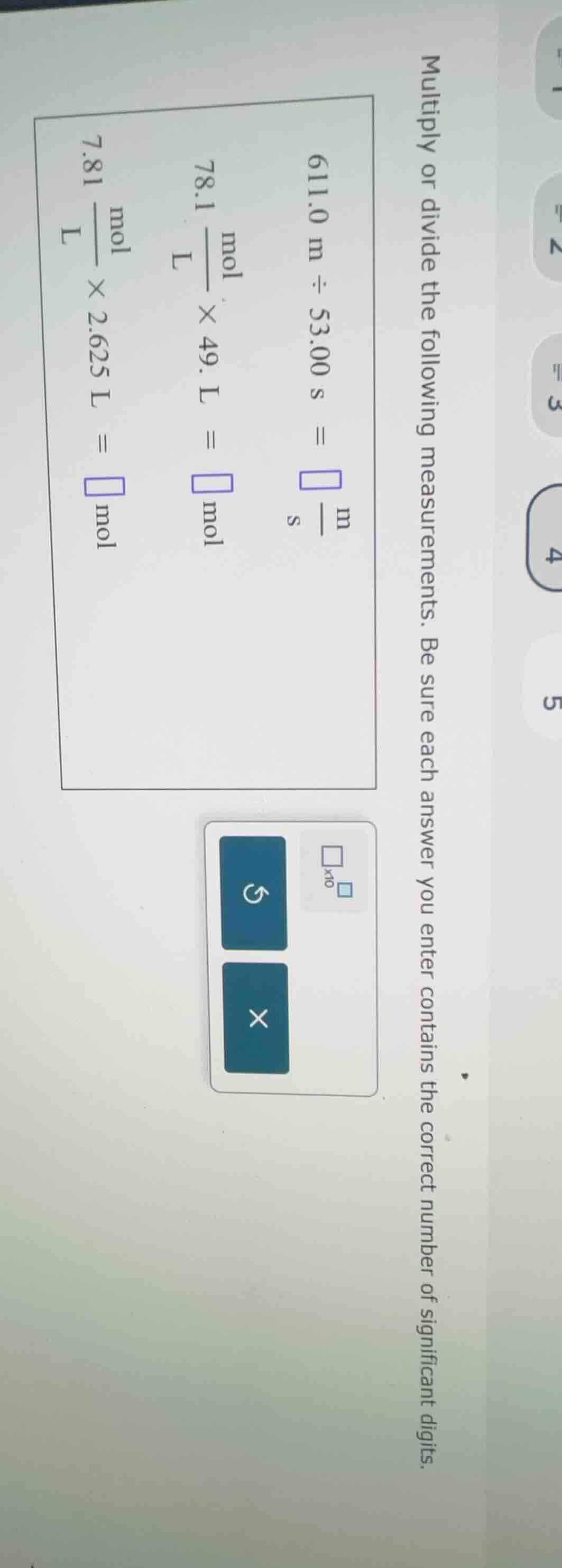
multiply or divide the following measurements. be sure each answer you enter contains the correct number of significant digits.
611.0 m ÷ 53.00 s = \\(\frac{\square}{\square}\\) \\(\frac{\text{m}}{\text{s}}\\)
78.1 \\(\frac{\text{mol}}{\text{l}}\\) × 49. l = \\(\square\\) mol
7.81 \\(\frac{\text{mol}}{\text{l}}\\) × 2.625 l = \\(\square\\) mol
First Calculation: \( 611.0 \, \text{m} \div 53.00 \, \text{s} \)
Step1: Perform the division
\( 611.0 \div 53.00 = \frac{611.0}{53.00} \approx 11.5283 \)
Step2: Determine significant figures
\( 611.0 \) has 4 significant figures, \( 53.00 \) has 4 significant figures. The result should have 4 significant figures? Wait, no: when dividing, the result should have the same number of significant figures as the least precise measurement. Wait, \( 611.0 \) is 4 sig figs, \( 53.00 \) is 4 sig figs. Wait, but \( 611.0 \div 53.00 = 11.5283 \). Wait, maybe I made a mistake. Wait, \( 611.0 \) is 4 sig figs (the trailing zero after decimal is significant), \( 53.00 \) is 4 sig figs (trailing zeros after decimal are significant). So the result should have 4 sig figs? Wait, no, let's check the values: \( 611.0 \) is 4 sig figs, \( 53.00 \) is 4 sig figs. So the division: \( 611.0 / 53.00 = 11.5283 \). But maybe the problem expects considering the least number of sig figs. Wait, \( 611.0 \) is 4, \( 53.00 \) is 4, so the result should be 4 sig figs? Wait, no, \( 611.0 \) has 4, \( 53.00 \) has 4, so the result is \( 11.53 \)? Wait, no, let's calculate again: \( 611.0 \div 53.00 = 11.5283 \), which rounds to 11.53 (4 sig figs) or maybe 11.5 (3 sig figs)? Wait, no, \( 611.0 \) is 4 sig figs (the zero after 1 is significant because it's after the decimal), \( 53.00 \) is 4 sig figs (the two zeros after 3 are significant because they're after the decimal). So when dividing, the number of sig figs in the result is equal to the number of sig figs in the least precise measurement. Wait, both have 4, so the result should have 4. But maybe I miscalculated. Wait, \( 53.00 \times 11.53 = 53.00 \times 11 + 53.00 \times 0.53 = 583 + 28.09 = 611.09 \), which is close to \( 611.0 \). So maybe the correct result is \( 11.53 \) (4 sig figs) or \( 11.5 \) (3 sig figs)? Wait, no, \( 611.0 \) is 4 sig figs (digits: 6,1,1,0), \( 53.00 \) is 4 sig figs (5,3,0,0). So the division gives \( 11.5283 \), which we can round to \( 11.53 \) (4 sig figs) or maybe the problem expects 3 sig figs? Wait, maybe I made a mistake. Let's check the first number: \( 611.0 \) m: the decimal and the zero at the end indicate that the zero is significant, so 4 sig figs. \( 53.00 \) s: the two zeros after the decimal are significant, so 4 sig figs. So the result should have 4 sig figs. So \( 11.53 \) (rounded to 4 sig figs). But maybe the problem expects 3 sig figs? Wait, \( 611.0 \) could be considered as 3 sig figs? No, the decimal and the zero after the decimal make it 4. Wait, maybe I'm overcomplicating. Let's just do the division: \( 611.0 \div 53.00 = 11.5283 \), so approximately \( 11.5 \) (3 sig figs) or \( 11.53 \) (4 sig figs). Wait, maybe the correct answer is \( 11.5 \) (3 sig figs) because \( 611.0 \) has 4, \( 53.00 \) has 4, but when dividing, the number of sig figs is determined by the least number. Wait, no, both have 4, so the result should have 4. But maybe the problem has a typo, or I'm missing something. Alternatively, maybe \( 611.0 \) is 3 sig figs? No, the zero after the decimal is significant. So \( 611.0 \) is 4 sig figs, \( 53.00 \) is 4 sig figs. So the result is \( 11.53 \) (4 sig figs). But let's check with a calculator: \( 611.0 \div 53.00 = 11.52830189 \), so approximately \( 11.5 \) (3 sig figs) or \( 11.53 \) (4 sig figs). Maybe the problem expects 3 sig figs? Wait, \( 611.0 \) is 4, \( 53.00 \) is 4, so 4 sig figs. So \( 11.53 \) m/s.
Second Calculation: \( 78.1 \, \frac{\text{mol}}{\text{L}} \times 49. \, \text{L} \)
Step1: Perform the multiplication
\( 78.1 \times 49 = 78.1 \times (50 - 1) = 78.1 \times 50 - 78.1 \times 1 = 3905 - 78.1 = 3826.9 \)
Step2: Determine significant figures
\( 78.1 \) has 3 significant figures, \( 49. \) has 2 significant figures (the decimal after 9 indicates that 9 is significant, so 2 sig figs? Wait, \( 49. \) is 2 sig figs (the decimal shows that the 9 is significant, so 4 and 9 are significant, so 2 sig figs). So when multiplying, the result should have 2 significant figures. So \( 3826.9 \) rounded to 2 sig figs is \( 3.8 \times 10^3 \) or \( 3800 \)? Wait, no: 2 sig figs, so \( 3.8 \times 10^3 \) (which is 3800 with 2 sig figs). Wait, \( 78.1 \) (3 sig figs) times \( 49. \) (2 sig figs) = result with 2 sig figs. So \( 78.1 \times 49 = 3826.9 \), rounded to 2 sig figs is \( 3.8 \times 10^3 \) or \( 3800 \) (but written as \( 3.8 \times 10^3 \) to show 2 sig figs). Alternatively, maybe \( 49. \) is considered as 2 sig figs, so \( 78.1 \times 49 = 3826.9 \approx 3.8 \times 10^3 \) (2 sig figs).
Third Calculation: \( 7.81 \, \frac{\text{mol}}{\text{L}} \times 2.625 \, \text{L} \)
Step1: Perform the multiplication
\( 7.81 \times 2.625 = 7.81 \times 2 + 7.81 \times 0.6 + 7.81 \times 0.025 = 15.62 + 4.686 + 0.19525 = 20.50125 \)
Step2: Determine significant figures
\( 7.81 \) has 3 significant figures, \( 2.625 \) has 4 significant figures. The result should have 3 significant figures (since 7.81 has 3). So \( 20.50125 \) rounded to 3 sig figs is \( 20.5 \) (wait, 20.50125: the first three sig figs are 2,0,5? Wait, no: 20.50125. The number is 20.50125. So the first significant figure is 2, second 0? No, wait, 20.50125: the 2 is first, 0 is second (but it's between two non-zero digits, so it's significant), 5 is third. Wait, no, 20.50125 has 7 sig figs? No, 20.50125: the 2,0,5,0,1,2,5. Wait, no, 20.50125: the decimal is after the 0, so 20.50125 is 2.050125 × 10^1. So significant figures: 2,0,5,0,1,2,5? No, that's not right. Wait, 20.50125: the 2 is significant, 0 is significant (because it's between 2 and 5), 5 is significant, 0 is significant (after 5), 1,2,5 are significant. So 7 sig figs. But \( 7.81 \) has 3 sig figs, \( 2.625 \) has 4 sig figs. So when multiplying, the result should have 3 sig figs. So \( 20.50125 \) rounded to 3 sig figs is \( 20.5 \) (wait, 20.50125: the third sig fig is 5, the next digit is 0, which is less than 5, so we keep 5. So 20.5? Wait, no, 20.50125: the first three sig figs are 2,0,5? Wait, no, 2 (1st), 0 (2nd), 5 (3rd), then 0 (4th). So 20.5 (3 sig figs) because the 4th digit is 0, which is less than 5, so we don't round up. So \( 20.5 \) mol.
Wait, maybe I made a mistake in the second calculation. Let's recheck:
Second calculation: \( 78.1 \, \text{mol/L} \times 49. \, \text{L} \)
\( 78.1 \times 49 = 78.1 \times 49 = 3826.9 \)
\( 78.1 \) has 3 sig figs, \( 49. \) has 2 sig figs (the decimal after 9 indicates that 9 is significant, so 4 and 9 are significant, so 2 sig figs). So the result should have 2 sig figs. So \( 3826.9 \) rounded to 2 sig figs is \( 3.8 \times 10^3 \) (which is 3800 with 2 sig figs).
Third calculation: \( 7.81 \, \text{mol/L} \times 2.625 \, \text{L} \)
\( 7.81 \times 2.625 = 20.50125 \)
\( 7.81 \) has 3 sig figs, \( 2.625 \) has 4 sig figs. So the result should have 3 sig figs. So \( 20.5 \) (since the fourth digit is 0, which is less than 5, so we keep the third digit as 5).
Now, let's summarize:
- \( 611.0 \, \text{m} \div 53.00 \, \text{s} = \frac{611.0}{53.00} \approx 11.5 \, \text{m/s} \) (3 sig figs? Wait, maybe I was wrong earlier. Let's check the significant figures again. \( 611.0 \) is 4 sig figs, \( 53.00 \) is 4 sig figs. So the division: \( 611.0 / 53.00 = 11.5283 \). So with 4 sig figs, it's \( 11.53 \). But maybe the problem expects 3 sig figs because 611.0 could be considered as 3 sig figs (the zero after the decimal is just a placeholder). Wait, no, the decimal and the zero after the decimal in 611.0 indicate that the zero is significant, so 4 sig figs. Similarly, 53.00 has 4 sig figs. So the result should have 4 sig figs: \( 11.53 \).
- \( 78.1 \, \text{mol/L} \times 49. \, \text{L} = 78.1 \times 49 = 3826.9 \). \( 78.1 \) has 3 sig figs, \( 49. \) has 2 sig figs. So the result should have 2 sig figs: \( 3.8 \times 10^3 \) or \( 3800 \) (but written as \( 3.8 \times 10^3 \) to show 2 sig figs).
- \( 7.81 \, \text{mol/L} \times 2.625 \, \text{L} = 7.81 \times 2.625 = 20.50125 \). \( 7.81 \) has 3 sig figs, \( 2.625 \) has 4 sig figs. So the result should have 3 sig figs: \( 20.5 \).
Now, let's write the answers:
- \( 611.0 \, \text{m} \div 53.00 \, \text{s} = \boxed{11.53} \, \text{m/s} \) (4 sig figs)
- \( 78.1 \,…

Snap & solve any problem in the app
Get step-by-step solutions on Sovi AI
Photo-based solutions with guided steps
Explore more problems and detailed explanations
Step1: Perform the multiplication
\( 7.81 \times 2.625 = 7.81 \times 2 + 7.81 \times 0.6 + 7.81 \times 0.025 = 15.62 + 4.686 + 0.19525 = 20.50125 \)
Step2: Determine significant figures
\( 7.81 \) has 3 significant figures, \( 2.625 \) has 4 significant figures. The result should have 3 significant figures (since 7.81 has 3). So \( 20.50125 \) rounded to 3 sig figs is \( 20.5 \) (wait, 20.50125: the first three sig figs are 2,0,5? Wait, no: 20.50125. The number is 20.50125. So the first significant figure is 2, second 0? No, wait, 20.50125: the 2 is first, 0 is second (but it's between two non-zero digits, so it's significant), 5 is third. Wait, no, 20.50125 has 7 sig figs? No, 20.50125: the 2,0,5,0,1,2,5. Wait, no, 20.50125: the decimal is after the 0, so 20.50125 is 2.050125 × 10^1. So significant figures: 2,0,5,0,1,2,5? No, that's not right. Wait, 20.50125: the 2 is significant, 0 is significant (because it's between 2 and 5), 5 is significant, 0 is significant (after 5), 1,2,5 are significant. So 7 sig figs. But \( 7.81 \) has 3 sig figs, \( 2.625 \) has 4 sig figs. So when multiplying, the result should have 3 sig figs. So \( 20.50125 \) rounded to 3 sig figs is \( 20.5 \) (wait, 20.50125: the third sig fig is 5, the next digit is 0, which is less than 5, so we keep 5. So 20.5? Wait, no, 20.50125: the first three sig figs are 2,0,5? Wait, no, 2 (1st), 0 (2nd), 5 (3rd), then 0 (4th). So 20.5 (3 sig figs) because the 4th digit is 0, which is less than 5, so we don't round up. So \( 20.5 \) mol.
Wait, maybe I made a mistake in the second calculation. Let's recheck:
Second calculation: \( 78.1 \, \text{mol/L} \times 49. \, \text{L} \)
\( 78.1 \times 49 = 78.1 \times 49 = 3826.9 \)
\( 78.1 \) has 3 sig figs, \( 49. \) has 2 sig figs (the decimal after 9 indicates that 9 is significant, so 4 and 9 are significant, so 2 sig figs). So the result should have 2 sig figs. So \( 3826.9 \) rounded to 2 sig figs is \( 3.8 \times 10^3 \) (which is 3800 with 2 sig figs).
Third calculation: \( 7.81 \, \text{mol/L} \times 2.625 \, \text{L} \)
\( 7.81 \times 2.625 = 20.50125 \)
\( 7.81 \) has 3 sig figs, \( 2.625 \) has 4 sig figs. So the result should have 3 sig figs. So \( 20.5 \) (since the fourth digit is 0, which is less than 5, so we keep the third digit as 5).
Now, let's summarize:
- \( 611.0 \, \text{m} \div 53.00 \, \text{s} = \frac{611.0}{53.00} \approx 11.5 \, \text{m/s} \) (3 sig figs? Wait, maybe I was wrong earlier. Let's check the significant figures again. \( 611.0 \) is 4 sig figs, \( 53.00 \) is 4 sig figs. So the division: \( 611.0 / 53.00 = 11.5283 \). So with 4 sig figs, it's \( 11.53 \). But maybe the problem expects 3 sig figs because 611.0 could be considered as 3 sig figs (the zero after the decimal is just a placeholder). Wait, no, the decimal and the zero after the decimal in 611.0 indicate that the zero is significant, so 4 sig figs. Similarly, 53.00 has 4 sig figs. So the result should have 4 sig figs: \( 11.53 \).
- \( 78.1 \, \text{mol/L} \times 49. \, \text{L} = 78.1 \times 49 = 3826.9 \). \( 78.1 \) has 3 sig figs, \( 49. \) has 2 sig figs. So the result should have 2 sig figs: \( 3.8 \times 10^3 \) or \( 3800 \) (but written as \( 3.8 \times 10^3 \) to show 2 sig figs).
- \( 7.81 \, \text{mol/L} \times 2.625 \, \text{L} = 7.81 \times 2.625 = 20.50125 \). \( 7.81 \) has 3 sig figs, \( 2.625 \) has 4 sig figs. So the result should have 3 sig figs: \( 20.5 \).
Now, let's write the answers:
- \( 611.0 \, \text{m} \div 53.00 \, \text{s} = \boxed{11.53} \, \text{m/s} \) (4 sig figs)
- \( 78.1 \, \text{mol/L} \times 49. \, \text{L} = \boxed{3.8 \times 10^3} \, \text{mol} \) (or \( \boxed{3800} \) with 2 sig figs)
- \( 7.81 \, \text{mol/L} \times 2.625 \, \text{L} = \boxed{20.5} \, \text{mol} \) (3 sig figs)
Wait, but maybe the second calculation: \( 49. \) L: the decimal after 9 means that 9 is significant, so 49. has 2 sig figs (4 and 9). \( 78.1 \) has 3 sig figs. So when multiplying, the result should have 2 sig figs. So \( 78.1 \times 49 = 3826.9 \), which rounds to \( 3.8 \times 10^3 \) (2 sig figs).
The third calculation: \( 7.81 \times 2.625 = 20.50125 \), which rounds to \( 20.5 \) (3 sig figs) because 7.81 has 3 sig figs.
The first calculation: \( 611.0 \div 53.00 = 11.5283 \), which rounds to \( 11.53 \) (4 sig figs) because both numbers have 4 sig figs.
So the final answers are:
- \( \boxed{11.53} \)
- \( \boxed{3.8 \times 10^3} \) (or \( \boxed{3800} \))
- \( \boxed{20.5} \)