QUESTION IMAGE
Question
name
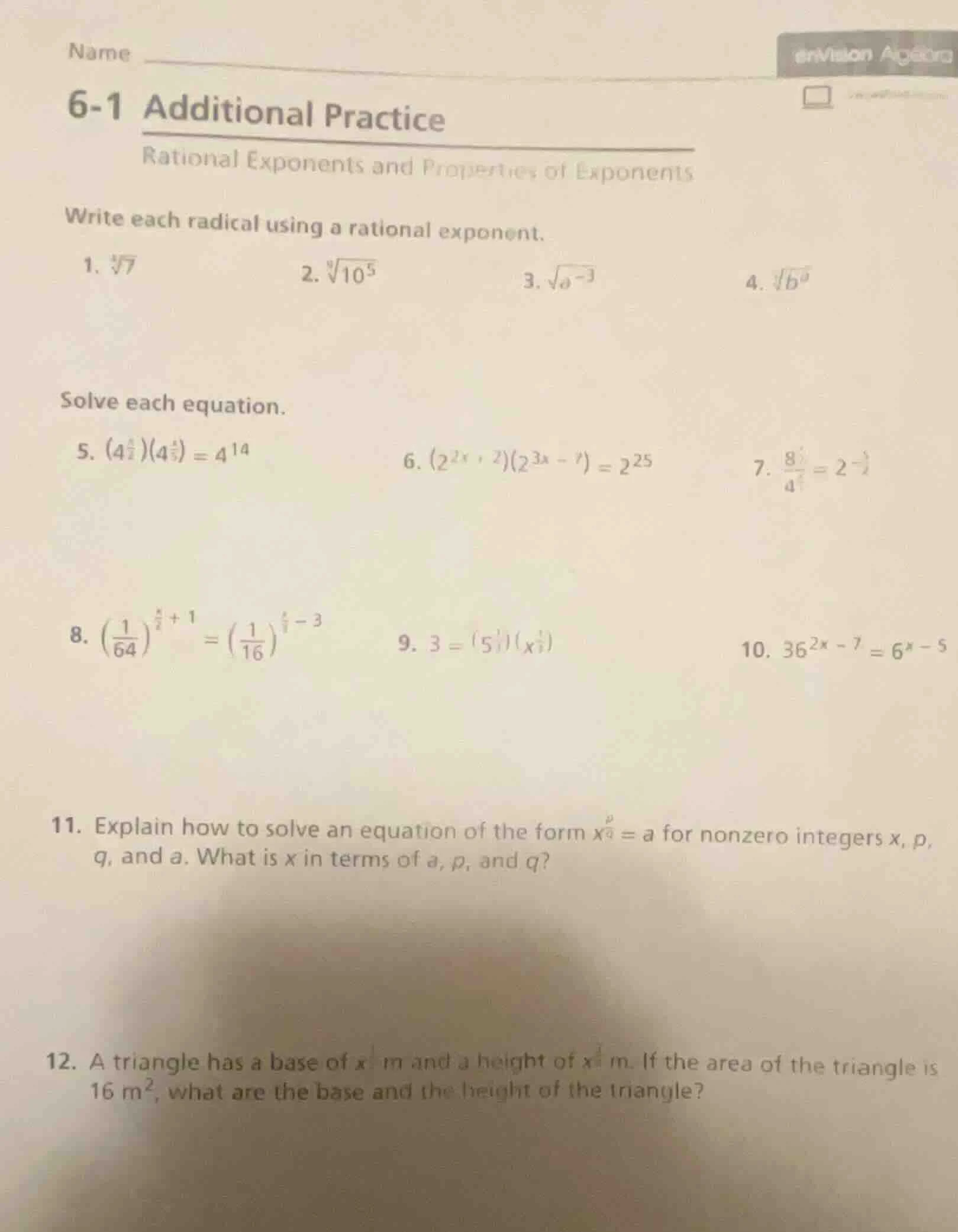
6-1 additional practice
rational exponents and properties of exponents
write each radical using a rational exponent.
- $sqrt4{7}$
- $sqrt9{10^{5}}$
- $sqrt{a^{-3}}$
- $sqrt3{b^{9}}$
solve each equation.
- $(4^{\frac{x}{2}})(4^{\frac{x}{3}})=4^{14}$
- $(2^{2x+2})(2^{3x - 7})=2^{25}$
- $\frac{8^{\frac{1}{3}}}{4^{\frac{1}{2}}}=2^{-\frac{1}{2}}$
- $\left(\frac{1}{64}\
ight)^{\frac{x}{2}+1}=\left(\frac{1}{16}\
ight)^{\frac{x}{4}-3}$
- $3=(5^{\frac{1}{3}})(x^{\frac{1}{3}})$
- $36^{2x - 7}=6^{x - 5}$
- explain how to solve an equation of the form $x^{\frac{p}{q}}=a$ for nonzero integers $x$, $p$, $q$, and $a$. what is $x$ in terms of $a$, $p$, and $q$
- a triangle has a base of $x^{\frac{1}{2}}$ m and a height of $x^{\frac{1}{2}}$ m. if the area of the triangle is $16$ $m^{2}$, what are the base and the height of the triangle?
Step1: Convert radical to rational exponent
For $\sqrt[3]{7}$, use $\sqrt[q]{a}=a^{\frac{1}{q}}$.
$7^{\frac{1}{3}}$
Step2: Convert radical to rational exponent
For $\sqrt[9]{10^5}$, use $\sqrt[q]{a^p}=a^{\frac{p}{q}}$.
$10^{\frac{5}{9}}$
Step3: Convert radical to rational exponent
For $\sqrt{a^{-3}}$, use $\sqrt{a}=a^{\frac{1}{2}}$.
$(a^{-3})^{\frac{1}{2}} = a^{-\frac{3}{2}}$
Step4: Convert radical to rational exponent
For $\sqrt[4]{b^9}$, use $\sqrt[q]{a^p}=a^{\frac{p}{q}}$.
$b^{\frac{9}{4}}$
Step5: Solve exponent equation (same base)
Set exponents equal: $\frac{x}{2}+\frac{x}{3}=14$
$\frac{3x+2x}{6}=14 \implies \frac{5x}{6}=14 \implies x=14\times\frac{6}{5}=\frac{84}{5}=16.8$
Step6: Solve exponent equation (same base)
Set exponents equal: $2x+2+3x-7=25$
$5x-5=25 \implies 5x=30 \implies x=6$
Step7: Rewrite bases as powers of 2
$8=2^3$, $4=2^2$. So $\frac{(2^3)^{\frac{1}{2}}}{(2^2)^{\frac{1}{4}}}=2^{-\frac{1}{2}}$
Simplify exponents: $\frac{2^{\frac{3}{2}}}{2^{\frac{1}{2}}}=2^{\frac{3}{2}-\frac{1}{2}}=2^1$. This equation $2^1=2^{-\frac{1}{2}}$ has no solution.
Step8: Rewrite bases as powers of $\frac{1}{4}$
$\frac{1}{64}=(\frac{1}{4})^3$, $\frac{1}{16}=(\frac{1}{4})^2$. So $((\frac{1}{4})^3)^{\frac{x}{2}+1}=((\frac{1}{4})^2)^{\frac{x}{3}-3}$
Set exponents equal: $3(\frac{x}{2}+1)=2(\frac{x}{3}-3)$
$\frac{3x}{2}+3=\frac{2x}{3}-6 \implies \frac{9x-4x}{6}=-9 \implies \frac{5x}{6}=-9 \implies x=-\frac{54}{5}=-10.8$
Step9: Isolate $x^{\frac{1}{2}}$
$x^{\frac{1}{2}}=\frac{3}{5^{\frac{1}{2}}}$
Square both sides: $x=\frac{9}{5}=1.8$
Step10: Rewrite 36 as $6^2$
$(6^2)^{2x-7}=6^{x-5}$
Set exponents equal: $2(2x-7)=x-5$
$4x-14=x-5 \implies 3x=9 \implies x=3$
Step11: Explain solving $x^{\frac{p}{q}}=a$
Raise both sides to the $\frac{q}{p}$ power to isolate $x$:
$(x^{\frac{p}{q}})^{\frac{q}{p}}=a^{\frac{q}{p}} \implies x=a^{\frac{q}{p}}$
Step12: Use triangle area formula
Area $=\frac{1}{2}\times$ base $\times$ height: $16=\frac{1}{2}x^{\frac{1}{2}}x^{\frac{3}{2}}$
Simplify: $16=\frac{1}{2}x^{\frac{1}{2}+\frac{3}{2}}=\frac{1}{2}x^2$
Solve for $x$: $x^2=32 \implies x=\sqrt{32}=4\sqrt{2}$
Base: $(4\sqrt{2})^{\frac{1}{2}}=(2^{\frac{5}{2}})^{\frac{1}{2}}=2^{\frac{5}{4}}=\sqrt[4]{32}$ m
Height: $(4\sqrt{2})^{\frac{3}{2}}=(2^{\frac{5}{2}})^{\frac{3}{2}}=2^{\frac{15}{4}}=\sqrt[4]{32768}$ m

Snap & solve any problem in the app
Get step-by-step solutions on Sovi AI
Photo-based solutions with guided steps
Explore more problems and detailed explanations
- $7^{\frac{1}{3}}$
- $10^{\frac{5}{9}}$
- $a^{-\frac{3}{2}}$
- $b^{\frac{9}{4}}$
- $x=\frac{84}{5}$
- $x=6$
- No solution
- $x=-\frac{54}{5}$
- $x=\frac{9}{5}$
- $x=3$
- Raise both sides to the $\frac{q}{p}$ power; $x=a^{\frac{q}{p}}$
- Base: $\sqrt[4]{32}$ m, Height: $\sqrt[4]{32768}$ m