QUESTION IMAGE
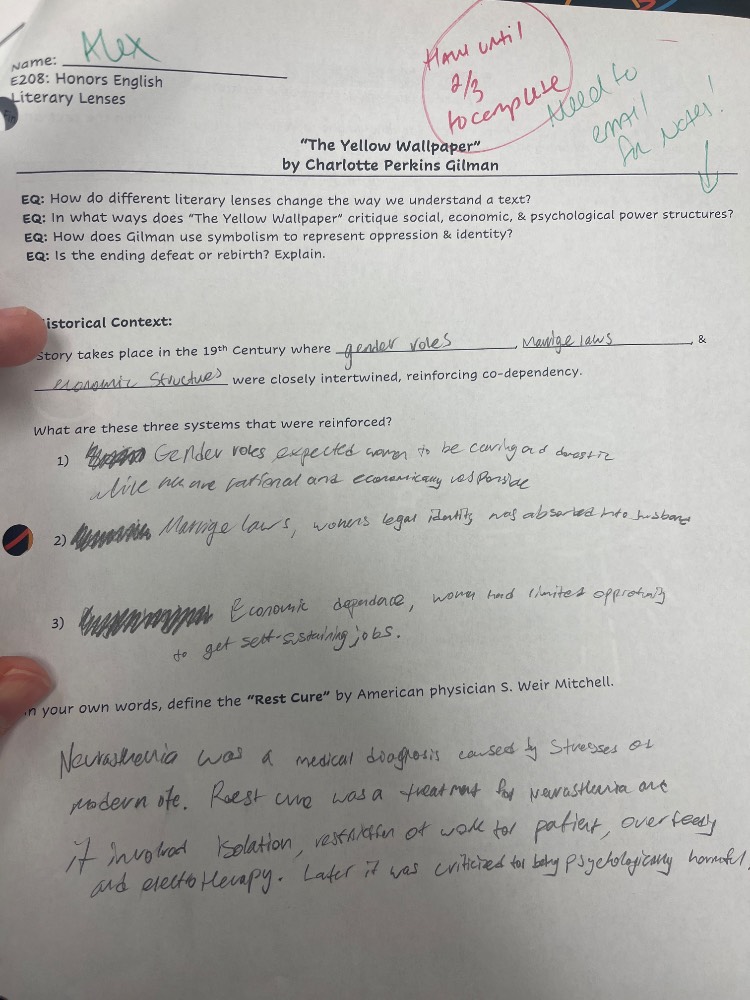
Question
name: alex
e208: honors english
literary lenses
\the yellow wallpaper\
by charlotte perkins gilman
eq: how do different literary lenses change the way we understand a text?
eq: in what ways does \the yellow wallpaper\ critique social, economic, & psychological power structures?
eq: how does gilman use symbolism to represent oppression & identity?
eq: is the ending defeat or rebirth? explain.
istorical context:
story takes place in the 19th century where gender roles, marriage laws, &
______ were closely intertwined, reinforcing co - dependency.
what are these three systems that were reinforced?
1)
2)
3)
in your own words, define the
est cure\ by american physician s. weir mitchell.
To answer the questions related to "The Yellow Wallpaper" and its historical context, literary analysis, and the "Rest Cure":
1. Identifying the Three Intertwined Systems (Historical Context)
The 19th - century setting of the story had three systems that reinforced co - dependency:
- Gender Roles: Social expectations dictated that women were often confined to domestic roles, while men held more power in public and economic spheres. This limited women’s autonomy and reinforced traditional gendered divisions of labor and authority.
- Marriage Laws: In this era, a woman’s legal identity was often absorbed into her husband’s. This meant that women had little legal standing of their own, and their rights (such as property rights) were closely tied to their marital status, furthering their dependence on men.
- Economic Dependence: Women had very limited opportunities to obtain self - sustaining jobs. This lack of economic independence meant that they were often reliant on male family members (like husbands or fathers) for financial support, which tied into the other two systems of gender roles and marriage laws.
2. Defining the “Rest Cure” by S. Weir Mitchell
The “Rest Cure” was a medical treatment, often prescribed for a condition called neurasthenia (a diagnosis for symptoms of stress or fatigue in the context of “modern life”). It involved:
- Isolation: Patients were separated from their usual social or family environments.
- Restriction of Work: Patients were not allowed to engage in any kind of work (including intellectual or creative work).
- Overfeeding: They were given large amounts of food to “build up” their strength.
- Electrotherapy: Electrical treatments were sometimes used as part of the cure.
However, this treatment was later criticized because it was psychologically harmful. It ignored the emotional and psychological needs of patients (especially women, who were often the recipients of this treatment) and could exacerbate feelings of helplessness and oppression, as seen in the protagonist’s experience in “The Yellow Wallpaper.”

Snap & solve any problem in the app
Get step-by-step solutions on Sovi AI
Photo-based solutions with guided steps
Explore more problems and detailed explanations
s to Specific Questions (from the Worksheet)
- For the “three systems” question, the answers are gender roles, marriage laws, and economic dependence (with the explanations above for each).
- For the “Rest Cure” definition, the key points are its use for neurasthenia, the elements of isolation, work restriction, overfeeding, electrotherapy, and its later psychological harm.
If you need more detailed analysis of the literary lenses (like feminist, psychological, or historical lenses) applied to the text, or further explanation of the story’s themes, feel free to ask!