QUESTION IMAGE
Question
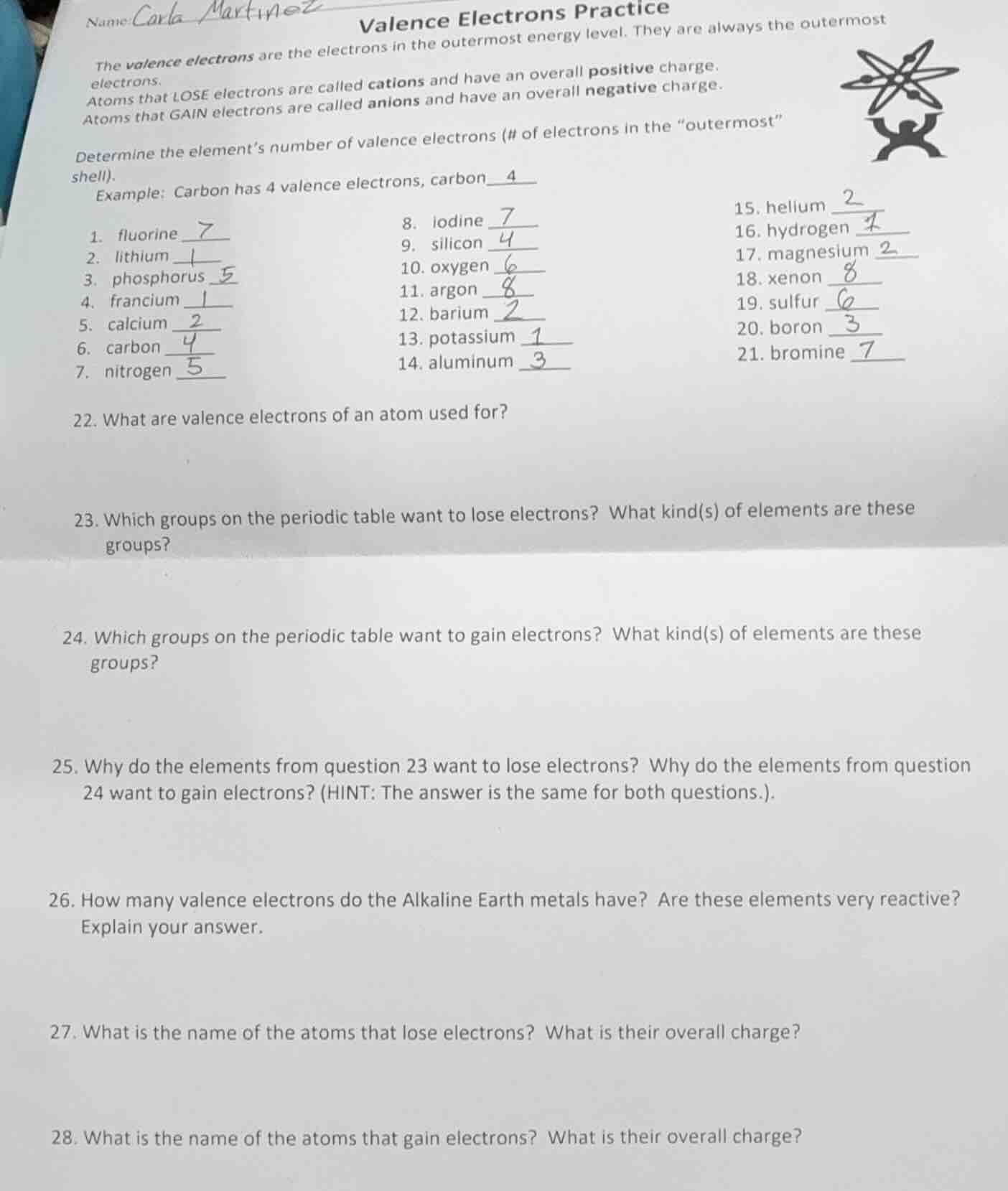
name: carla martinez valence electrons practice the valence electrons are the electrons in the outermost energy level. they are always the outermost electrons. atoms that lose electrons are called cations and have an overall positive charge. atoms that gain electrons are called anions and have an overall negative charge. determine the element’s number of valence electrons (# of electrons in the “outermost” shell). example: carbon has 4 valence electrons, carbon 4 1. fluorine 7 2. lithium 1 3. phosphorus 5 4. francium 1 5. calcium 2 6. carbon 4 7. nitrogen 5 8. iodine 7 9. silicon 4 10. oxygen 6 11. argon 8 12. barium 2 13. potassium 1 14. aluminum 3 15. helium 2 16. hydrogen 1 17. magnesium 2 18. xenon 8 19. sulfur 6 20. boron 3 21. bromine 7 22. what are valence electrons of an atom used for? 23. which groups on the periodic table want to lose electrons? what kind(s) of elements are these groups? 24. which groups on the periodic table want to gain electrons? what kind(s) of elements are these groups? 25. why do the elements from question 23 want to lose electrons? why do the elements from question 24 want to gain electrons? (hint: the answer is the same for both questions.). 26. how many valence electrons do the alkaline earth metals have? are these elements very reactive? explain your answer. 27. what is the name of the atoms that lose electrons? what is their overall charge? 28. what is the name of the atoms that gain electrons? what is their overall charge?
Question 22
Valence electrons are used in chemical bonding. Atoms interact (bond) with other atoms by transferring (ionic bonding) or sharing (covalent bonding) valence electrons to achieve a stable electron configuration (like a noble gas, usually 8 valence electrons, or 2 for hydrogen/helium).
Groups 1 (Alkali Metals), 2 (Alkaline Earth Metals), and 13 (some elements like Aluminum) on the periodic table tend to lose electrons. These are metals (alkali metals, alkaline earth metals, and some post - transition metals). Metals have low electronegativity and relatively few valence electrons (1, 2, or 3 for many), so losing electrons gets them to a stable electron configuration (like a noble gas).
Groups 15, 16, and 17 (Halogens) on the periodic table tend to gain electrons. Group 15 has 5 valence electrons, group 16 has 6, and group 17 has 7. These groups contain non - metals (and some metalloids in group 15). Non - metals have high electronegativity and need to gain electrons (1, 2, or 3 respectively) to achieve a stable octet (8 valence electrons, or 2 for hydrogen).

Snap & solve any problem in the app
Get step-by-step solutions on Sovi AI
Photo-based solutions with guided steps
Explore more problems and detailed explanations
Valence electrons are used for chemical bonding (to form compounds by transferring or sharing electrons to achieve a stable electron configuration like a noble gas).