QUESTION IMAGE
Question
name class date
section 2 acceleration continued
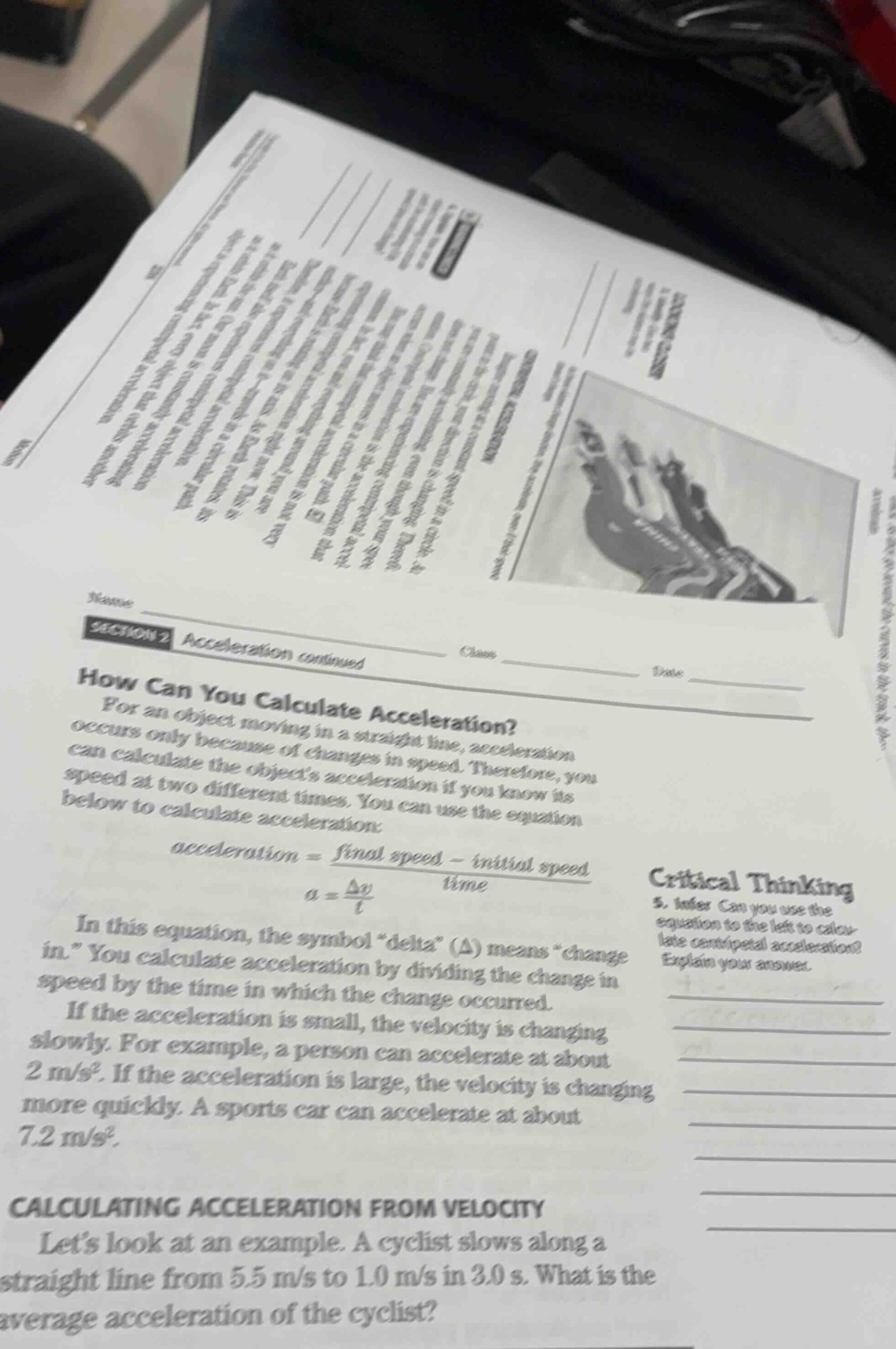
how can you calculate acceleration?
for an object moving in a straight line, acceleration occurs only because of changes in speed. therefore, you can calculate the object’s acceleration if you know its speed at two different times. you can use the equation below to calculate acceleration:
acceleration = (final speed - initial speed) / time
a = δv / t
in this equation, the symbol “delta” (δ) means “change in.” you calculate acceleration by dividing the change in speed by the time in which the change occurred.
if the acceleration is small, the velocity is changing slowly. for example, a person can accelerate at about 2 m/s². if the acceleration is large, the velocity is changing more quickly. a sports car can accelerate at about 7.2 m/s².
calculating acceleration from velocity
let’s look at an example. a cyclist slows along a straight line from 5.5 m/s to 1.0 m/s in 3.0 s. what is the average acceleration of the cyclist?
critical thinking
- infer can you use the equation to the left to calculate centripetal acceleration? explain your answer.
Step1: Identify known values
Final speed ($v_f$) = 1.0 m/s, Initial speed ($v_i$) = 5.5 m/s, Time ($t$) = 3.0 s.
Step2: Use the acceleration formula
The formula for acceleration is $a = \frac{v_f - v_i}{t}$. Substitute the values: $a = \frac{1.0 - 5.5}{3.0}$.
Step3: Calculate the numerator
$1.0 - 5.5 = -4.5$ m/s.
Step4: Divide by time
$a = \frac{-4.5}{3.0} = -1.5$ m/s². The negative sign indicates deceleration (slowing down).

Snap & solve any problem in the app
Get step-by-step solutions on Sovi AI
Photo-based solutions with guided steps
Explore more problems and detailed explanations
The average acceleration of the cyclist is $-1.5$ m/s² (or 1.5 m/s² of deceleration).