QUESTION IMAGE
Question
name________ class______ date________
what is an oxidation number?
lesson review
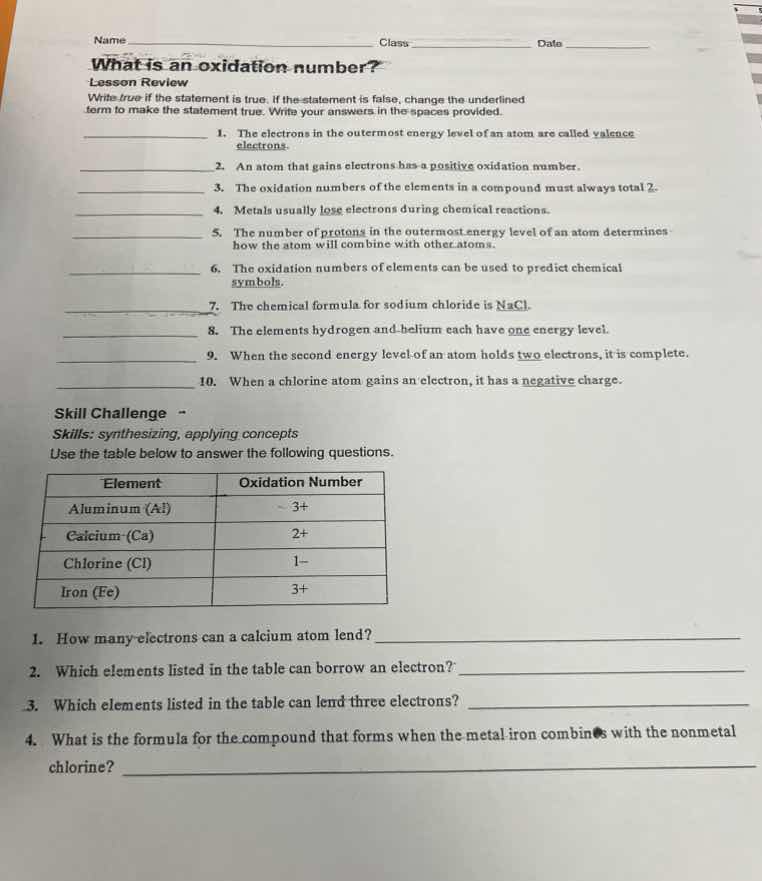
write true if the statement is false, change the underlined term to make the statement true. write your answers in the spaces provided.
- the electrons in the outermost energy level of an atom are called valence electrons.
- an atom that gains electrons has a positive oxidation number.
- the oxidation numbers of the elements in a compound must always total 2.
- metals usually lose electrons during chemical reactions.
- the number of protons in the outermost energy level of an atom determines how the atom will combine with other atoms.
- the oxidation numbers of elements can be used to predict chemical symbols.
- the chemical formula for sodium chloride is nacl.
- the elements hydrogen and helium each have one energy level.
- when the second energy level of an atom holds two electrons, it is complete.
- when a chlorine atom gains an electron, it has a negative charge.
skill challenge -
skills: synthesizing, applying concepts
use the table below to answer the following questions.
element | oxidation number
aluminum (al) | 3+
calcium (ca) | 2+
chlorine (cl) | 1-
iron (fe) | 3+
- how many electrons can a calcium atom lend?
- which elements listed in the table can borrow an electron?
- which elements listed in the table can lend three electrons?
- what is the formula for the compound that forms when the metal iron combines with the nonmetal chlorine?
Lesson Review
- Valence electrons are defined as electrons in the outermost energy level of an atom.
- Atoms that gain electrons become negatively charged, so their oxidation number is negative, not positive.
- The sum of oxidation numbers in a neutral compound is always 0, not 2.
- Metals have low ionization energy, so they tend to lose electrons in reactions.
- The number of valence electrons (outer electrons), not protons, determines bonding behavior.
- Oxidation numbers help predict chemical formulas, not symbols.
- The correct chemical formula for sodium chloride is NaCl (no capitalization for the second element symbol).
- Hydrogen has 1 energy level, but helium also only has 1 energy level, so this statement is true.
- The second energy level is complete when it holds 8 electrons, not 2.
- A neutral chlorine atom has 17 protons and 17 electrons; gaining 1 electron gives it 18 electrons, resulting in a -1 negative charge.
Step1: Relate charge to electron transfer
A metal's oxidation number equals the number of electrons it can lend (losing electrons gives a positive charge). Nonmetals with negative oxidation numbers can borrow (gain) electrons.
Step2: Match oxidation numbers to questions
For electron lending/borrowing, use the sign and magnitude of the oxidation number. For compound formulas, balance total positive and negative charge.
Step3: Balance charges for iron-chlorine compound
Iron has a +3 charge, chlorine has a -1 charge. Find the lowest whole number ratio to balance charge: 1 Fe³⁺ and 3 Cl⁻.

Snap & solve any problem in the app
Get step-by-step solutions on Sovi AI
Photo-based solutions with guided steps
Explore more problems and detailed explanations
- True
- False; negative
- False; 0
- True
- False; electrons
- False; formulas
- False; NaCl
- True
- False; 8
- True
---