QUESTION IMAGE
Question
name: class #: jan, 16th
document #2: the war production board
(wpb)
the effort to defeat the axis powers took more than just soldiers. american
forces needed planes, tanks, weapons, parachutes, and other supplies.
under the guidance of the war production
board, factories churned out materials around
the clock. by 1945, the country had built about
300,000 aircraft and 75,000 ships. the
united states was producing 60% of the
allied ammunition.
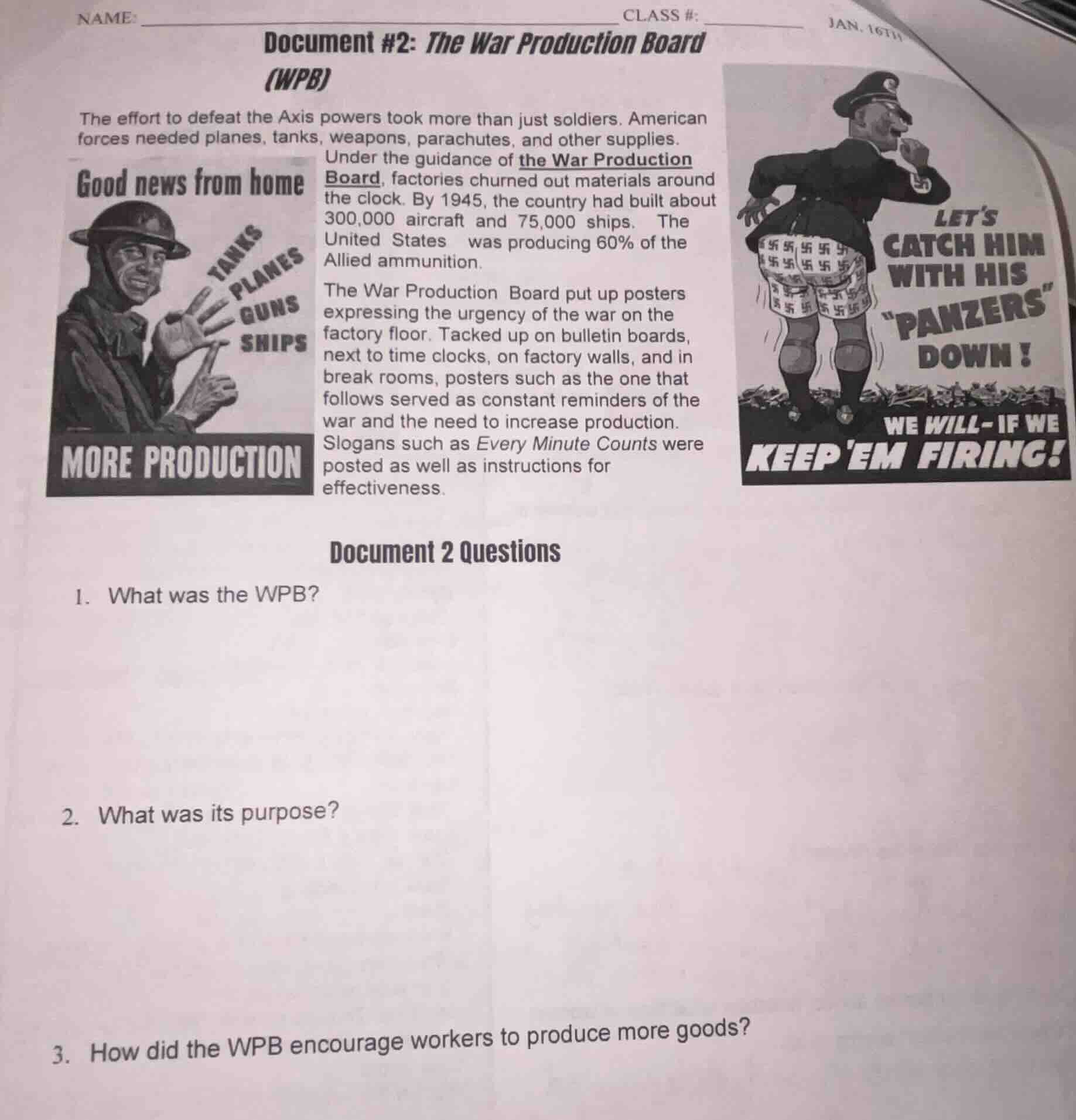
the war production board put up posters
expressing the urgency of the war on the
factory floor. tacked up on bulletin boards,
next to time clocks, on factory walls, and in
break rooms, posters such as the one that
follows served as constant reminders of the
war and the need to increase production.
slogans such as every minute counts were
posted as well as instructions for
effectiveness.
document 2 questions
- what was the wpb?
- what was its purpose?
- how did the wpb encourage workers to produce more goods?
- The WPB is defined in the provided text as a U.S. wartime body overseeing production.
- Its purpose is tied to supplying the Allied war effort against the Axis powers.
- The text specifies the WPB used visual and textual materials in factory spaces to motivate workers.

Snap & solve any problem in the app
Get step-by-step solutions on Sovi AI
Photo-based solutions with guided steps
Explore more problems and detailed explanations
- The WPB (War Production Board) was a U.S. organization that guided American factories to produce war materials during World War II.
- Its purpose was to coordinate and maximize the production of essential war supplies (like aircraft, ships, weapons, and ammunition) to support the U.S. and Allied forces in defeating the Axis powers, ultimately producing 60% of Allied ammunition by 1945.
- The WPB encouraged workers to produce more goods by putting up urgent, war-focused posters (displayed in factory bulletin boards, near time clocks, on walls, and in break rooms) and using motivating slogans such as Every Minute Counts to remind workers of the war effort and push for increased production.