QUESTION IMAGE
Question
name ______
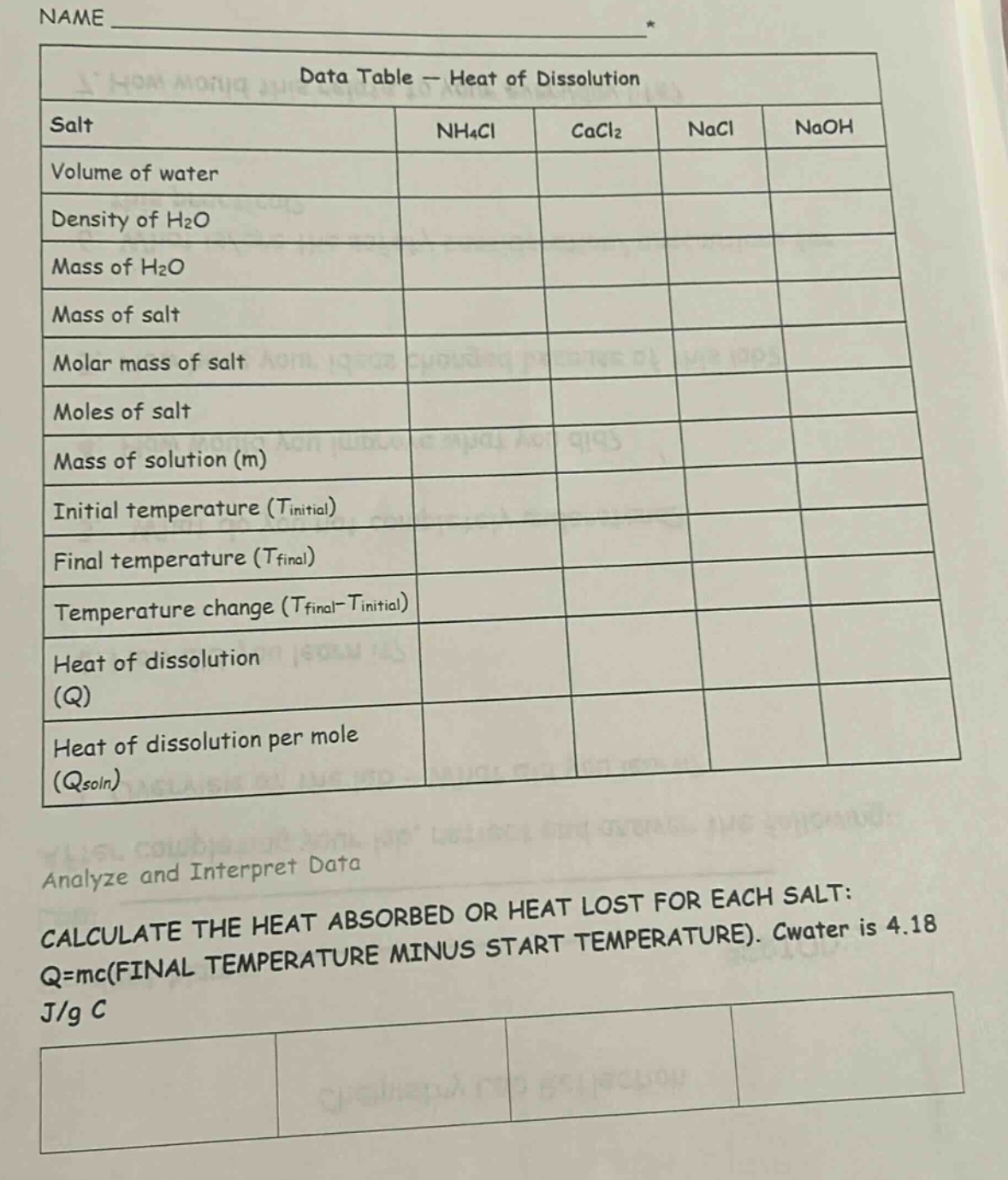
data table — heat of dissolution
salt | nh₄cl | cacl₂ | nacl | naoh
volume of water | | | |
density of h₂o | | | |
mass of h₂o | | | |
mass of salt | | | |
molar mass of salt | | | |
moles of salt | | | |
mass of solution (m) | | | |
initial temperature (t_initial) | | | |
final temperature (t_final) | | | |
temperature change (t_final - t_initial) | | | |
heat of dissolution (q) | | | |
heat of dissolution per mole (q_soln) | | | |
analyze and interpret data
calculate the heat absorbed or heat lost for each salt:
q = mc(final temperature minus start temperature). c_water is 4.18 j/g °c
To calculate the heat absorbed or lost for each salt, we use the formula \( Q = mc\Delta T \), where:
- \( m \) is the mass of the solution (in grams),
- \( c \) is the specific heat capacity of water (4.18 J/g°C),
- \( \Delta T \) is the temperature change (\( T_{\text{final}} - T_{\text{initial}} \), in °C).
Step 1: Determine the mass of the solution (\( m \))
The mass of the solution is the sum of the mass of water and the mass of the salt:
\( m = \text{Mass of } \ce{H2O} + \text{Mass of salt} \)
Step 2: Calculate the temperature change (\( \Delta T \))
Subtract the initial temperature from the final temperature:
\( \Delta T = T_{\text{final}} - T_{\text{initial}} \)
Step 3: Substitute values into the formula \( Q = mc\Delta T \)
For each salt (e.g., \( \ce{NH4Cl} \), \( \ce{CaCl2} \), \( \ce{NaCl} \), \( \ce{NaOH} \)):
- Find \( m \) (from Step 1).
- Use \( c = 4.18 \, \text{J/g°C} \).
- Find \( \Delta T \) (from Step 2).
- Multiply \( m \times c \times \Delta T \) to get \( Q \).
For example, if:
- Mass of \( \ce{H2O} = 100 \, \text{g} \),
- Mass of salt = \( 10 \, \text{g} \),
- \( T_{\text{initial}} = 25^\circ\text{C} \),
- \( T_{\text{final}} = 20^\circ\text{C} \) (for an endothermic process like \( \ce{NH4Cl} \) dissolution):
- \( m = 100 + 10 = 110 \, \text{g} \)
- \( \Delta T = 20 - 25 = -5^\circ\text{C} \) (negative sign indicates heat absorption)
- \( Q = (110 \, \text{g})(4.18 \, \text{J/g°C})(-5^\circ\text{C}) = -2299 \, \text{J} \) (or \( -2.30 \, \text{kJ} \))
Repeat this process for each salt using their respective data to find \( Q \).

Snap & solve any problem in the app
Get step-by-step solutions on Sovi AI
Photo-based solutions with guided steps
Explore more problems and detailed explanations
To calculate the heat absorbed or lost for each salt, we use the formula \( Q = mc\Delta T \), where:
- \( m \) is the mass of the solution (in grams),
- \( c \) is the specific heat capacity of water (4.18 J/g°C),
- \( \Delta T \) is the temperature change (\( T_{\text{final}} - T_{\text{initial}} \), in °C).
Step 1: Determine the mass of the solution (\( m \))
The mass of the solution is the sum of the mass of water and the mass of the salt:
\( m = \text{Mass of } \ce{H2O} + \text{Mass of salt} \)
Step 2: Calculate the temperature change (\( \Delta T \))
Subtract the initial temperature from the final temperature:
\( \Delta T = T_{\text{final}} - T_{\text{initial}} \)
Step 3: Substitute values into the formula \( Q = mc\Delta T \)
For each salt (e.g., \( \ce{NH4Cl} \), \( \ce{CaCl2} \), \( \ce{NaCl} \), \( \ce{NaOH} \)):
- Find \( m \) (from Step 1).
- Use \( c = 4.18 \, \text{J/g°C} \).
- Find \( \Delta T \) (from Step 2).
- Multiply \( m \times c \times \Delta T \) to get \( Q \).
For example, if:
- Mass of \( \ce{H2O} = 100 \, \text{g} \),
- Mass of salt = \( 10 \, \text{g} \),
- \( T_{\text{initial}} = 25^\circ\text{C} \),
- \( T_{\text{final}} = 20^\circ\text{C} \) (for an endothermic process like \( \ce{NH4Cl} \) dissolution):
- \( m = 100 + 10 = 110 \, \text{g} \)
- \( \Delta T = 20 - 25 = -5^\circ\text{C} \) (negative sign indicates heat absorption)
- \( Q = (110 \, \text{g})(4.18 \, \text{J/g°C})(-5^\circ\text{C}) = -2299 \, \text{J} \) (or \( -2.30 \, \text{kJ} \))
Repeat this process for each salt using their respective data to find \( Q \).