QUESTION IMAGE
Question
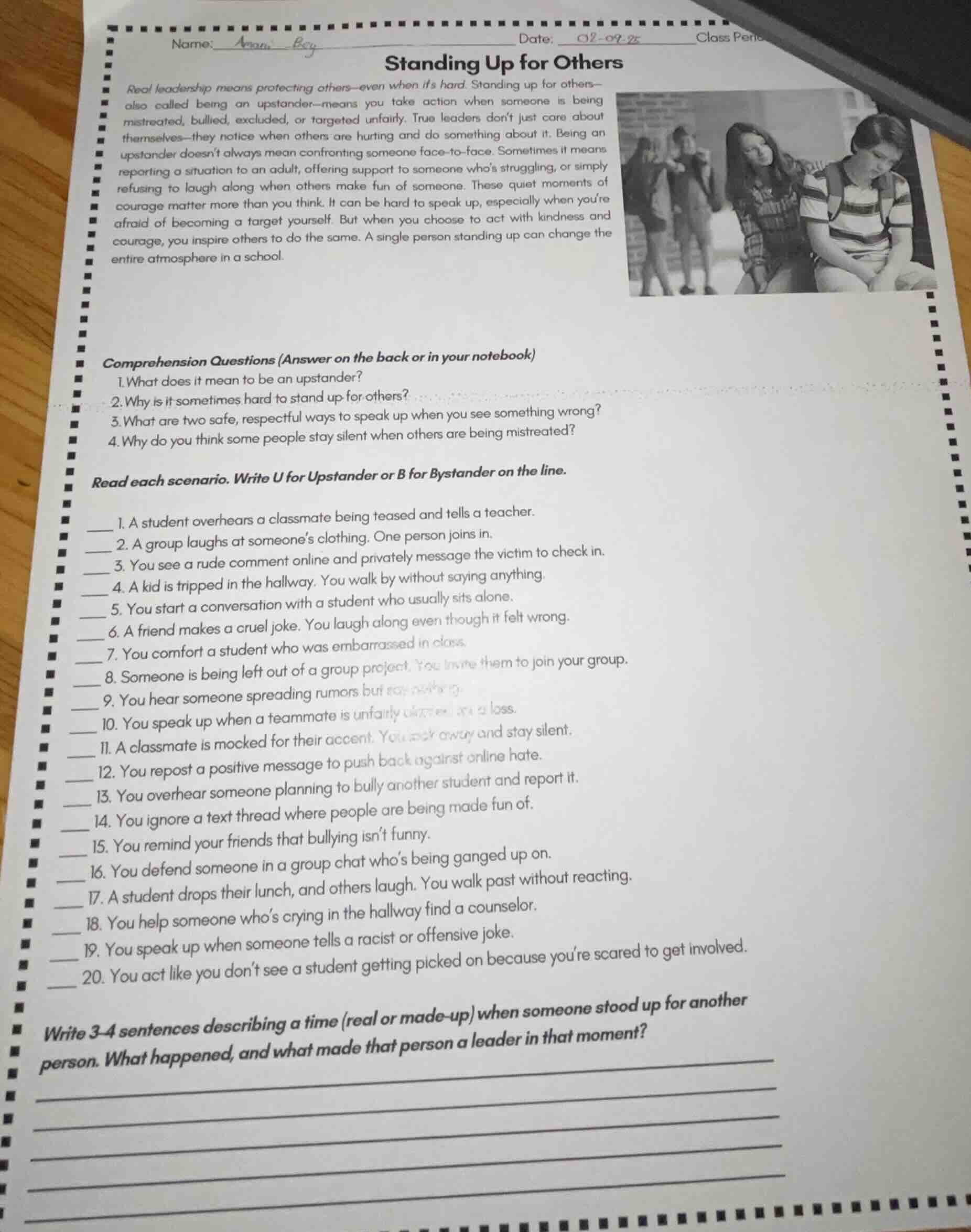
name: date: 02-09-25class periostanding up for othersreal leadership means protecting others-even when its hard. standing up for others-also called being an upstander-means you take action when someone is beingmistreated, bullied, excluded, or targeted unfairly. true leaders dont just care aboutthemselves-they notice when others are hurting and do something about it. being anupstander doesnt always mean confronting someone face-to-face. sometimes it meansreporting a situation to an adult, offering support to someone whos struggling, or simplyrefusing to laugh along when others make fun of someone. these quiet moments ofcourage matter more than you think. it can be hard to speak up, especially when youreafraid of becoming a target yourself. but when you choose to act with kindness andcourage, you inspire others to do the same. a single person standing up can change theentire atmosphere in a school.comprehension questions (answer on the back or in your notebook)1. what does it mean to be an upstander?2. why is it sometimes hard to stand up for others?3. what are two safe, respectful ways to speak up when you see something wrong?4. why do you think some people stay silent when others are being mistreated?read each scenario. write u for upstander or b for bystander on the line._ 1. a student overhears a classmate being teased and tells a teacher._ 2. a group laughs at someones clothing. one person joins in._ 3. you see a rude comment online and privately message the victim to check in._ 4. a kid is tripped in the hallway. you walk by without saying anything._ 5. you start a conversation with a student who usually sits alone._ 6. a friend makes a cruel joke. you laugh along even though it felt wrong._ 7. you comfort a student who was embarrassed in class._ 8. someone is being left out of a group project. you invite them to join your group._ 9. you hear someone spreading rumors but say nothing._ 10. you speak up when a teammate is unfairly criticized in class._ 11. a classmate is mocked for their accent. you look away and stay silent._ 12. you repost a positive message to push back against online hate._ 13. you overhear someone planning to bully another student and report it._ 14. you ignore a text thread where people are being made fun of._ 15. you remind your friends that bullying isnt funny._ 16. you defend someone in a group chat whos being ganged up on._ 17. a student drops their lunch, and others laugh. you walk past without reacting._ 18. you help someone whos crying in the hallway find a counselor._ 19. you speak up when someone tells a racist or offensive joke._ 20. you act like you dont see a student getting picked on because youre scared to get involved.write 3-4 sentences describing a time (real or made-up) when someone stood up for anotherperson. what happened, and what made that person a leader in that moment?
Comprehension Questions:
- Defined using the text's description of upstanders taking action for mistreated people.
- Based on the text's note about fear of becoming a target.
- Selected from the safe actions listed in the text.
- Inferred from common fears tied to the text's context of peer pressure and self-protection.
Scenario Classification:
Classified each scenario as Upstander (U) if the person takes supportive/protective action for someone being mistreated, or Bystander (B) if they stay silent, join in, or ignore the mistreatment.
Narrative Response:
Created a realistic scenario aligned with the text's definition of upstander leadership, including the event, action, and why the person was a leader.

Snap & solve any problem in the app
Get step-by-step solutions on Sovi AI
Photo-based solutions with guided steps
Explore more problems and detailed explanations
Comprehension Questions:
- An upstander is someone who takes action when someone is mistreated, bullied, excluded, or targeted unfairly—this can include reporting to an adult, supporting the person, or refusing to join in the mistreatment.
- It can be hard because people fear becoming a target themselves.
- Two safe, respectful ways are reporting the situation to an adult, and offering support to the person who is struggling.
- Some people stay silent because they are afraid of being targeted next, they don't want to go against their peers, or they don't know how to intervene safely.
Scenario Classification:
- U
- B
- U
- B
- U
- B
- U
- U
- B
- U
- B
- U
- U
- B
- U
- U
- B
- U
- U
- B
Narrative:
Last week, a new student named Lila was sitting alone at lunch while a group of kids whispered and pointed at her. My classmate Javi noticed, walked over, and asked Lila to join our table. When one kid tried to make a joke about Lila's worn backpack, Javi said, "That's not cool—her backpack has stories, just like ours." Javi was a leader in that moment because he chose kindness over fitting in, and his small act made Lila feel welcome; soon, other kids started talking to Lila too, changing the whole mood of the lunchroom.